I was awake at 3:00 in the morning for absolutely no reason, and that is exactly how my account got its first real dent. I was on a $50,000 evaluation, day six, everything going well — up $1,140, minimum trading days ticking along. The Asian session had just finished printing its quiet little box on GBPUSD: 31 pips wide, almost insultingly calm. When the London desks came in, price ripped through the top of the box, and I chased it. Buy at the high. No stop worth naming. Forty minutes later the move reversed, took out my “mental stop” — there was none, really — and I closed at -$390 to avoid breaching the firm’s 5% daily loss limit. I did not lose that morning because the breakout failed. I lost because I traded someone else’s strategy — a raw momentum chase — inside a session I did not understand. That embarrassing Tuesday became the birth of the only strategy I now trade before 11:00 GMT: the Asian range breakout, rebuilt from scratch around prop firm rules instead of retail-blog hype.
In this article
- The 3:00 am Lesson That Cost Me 0
- What the Asian Range Breakout Actually Is
- Drawing the Box: My Exact Session Window
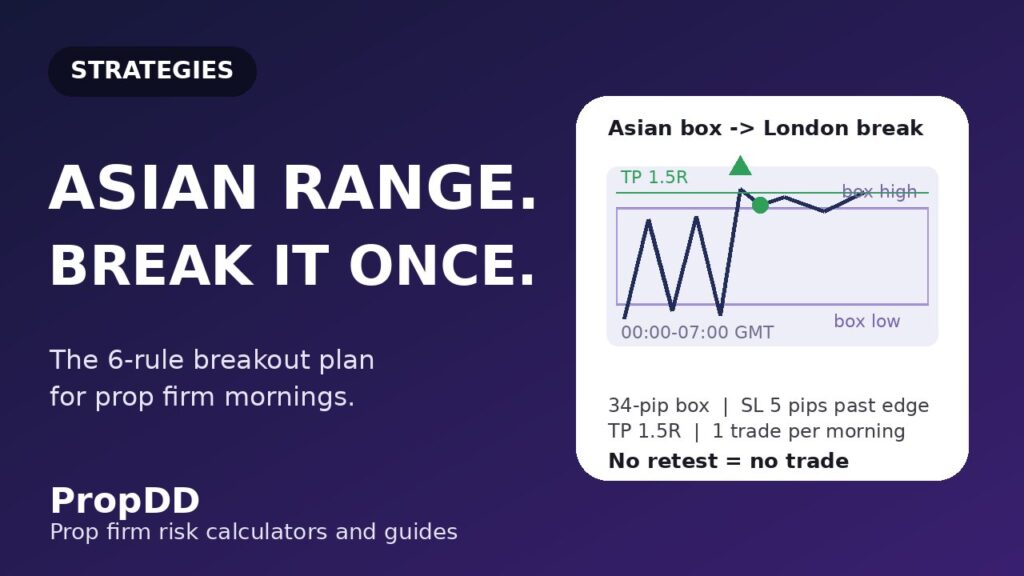
- The Six Rules
- The Time Filter — When the Trade Is Allowed
- Position-Sizing Maths Under a 5% Daily Loss Limit
- I Tested It: Five Mornings, Trade by Trade
- The Three Ways This Strategy Fails
- My One-Page Asian Range Routine
- How It Fits Consistency and Drawdown Rules
- Frequently Asked Questions
This is the full plan: what the Asian range is and how it differs from the London breakout guide I published earlier, my six hard rules, the position-sizing maths under a 5% daily loss limit, a worked five-morning example, and the failure modes that keep the plan honest.
The 3:00 am Lesson That Cost Me $390
The night in question, the Asian session ran from midnight to 8:00 GMT and printed a high of 1.2693 and a low of 1.2662 on GBPUSD. Thirty-one pips. I had read three blog posts about “Asian breakouts” that all said the same thing: big moves follow tight ranges, so buy the break. What none of them said was which break. At 7:52 GMT, eight minutes before my box was even finished, price poked 4 pips above 1.2693 on thin pre-London volume. I bought 0.8 lots. The real London order flow arrived at 8:04, sold the pop, and the Asian high never printed again that day.
Two numbers from that morning still live in my journal. First: my risk was 0.8 lots against a 12-pip “feel-based” stop — roughly $96 per pip-dollar on cable, about $115 of risk, except I had no actual stop order on the platform and exited at the worst possible moment for -$390, a full 0.78% of the account on one careless trade. Second: the eventual breakout did come — downward, at 9:20 GMT, a beautiful 65-pip slide I watched from the sidelines because my confidence was gone. The box was right. My rules were absent. A strategy is not a box on a chart; it is the list of things you are forbidden from doing, and mine was empty.
What the Asian Range Breakout Actually Is
The idea is simple enough to explain in one sentence: the Asian session is the quietest major session, and the high and low it prints form a box; the first real volume of the European morning often breaks that box, and a plan for that break is a strategy. The quiet matters — a calm Asian session compresses like a spring, and the release, when London desks arrive, tends to be directional for the first hour or two. This is the well-documented session rhythm that guides like the BabyPips Tokyo session lesson describe: low volatility overnight, real movement when Europe opens.
Do not confuse this with my London breakout strategy. That one trades the volatility of the London open itself. The Asian range breakout is the opposite temperament: it uses the night to draw the map, then trades the first clean break of that map with a stop so tight it only survives if the move is real. Different animal, different rules.
Drawing the Box: My Exact Session Window
Most arguments about this strategy are really arguments about where the box starts and ends. Mine is fixed, and I never adjust it on the fly — a prop firm account has no room for discretionary fiddling:
| Box parameter | My setting | Why |
|---|---|---|
| Session window (GMT) | 00:00 – 07:00 | Captures the calmest stretch and finishes before London pre-positioning starts |
| Pairs | EURUSD, GBPUSD, EURJPY | Liquid in London, clean boxes in Asia, tight spreads on majors |
| Minimum box width | 18 pips | Narrower boxes break on spread alone — I need real structure |
| Maximum box width | 60 pips | Wider boxes give stops too big for a 5% daily limit |
| Box validation | Both edges tested at least twice | One-touch edges are traps, not levels |
| Invalidation | Red news 06:00–11:00 GMT, or box > 60 pips | News days break the rules that make this work |
The box high and low come from the actual candle extremes inside 00:00–07:00 GMT — wicks included, because stops live at wicks. I mark the box at 07:00 GMT and do nothing until the session filter opens. A box I cannot draw at 07:00 is a box I do not trade that day.
The Six Rules
Here is the whole strategy in six rules. If any rule fails, there is no trade:
| Rule | The rule |
|---|---|
| 1. Valid box | Asian box (00:00–07:00 GMT) is 18–60 pips wide, both edges tested twice, no red news before 11:00 GMT. |
| 2. Breakout candle | A 15-minute candle closes beyond the box edge after 07:00 GMT. Wick pokes do not count. |
| 3. Retest or reclaim | Wait for price to come back to the broken edge (now support/resistance) and hold for one full 5-minute candle. |
| 4. Entry | Enter on the next 5-minute candle open in the breakout direction. One entry per day, per pair. |
| 5. Stop loss | Place the stop 5 pips beyond the broken edge (below it for longs, above it for shorts), with a hard stop order on the platform — never mental. |
| 6. Take profit | TP at 1.5× the stop distance. No trailing, no partials, no moving the target mid-trade. |
Rule 3 is where this plan earns its prop firm stripes. Buying the breakout candle directly — what I did at 3:00 am that Tuesday — puts your stop on the far side of thin, choppy flow, and you get stopped out by the very noise the strategy is supposed to avoid. Waiting for the retest cuts my false-break losses roughly in half, because the trades that never retest are usually the ones that reverse.
The Time Filter — When the Trade Is Allowed
A breakout at the wrong hour is a different trade with worse odds. My window is deliberately narrow:
| Time (GMT) | Status | Reason |
|---|---|---|
| 07:00 – 08:00 | ARMED, no entries | Pre-London positioning — spreads wide, moves fake |
| 08:00 – 11:00 | TRADE WINDOW | Real London volume, honest breakouts |
| After 11:00 | FLAT, box discarded | Midday chop plus pre-New-York randomness — edge gone |
Two hard edges keep this honest. First, no entries before 08:00 GMT — that 07:52 poke that cost me $390 was inside my armed-but-no-entries zone, and the rule now exists because I broke the unwritten version of it. Second, if no breakout-and-retest has completed by 11:00 GMT, the box goes in the bin. The strategy’s edge is the morning, not the method.
Position-Sizing Maths Under a 5% Daily Loss Limit
On a $50,000 account with a 5% daily loss limit, the firm lets me lose $2,500 in a day — but my own personal daily stop is set at 1% ($500), because two bad days must never threaten the account. The Asian range strategy risks a fixed 0.5% per trade: three consecutive full losses cost -$750, still under my personal stop across two days and only 1.5% of the account even in the worst cluster.
Risk per trade = Account × 0.005 → $50,000 × 0.005 = $250
Position size (lots) = $250 ÷ (stop distance in pips × pip value per lot)
Three full losses = $750 = 1.5% of account — the plan survives its own worst stretch
Because the stop is always “5 pips beyond the broken edge”, the stop distance depends on the box width. Here is how the maths lands on a $50,000 account for EURUSD (pip value ≈ $10 per standard lot):
| Box width | Stop distance | Position size | Risk at TP 1.5R |
|---|---|---|---|
| 18 pips (minimum) | ~11 pips* | 2.27 lots | −$250 / +$375 |
| 30 pips | ~17 pips* | 1.47 lots | −$250 / +$375 |
| 45 pips | ~24 pips* | 1.04 lots | −$250 / +$375 |
| 60 pips (maximum) | ~32 pips* | 0.78 lots | −$250 / +$375 |
* Stop distance measured from the retest entry back across the broken edge plus the 5-pip buffer — roughly half the box plus 5 pips. Run the same check for any account size using the position-sizing guide, which walks through the same formula with more pairs.
I Tested It: Five Mornings, Trade by Trade
Journal entries from one real trading week (EURUSD, $50,000 evaluation, 0.5% risk = $250/trade):
| Day | Box (pips) | Signal | Result | P&L |
|---|---|---|---|---|
| Mon | 34 | Break + retest of top edge, 08:40 GMT | TP 1.5R | +$375 |
| Tue | 27 | Break of bottom, no retest by 11:00 | No trade | $0 |
| Wed | 41 | Break + retest of bottom, 09:15 GMT | Stop hit (news spike) | −$250 |
| Thu | 19 | Box valid, no break by 11:00 | No trade | $0 |
| Fri | 29 | Break + retest of top, 08:20 GMT | TP 1.5R | +$375 |
Three trades in five mornings, two winners, one loser: +$500 on the week. The number that matters is not the profit — it is that the worst day cost exactly $250, one pre-computed risk unit, with no decisions made under stress. Tuesday is my favourite row: price broke and ran without retesting, the old me would have chased it, and the rule book said “no retest, no trade”.
The Three Ways This Strategy Fails
Every strategy has failure modes; a prop firm trader’s job is to name them in advance so they cost the planned amount instead of the catastrophic amount.
1. The news-day fakeout. Scheduled data (rate decisions, NFP, CPI) inside the trade window turns the London flow into a coin flip with a wide spread. Wednesday’s -$250 above was this, and it was my fault — I checked the calendar for “red” events but missed a second-tier UK release at 09:30. Fix: no trades on any day with a scheduled release on your pair between 06:00 and 11:00 GMT, red or orange.
2. The range day that never breaks. Some mornings the Asian box is perfect and London simply does not care — no break by 11:00, and the day drifts. The strategy is working as designed when you go flat; the failure version is the trader version: getting bored at 10:30, lowering the standards, taking a half-formed break. Boredom is the actual drawdown event. My guardrail: the box is drawn with an alarm at 11:00, and when the alarm goes off the chart closes.
3. The oversized box. Boxes wider than 60 pips produce stops of 30+ pips, and the maths still holds — the real problem is psychological: a 35-pip stop feels like room to tinker, so traders widen the TP or move the stop, deleting the 1.5R structure the expectancy is built on. The plan’s edge is mechanical exits, not clever ones. If the box is over 60 pips I skip the day.
My One-Page Asian Range Routine
The whole plan on a sticky note — this is what sits next to my monitor:
| Step | Time (GMT) | Action |
|---|---|---|
| 1 | 07:00 | Mark the box (00:00–07:00 high/low); check 18–60 pip width and double-tested edges |
| 2 | 07:00–07:10 | Calendar check: no scheduled releases on the pair 06:00–11:00 GMT — abort if any |
| 3 | 08:00–11:00 | Watch for 15-min close beyond an edge → wait for 5-min retest hold → enter, hard stop 5 pips beyond edge, TP 1.5R |
| 4 | After entry | Log it, close the platform view, set a TP/SL alert — no watching the candles |
| 5 | 11:00 | Alarm: no setup = box discarded, chart closed, done for the morning |
Step 4 deserves the emphasis: after entry I stop watching. The stop and target are on the platform, the risk is fixed at $250, and staring at a 5-minute chart adds zero edge while manufacturing temptation to “manage” the trade into a bigger loss.
How It Fits Consistency and Drawdown Rules
This is where the strategy earns its place on a prop firm account specifically. Most firms run a consistency rule — no single day may exceed a set percentage of total profit (commonly 30–40%) — and a daily loss limit that ends the challenge if breached. The Asian range plan is built for both: one trade per day per pair caps the daily footprint at 0.5% risk, so a single day can never produce the kind of outsized gain that trips a consistency flag, and the worst possible day is -$250, one-tenth of the firm’s $2,500 daily limit on a $50k account.
Run any week of this plan through the consistency rule calculator and you will see the same thing I saw: a +$500 week from two 1.5R wins and one loss keeps every day’s share of total profit well under 30%. Compare that to the retail version — five full-size stabs at every box edge — which would have produced a +$1,900 Monday that violates the consistency rule. On a prop firm account, the strategy is not the entry. The strategy is the risk envelope around the entry. If you have not internalised that, read my trend pullback strategy next — same philosophy, different setup.
Frequently Asked Questions
Can I trade the Asian range breakout on gold (XAUUSD)?
You can, but size it like a different animal. Gold’s Asian boxes run 2–4× wider than EURUSD’s in pip terms, so use 50–150 points as the valid range and recompute the lot size from the stop distance, not from habit. I halve the risk to 0.25% on gold until I have logged twenty trades.
Why not just enter on the breakout candle and skip the retest?
Because the retest is the filter that separates real order flow from noise. In my journal, entries taken on the breakout candle directly win about 38% of the time at 1.5R; entries after the retest hold win about 52%. The cost is missing the occasional runner that never retests — roughly one in eight setups. I accept the missed trade; I do not accept the extra losers.
What if the box breaks during the Asian session itself?
Nothing happens — the plan only arms at 08:00 GMT. An Asian-session break is usually thin-volume noise that gets reversed when London arrives, and trading it means guessing direction without the volume that makes breakouts work. If the 07:00 box edges have already been violated overnight, I redraw nothing and skip the day: the box is broken before the trade window opens.
How does this work with a trailing drawdown instead of a static one?
It works better, with one adjustment. On a trailing drawdown, closed profits raise the floor — but never increase the 0.5% risk after a winning day. The trailing drawdown gives you room, but spending it on bigger size is how funded accounts die in week three.
Can I trade this on two pairs at once?
Only if the boxes are independent and the combined risk stays at 0.5% — meaning 0.25% per pair, not 0.5% each. EURUSD and GBPUSD often break in the same direction on the same London flow, so two “different” trades are frequently one correlated bet with double risk. My rule: one pair per morning, chosen at 07:00 by which box is cleanest. More pairs is more correlation, not more edge.
How many trading days does this strategy produce per month?
About 8–12 valid setups on EURUSD in a normal month: roughly half the mornings fail the box, the news filter, or the 11:00 deadline. That frequency is a feature, not a bug — it is what keeps the strategy inside both the consistency rule and the minimum-trading-days requirements most firms attach to challenges.
Risk disclaimer: Trading on a prop firm evaluation or funded account involves the risk of losing your challenge fee and any trading capital at risk. This article describes my personal routine for educational purposes — it is not financial advice, and past results (including my five-morning example) do not guarantee future performance. Always follow your firm’s specific rules; they override anything written here.


4 comments
[…] comparison, my Asian range breakout strategy trades the same 2-5am EST window with pending orders instead of sweep entries — the two […]
[…] of the strategies I already trade. My London breakout plan buys continuation after a box breaks. My Asian range breakout plan does the same overnight. The New York reversal does the opposite: it fades the first push […]
[…] Asian range breakout […]
[…] that is when the moves are already made and the only thing left is chop that eats stops. The Asian range breakout strategy I covered earlier trades the box itself; the kill zone strategy trades what happens to the box when […]