A $10,000 challenge is where many people start, and it comes with a quiet trap. The numbers look small, so the mistakes feel small, so the risk creeps up. A $500 daily limit sounds modest next to the $5,000 limit on a bigger account. But a 5% daily limit is a 5% daily limit at any size, and the percentage rules are exactly as unforgiving on a small account as on a large one.
In this article
- The dollar numbers on a ,000 account
- What of risk means in lots
- Spreads weigh more on small risk
- Is the instrument too big for the account?
- Pacing an 0 target
- The temptation to size up
- Don't overtrade to compensate
- A sample week
- Fees, payouts and expectations
- What to track
- Mistakes to avoid
- How much of the daily limit one loss really uses
- A budget for the whole attempt
- When a small account is the right choice
- When to move up
- Check the rules that matter more at small size
- A one-page plan for the account
- A note on patience with small dollars
- Keep the plan boring on purpose
- Frequently asked questions
- The short version
This guide walks through a plan for a $10,000 evaluation: the dollar numbers, what lot sizes they allow, why spreads bite harder on small risk and how to pace the profit target without leaning on size. It uses round figures and assumes a 5% daily limit, a 10% overall limit and an 8% target. Yours may differ, so confirm each in your rulebook, and use the drawdown calculator to check the figures for your own account.
The dollar numbers on a $10,000 account
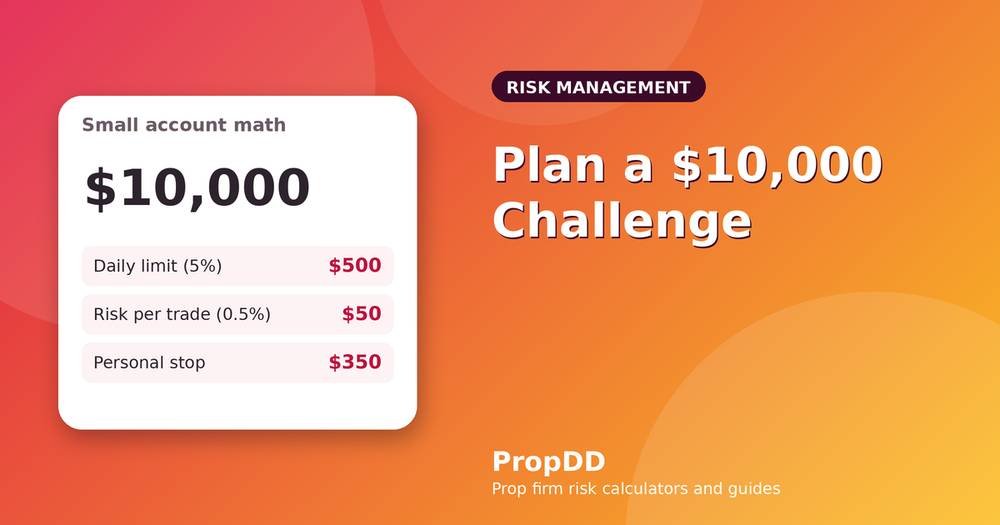
With those assumptions, the daily limit is $500, the overall limit is $1,000 and the target is $800. At 0.5% risk per trade you’d risk $50. A personal stop at 70% of the daily limit is $350. Ten full-size losses would hit the daily limit, and seven would reach your personal stop. Write these five numbers on a card before you open a chart. The way each is derived is in how to calculate max daily loss.
Notice how small the dollars are. A $50 loss feels like nothing, and that’s exactly why people on small accounts take more trades and bigger risks than they would on a larger one. The percentage is what matters, not the amount of money you can see.
What $50 of risk means in lots
Using EURUSD with a pip worth about $10 per standard lot, the lot size is $50 divided by the stop distance in pips times $10, rounded down.
| Stop (pips) | Lots for $50 risk | Pip value at that size |
|---|---|---|
| 10 | 0.50 | $5.00 |
| 15 | 0.33 | $3.30 |
| 20 | 0.25 | $2.50 |
| 25 | 0.20 | $2.00 |
| 30 | 0.16 | $1.60 |
| 40 | 0.12 | $1.20 |
Almost all of these are comfortably above the usual minimum lot of 0.01, so size isn’t the problem. Rounding down matters, though: 0.16 lots instead of 0.17 keeps your risk at or under the plan. The formula and the practice drills are in position sizing for prop firm challenges.
Spreads weigh more on small risk
A one-pip spread on a 20-pip stop is 5% of your risk before the market has moved. On a $50 trade that’s $2.50 of friction. Across ten trades, it’s $25 of the $800 target, more than 3%, and commissions come on top. This is the hidden cost of a small account with tight stops: your edge has to be strong enough to overcome costs that are a bigger share of each trade. Check the spread at your trading hours and include it in your stop distance when you size. The effect of costs on daily room is covered in swaps and commissions.
Is the instrument too big for the account?
Some instruments have large minimum sizes. A minimum lot on an index or on gold can carry more risk per point than a $50 budget allows. Check the contract specification before you plan to trade one. If the minimum contract risks $120 on your normal stop, the trade doesn’t fit a $50 plan, and the answer is to skip it, not to bend the plan. See trading gold within a daily drawdown limit and trading indices within a daily limit for how point values change the arithmetic.
Pacing an $800 target
If your average winner is 1.5R, that’s $75, and you’d need around eleven net winners to reach $800. With a 50% win rate and 1.5R winners, expectancy before costs is +0.25R, which is $12.50 per trade. Eighty trades, then, or roughly six to eight weeks at two or three trades a day. That’s the honest timeline. It’s slow, it’s survivable and it doesn’t require heroics. Our plan for pacing is in how to pass a prop firm challenge with small daily risk.
The temptation to size up
The fee, the small dollars and the slow pace combine into a strong pull toward bigger risk. “If I risk 2% I’ll get there in two weeks.” It’s the same trap as on a bigger account, only more tempting because $200 of risk feels so small. At 2% risk, three consecutive losses are $600 on a $10,000 account, which is over the daily limit. The percentage arithmetic doesn’t care about how small the dollars feel. A fixed written risk per trade, never changed after a loss or a win, is the simplest defence.
Don’t overtrade to compensate
A related trap is taking many small trades to make the account “do something”. More trades mean more costs and more chances to break your rules. Cap the number of trades per day, ideally at three or four, and treat days with no valid setup as a success. For how a trade cap changes the odds of a daily breach, see overtrading on prop accounts.
A sample week
Monday: two trades at $50 risk, one winner at +1.5R (+$75), one loser (−$50), net +$25, about 5% of the daily limit used at worst. Tuesday: three trades, all losers, −$150, 30% of the limit, and the trader stops at the three-loss rule. Wednesday: no valid setup, no trades. Thursday: one trade, a winner at +2R (+$100). Friday: two trades, one winner, one loser, net +$25. The week ends up about $100, with the worst day using under a third of the daily limit. It isn’t exciting. It’s what small, steady risk looks like.
Fees, payouts and expectations
The fee for a small challenge is a bigger share of the account than for a large one, and a payout on a $10,000 account is correspondingly modest. Before you buy, work out the numbers honestly: fee, the profit split, the likely dollars per month at a sustainable risk and how many attempts you’re prepared to pay for. If the arithmetic doesn’t work for you, a bigger account won’t fix it, since it will have the same percentage risk and a bigger fee. Plan around learning and process first.
What to track
Keep a simple log: risk per trade in dollars and R, the spread you paid, the daily limit used at the end of each day and one word for your mood. After a month, check how much of your gross result went to costs and how often your worst day exceeded 50% of the limit. The layout is in trading journal for prop firm traders.
Mistakes to avoid
Treating small dollars as small risk. Using the minimum lot of a large instrument. Ignoring spread on tight stops. Raising risk to speed up the target. Trading more often to feel productive. Buying the next attempt before a post-mortem. Each one is common and each can be fixed with a written rule.
How much of the daily limit one loss really uses
On a $10,000 account with a $500 daily limit and a $50 risk, one full loss uses 10% of the day. That’s the same share as a $500 loss on a $100,000 account, so a small account isn’t a gentler place. The only real difference is how it feels. A $50 loss doesn’t sting, and a $500 one does. A good exercise is to translate your risk into “percent of the day” before each trade: this one uses 10%, the three before it have used 30%, so I’ve used 40% in total. Speaking in percentages keeps the small-dollar illusion from loosening your rules.
A budget for the whole attempt
Treat the challenge fee as a budget line. Suppose the fee is a certain amount, you plan for at most two attempts and the expected monthly payout at a sustainable risk is modest. Put the three numbers side by side. If the plan only works when everything goes right on the first try, it’s fragile. A plan that makes sense even if the first attempt teaches you something instead of paying you is far sturdier, and it takes pressure off each trade, which in turn improves the trading.
When a small account is the right choice
A small challenge is a sensible way to learn how a firm’s rules work in practice: how the dashboard behaves, how the reset time feels in your time zone, how costs affect the daily limit. It’s also a gentler way to test your routine under mild pressure. If you can follow your plan for several weeks on a small account, you’ve demonstrated the habit that a larger account demands. If you can’t, you’ve found that out at a lower price. That’s a perfectly good reason to start small, as long as you treat it as a serious test.
When to move up
Don’t move to a larger account because the small one feels slow. Move when your journal shows several weeks with rule breaks at zero, daily limit use mostly under 40% and a risk per trade you never change. Then move up with the same percentage, and ease into the larger dollar amounts, as described in scaling plans and drawdown on funded accounts. A larger account amplifies what you already do, including the bad habits.
Check the rules that matter more at small size
A few rules bite harder on small accounts: minimum trading days (which can force trades you’d rather skip), minimum lot sizes on some instruments, and fixed-dollar commission rules, which weigh more on small risk. Read these before buying. The checklist in daily drawdown rules: what to check before you buy covers each one. Small details can matter a great deal when your budget per trade is $50.
A one-page plan for the account
Write it like this, and fill the blanks. Account $10,000. Daily limit $500. Personal stop $350. Risk per trade $50, never changed. Maximum trades three. Instruments: two, with minimum lots that fit. Session: one window of two hours. After two losses, a thirty-minute break. After three or the personal stop, done for the day. Weekly review on Sunday. It fits on a postcard, and a postcard is all a small account needs. The full template is in the risk management plan template.
A note on patience with small dollars
Small accounts reward patience in a way that’s easy to miss. A week that makes $100 feels underwhelming, and the temptation is to speed up. But a series of unremarkable weeks is exactly what a passed challenge looks like. If you can make steady, boring progress on $10,000, the same habits scale. If you can’t be patient with small numbers, you won’t be patient with large ones.
Keep the plan boring on purpose
The best compliment for a small-account plan is that it’s dull. Same size, same hours, same cap, same review. If you notice yourself looking for ways to make it more exciting, that’s the signal to slow down, not to speed up. Excitement and risk management rarely travel together.
Frequently asked questions
Is a $10,000 challenge easier than a larger one?
The percentage rules are the same. The difference is the fee, the dollar sizes and how tempting it is to take extra risk. It isn’t easier, only cheaper to try.
What risk per trade suits a small account?
The same as on any size: usually 0.25% to 0.5% for most people. On $10,000 that’s $25 to $50.
Can I use the minimum lot on everything?
Only if the resulting risk fits your plan. On some instruments the minimum lot risks more than your budget allows.
Should I start with a small account to learn?
It can be a sensible way to learn the rules at lower cost, as long as you treat the percentages seriously.
The short version
On a $10,000 account, the daily limit is $500 and your risk per trade is about $50. Size from the stop and round down, watch spreads, don’t let small dollars loosen your rules and pace the target over weeks. For the rule behind it all, read the prop firm max daily drawdown explained, and for neutral background on managing risk, see Investopedia’s risk management overview and the free BabyPips lessons.