Passing the challenge feels like the finish line, and then the firm mentions scaling. Hit certain targets, stay inside the rules for a while, and your account gets bigger. It’s the part of the pitch that makes funded trading sound like a career. It’s also the point at which a lot of traders quietly make their first serious mistake, because the numbers around them change and their habits don’t.
In this article
- What a scaling plan usually looks like
- What happens to the daily limit
- What happens to the overall limit
- Worked example: a step from 0,000 to 0,000
- Your start-of-day figure after a step
- Keep your risk percentage, not your dollar amount
- Why bigger sometimes means worse
- Payouts and the drawdown base
- Consistency and profit rules
- Is scaling worth chasing?
- A slow ramp, in practice
- Recalculate everything on the day
- A short list of traps
- What to ask support before you scale
- An imaginary year with a scaling plan
- A small sheet for tracking targets
- The same trader, a bigger number
- When not to scale
- Check again at every step
- Frequently asked questions
- The short version
This article is about what actually shifts when an account scales: the daily limit, the overall limit, your start-of-day figure and, less obviously, your own head. I’ll use examples with round numbers. Every firm’s scaling plan is different, so treat these as shapes to recognise, not as descriptions of any particular program.
What a scaling plan usually looks like
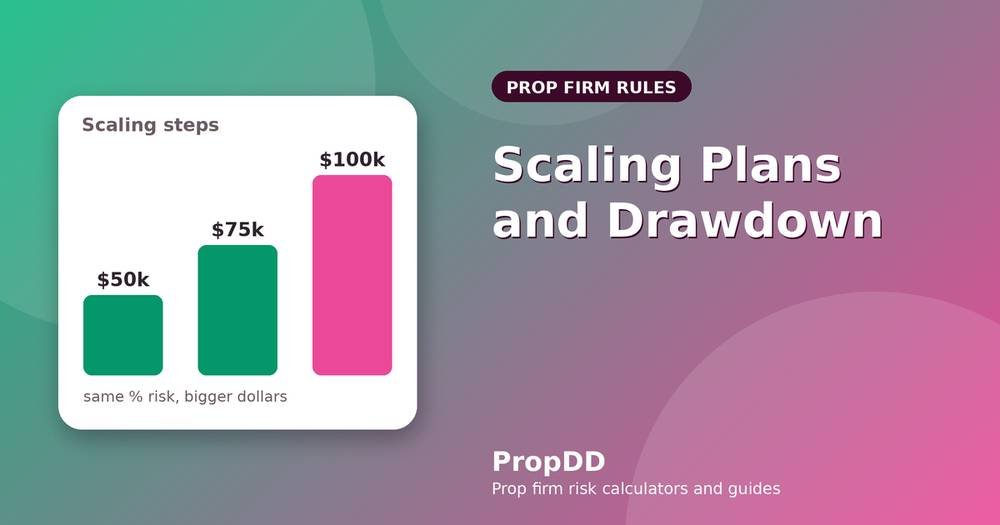
The broad pattern is common. After some period of trading, perhaps a few months, and subject to conditions such as a minimum profit and no rule breaches, the firm increases the size of your account by a set step. Some plans also raise the profit split. Others add requirements that must be met before each step. The details are in the terms, and they’re worth reading slowly because they often contain the conditions that quietly cancel a scale-up.
What happens to the daily limit
Normally the daily limit scales with the account. A five percent daily limit on $100,000 is $5,000. After a step to $150,000, the same five percent is $7,500. The percentage hasn’t changed, the dollars have. For a trader who thinks in percentages, nothing has really changed. For a trader who thinks in dollars, a lot has. It’s the same ratio and a very different feeling, and feelings drive decisions at 2 p.m. on a losing day.
What happens to the overall limit
The overall limit usually scales too, but how it’s re-based matters. Some firms keep the old floor and add the new money on top, others re-set the floor relative to the new balance. If your overall limit is trailing, the floor might move up the moment you scale, and your cushion might shrink in relative terms. Check what happens to the floor on the day of the step, and write down the new figure. The general difference between types is covered in static versus trailing drawdown.
Worked example: a step from $100,000 to $150,000
| Before | After | |
|---|---|---|
| Account size | $100,000 | $150,000 |
| Daily limit (5%) | $5,000 | $7,500 |
| Risk per trade at 0.5% | $500 | $750 |
| Overall limit (10%, static) | $10,000 | $15,000 |
| Losses you can take in a day | 10 | 10 |
The last row is the interesting one. At constant percentage risk, you can absorb the same number of losing trades. The maths is the same. The dollar amounts are 50% bigger, which is the entire difference, and it’s an emotional one, not a numerical one. Losing $750 feels different from losing $500 even though it’s the same 0.5%.
Your start-of-day figure after a step
When the account is scaled, your balance jumps. The daily limit on the day of the step should be calculated from the new figures, but how the firm treats that first day varies. Some use the new balance from the next reset, others from the moment of the change. Ask support, note the answer, and enter the right start-of-day number into the calculator at the right time. A mismatch on that single day is an easy way to get caught.
Keep your risk percentage, not your dollar amount
There are two natural ways to respond to a bigger account. You can keep your dollar risk the same, so you’re risking less in percentage terms, or keep the percentage the same, so the dollars grow. Neither is wrong, but the second is the usual default, and it’s the one that can bite. If you move from $500 to $750 per trade overnight, your results swing more and your nerves swing with them. A gentler way: step the dollar risk up over a few weeks, not in one day, and give yourself time to feel comfortable at each level.
Why bigger sometimes means worse
Traders often perform worse right after scaling, for reasons that have nothing to do with skill. Bigger numbers on the screen change risk perception. Some start to trade bigger “because the account can take it”. Others become over-cautious and cut winners early. And a few start to think about the new payout and begin protecting profits instead of trading the plan. None of this is a character flaw. It’s what happens when you change the scale of stakes without changing the routine around them.
Payouts and the drawdown base
Withdrawing profits changes your balance, and some firms re-base the drawdown or the floor after a payout. Others leave the floor alone. If your overall limit trails balance, taking money out can interact with the floor in ways you don’t expect. Before your first payout, ask exactly how the floor and the daily base are treated, and keep the reply. This is a good time to re-read the terms, since the payout section is often where unusual conditions live.
Consistency and profit rules
Many funded programs have rules on how profit is distributed over time, for example, no single day above a certain share of total profit. These are unrelated to drawdown but interact with it: a trader who tries to take a big day to speed up scaling can break a consistency rule or risk a daily breach on the same day. Read them together, and if a rule looks odd, ask. We cover how to read a rulebook systematically in daily drawdown rules: what to check before you buy a challenge.
Is scaling worth chasing?
It depends on what you want. A bigger account means bigger absolute profits, but also bigger absolute losses and bigger pressure. Some traders find their best results come at a modest size where they feel relaxed. If your edge exists at $50,000 and you’re calm at that size, there’s nothing wrong with taking your time. The scaling plan is an option, not an obligation, and a breach at the new size undoes months of work.
A slow ramp, in practice
Here’s a simple approach. In the first two weeks after a step, trade at your old dollar risk. In weeks three and four, move to halfway between the old and new. After that, if your journal shows you’re following your plan and your daily limit use is comfortably under half, move to the new level. It costs you a few weeks of slightly smaller profits and saves you from the commonest scaling mistake, which is trading a bigger account the way you traded a smaller one when your nerves weren’t ready.
Recalculate everything on the day
On the day of a step, enter the new account size and the new start-of-day figure into the drawdown calculator, write the new daily floor and personal stop and update your trading plan. A personal daily stop set for the old size may not be right for the new one. And don’t forget the overall floor, which is the number that actually decides whether the account survives a bad month.
A short list of traps
Assuming the limits scale automatically, with no changes to the rules. Forgetting the new reset or base. Increasing risk by the full ratio the day you scale. Treating the new payout as already earned. Taking a big day to hit a scaling target and tripping a consistency rule or a daily limit. Each of them is avoidable with a little reading and a little patience.
What to ask support before you scale
Four questions: how are the daily and overall floors calculated after the step; what is my start-of-day figure on the day of the step; does the step change the reset time or any rules; and how does a payout affect the floor. Ask them in writing, keep the answers and re-check after each step, because rules change.
An imaginary year with a scaling plan
Picture a trader who passes a $50,000 challenge in January and starts funded trading in February. For the first three months they trade at 0.4% risk, take small payouts and keep a clean record. In May, the firm offers a step to $75,000 on the condition of a minimum profit and no breaches. The trader accepts. For two weeks they keep dollar risk at $200, then move to $300 over the next fortnight, which keeps the percentage at 0.4%.
In August there’s another step to $100,000. By now the trader has a rhythm: recalculate floors on the day, update the personal stop, journal the first week of the new size. A bad week in September uses 55% of one daily limit, which triggers the rule “cut risk by half for a week”. The account survives, the notes explain why, and by November the trader is at the full size, comfortable and still within the rules.
It’s an unremarkable story, which is exactly the point. Nothing dramatic, no heroics, just a rule for every transition. Compare it with the usual alternative: scale, double the risk the same day, hit a daily limit in the first week and lose the account. The difference isn’t skill. It’s whether the step was planned.
A small sheet for tracking targets
If your plan has conditions, such as a minimum profit over a period or a number of profitable months, track them in a simple sheet: the requirement, your current progress, the date by which it needs to be met and a note about anything that could jeopardise it. Looking at a column of “needs 2.1% more by the 30th” is a quick way to notice when you’re tempted to force a big trade to catch up. If the sheet makes you want to take more risk, close it and look at the plan instead.
The same trader, a bigger number
It’s easy to underestimate how much a number on the screen shapes behaviour. A $500 loss feels like a bad day. A $750 loss, after a scale, feels like a worse one, even though it’s the same percentage. The trick is to notice the difference and deliberately keep the routine the same: same pre-session check, same rules, same journal. Boring continuity is the antidote to the strange excitement or anxiety of a bigger balance.
When not to scale
If you’ve had two or three close calls in a month, if your daily limit use is often above 60%, or if your journal shows rule breaks, scaling won’t fix any of it. Magnifying a loose process makes the loose parts bigger. Take a month to tighten the routine and apply for the step later. Most programs let you wait. A calm account at the current size is better than a stressed one at the next.
Check again at every step
Don’t assume the second scaling step works like the first. Terms can differ between levels, and sometimes the conditions get stricter as the account grows. Re-read the section each time, update your notes with the date and ask support about anything that’s changed.
Frequently asked questions
Does the daily drawdown percentage change when I scale?
Usually not, but the dollar amount does. Check the terms for any change in percentage between phases.
Should I risk more after scaling?
Keeping the same percentage is normal. Moving to it gradually over a few weeks is easier on your nerves than switching overnight.
Can scaling make my overall cushion smaller?
It can, if the overall floor trails and moves up when the balance does. Ask how the floor is re-based on the day of the step.
What if I breach after scaling?
The consequence depends on the terms. On many programs the account closes and the scaling progress goes with it, so treat the larger account with extra care.
The short version
Scaling changes the dollars, not the logic. Keep your risk percentage, ease into the bigger numbers, recalculate your floors on the day and ask support how the base and the floor are treated after a step. For the rule that governs it all, see the prop firm max daily drawdown explained, and for background on the sizing side, Investopedia’s page on position sizing is a neutral read.