Most traders have a strategy and no plan. The strategy says when to buy and sell. The plan says what you do when the strategy stops working, when you’re tired, when the day has gone badly and when the daily loss limit is a few hundred dollars away. It’s the part nobody finds exciting, and it’s the part that decides whether the account is still alive in three months.
In this article
- Why write it down at all
- Part 1: the account facts
- Part 2: the daily numbers
- Part 3: risk per trade
- Part 4: what counts as a valid trade
- Part 5: stop and exit rules
- Part 6: open risk caps
- Part 7: news and sessions
- Part 8: what I do after a loss
- Part 9: what I do after a win
- Part 10: weekly rules
- Part 11: when things break
- The one-page template
- A filled-in example for a ,000 account
- Using it every day
- Reviewing and changing the plan
- Mistakes to avoid
- Three versions for three kinds of trader
- Where to keep it
- Objections you'll hear from yourself
- Start tonight
- Frequently asked questions
- The short version
What follows is a template for a one-page risk management plan, built for a prop firm account, with a filled-in example at the end. Copy it into a document, fill in the blanks with your own numbers and print it. You’ll want the drawdown calculator nearby for the first few lines.
Why write it down at all
Because you won’t remember it when it matters. A rule you carry in your head gets quietly edited by your mood: five percent becomes “about five”, three trades becomes “maybe four if it’s a good one”. A rule on paper doesn’t get edited. It just sits there, reading you the same sentence you wrote when you were calm.
There’s also a less obvious benefit. Writing the plan forces you to find out what you don’t know. Many people discover, halfway through, that they can’t say when their trading day resets, or whether swaps count toward the limit. Better to find that out on a Sunday evening than at 2 p.m. on a Thursday.
Part 1: the account facts
Start with the numbers that come from the firm, not from you. Copy them from the rulebook, with the date you checked them.
| Item | My answer |
|---|---|
| Account size | |
| Daily loss limit (percent or dollars) | |
| What it’s calculated on | |
| Balance or equity | |
| Reset time, in my time zone | |
| Overall loss limit, and static or trailing | |
| Costs that count | |
| News and weekend rules |
If you can’t fill a row, stop and find out. The checklist in daily drawdown rules: what to check before you buy covers each one in turn.
Part 2: the daily numbers
Every morning you’ll write four figures at the top of the page: start-of-day equity, the daily floor, your personal stop and the maximum number of trades. The floor is the start-of-day figure minus the max daily loss; see how to calculate max daily loss if you need the steps. The personal stop should sit at 60% to 70% of the firm’s limit. The trade cap is usually three or four. These four numbers are what turn the plan from a document into a habit.
Part 3: risk per trade
One line: “I risk ___% of my account per trade, which is $___ today.” Choose it by working backwards from the daily limit, aiming to survive at least five losses in a row inside your personal stop. Add a second line: “I never change this number after a loss.” That sentence has saved more accounts than any indicator. The method is in how much to risk per trade.
Part 4: what counts as a valid trade
This isn’t your whole strategy, only the checklist that decides whether a trade is allowed. Something like: the setup is one of my named setups, the stop has a reason (the idea is wrong beyond this level), the reward is at least 1.5 times the risk, no high-impact news in the next thirty minutes, and total open risk after this trade stays under my cap. If any answer is no, there’s no trade. Making the list short makes it usable.
Part 5: stop and exit rules
Four lines will do. Every trade has a stop in the market when it’s opened. Stops can be tightened but never loosened. I don’t add to a losing position. I close a trade early only if the setup is invalid, not because I feel nervous. If you’ve ever watched a stop move “just a little”, you’ll know why this section earns its place. Sizing the position from the stop distance is covered in position sizing for prop firm challenges.
Part 6: open risk caps
Set a ceiling for total risk across all open trades, typically 1% to 1.5% of the account, and treat correlated pairs as a single position. Write the cap in dollars next to the percentage, since dollars are easier to compare with the room you have left. The reasoning is in floating losses and open trades.
Part 7: news and sessions
List the hours you trade, in your own time zone, and the events you skip. For example: I trade the London session until the New York open, I flatten fifteen minutes before any high-impact release and I don’t trade the first thirty minutes after one. If your firm has a news rule, copy its wording here. The practical side is in news trading and daily drawdown.
Part 8: what I do after a loss
Write the sequence out. After one loss, I continue as normal. After two in a row, I take a thirty-minute break away from the screen. After three, or when I reach my personal stop, I close everything and stop for the day. I do not trade to get the loss back. If this sounds obvious, read it again at the exact moment you’re annoyed, and you’ll see why it needs to be on paper. The longer story is in revenge trading and the daily loss limit.
Part 9: what I do after a win
Hardly anyone writes this section and it’s one of the most useful. After a strong day, say more than 1.5R, I may take one more trade at normal size and then I’m done. I don’t raise my risk the next morning. A win isn’t a mandate to be braver.
Part 10: weekly rules
Add a weekly stop: if I’m down more than a set percentage in a week, I trade at half size next week. Add a weekly review: ten minutes on Sunday, one change for the coming week, written down. A trading journal makes this much easier, because the review is just reading what you’ve already recorded.
Part 11: when things break
Plan for the dull emergencies. What do I do if my internet fails with a trade open? (Know your platform’s mobile app, keep the firm’s support contact, always have a stop.) What if the platform freezes? What if the dashboard and my platform disagree? What if I feel unwell mid-session? One line each is enough. It’s the least dramatic part of the plan and the one that pays off on a bad day.
The one-page template
Account: size ___ · daily limit ___% on ___ · measured on equity/balance · reset ___ (my time) · overall limit ___ (static/trailing).
Today: start equity ___ · daily floor ___ · personal stop ___ · max trades ___ · risk per trade $___.
Rules: hard stop on every trade; stops never widened; no averaging down; open risk under $___; skip high-impact news; two losses = 30-minute break; three losses or personal stop = done for the day; no risk changes after losses or wins.
Weekly: weekly stop ___%; Sunday review; one change.
Emergency: support contact ___ · mobile platform ready · always a stop in the market.
A filled-in example for a $50,000 account
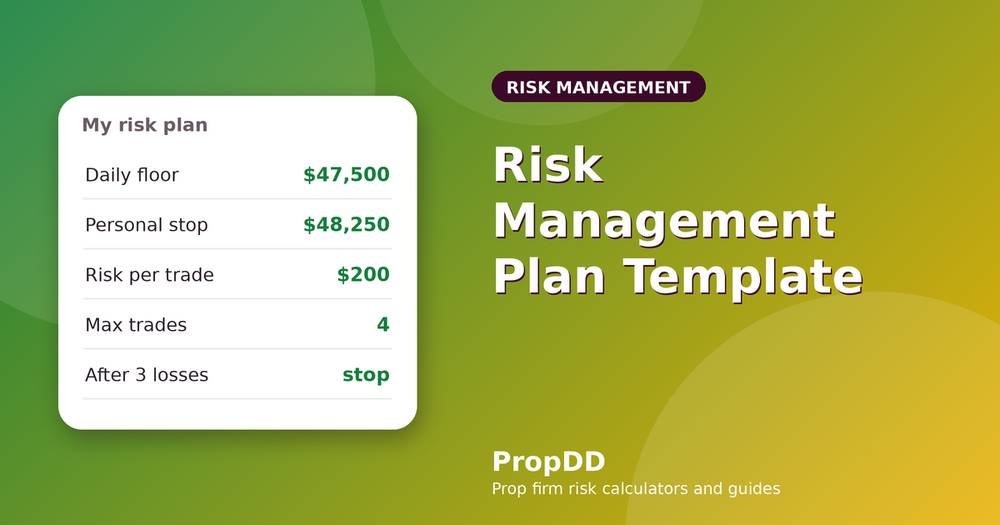
Account $50,000, daily limit 5% on start-of-day equity, equity-based, reset at 00:00 server time (03:00 my time), overall limit 10% static. On a day starting at $50,000: floor $47,500, personal stop $48,250 (70% of the limit used, so a $1,750 loss allowed), risk per trade $200, maximum four trades, open risk cap $600. Rules as above. Weekly stop 4%. It takes up about half a page, and that half page does more for the account than most strategy tweaks.
Using it every day
Print one copy and put it where you can see it. Each morning, write the date and the four daily numbers. During the session, tick off trades. In the evening, record how much of the limit you used. If you find yourself breaking a rule, don’t cross it out, add a note about why. Over a few weeks, the pattern of exceptions tells you which rules are too strict, which are too loose and which just need to be followed.
Reviewing and changing the plan
Change the plan on Sundays, not mid-session. If a rule keeps getting broken, ask whether it’s the wrong rule or the wrong habit. A rule that’s broken in a calm moment is probably unrealistic and should be adjusted. A rule that’s broken only when you’re upset is a good rule, and the fix is a better way to stay calm. Resist the urge to rewrite after every bad day. Your plan should be the steady part of the picture.
Mistakes to avoid
Writing a plan so long that you won’t read it. Writing rules you know you won’t follow. Skipping the numbers and writing only principles. Never reviewing it. Copying someone else’s plan without checking that their risk fits your account. Treating the plan as a punishment instead of a seatbelt.
Three versions for three kinds of trader
The template bends to fit different styles. A scalper’s plan has a lower personal stop, perhaps 50% of the limit, a high trade cap and a strict rule about costs per trade. A swing trader’s plan has a bigger focus on open risk and weekend rules, with fewer trades and wider stops. A part-time trader who only has two hours a day puts the weight on the pre-session routine and a hard cap of two trades, because a limited window makes rushing more likely. Same skeleton, different emphasis. Start with the version closest to you and adjust after a month.
Where to keep it
On paper, next to the monitor, and as a note on your phone. The paper copy is for the moments you’re staring at a losing trade. The phone copy is for when you’re away from the desk and tempted to check the market. Don’t bury it in a folder you never open. If it takes more than five seconds to find, it won’t get used.
Objections you’ll hear from yourself
“It’s too rigid.” Rigid is the point; flexibility is what got you into trouble. “I’ll lose good trades by following it.” Sometimes, yes, and it will also stop you from taking the bad ones, which are more expensive. “I know all this already.” Maybe, but knowing and following are different skills, and only one of them shows up on the equity curve.
Start tonight
Don’t wait for the next challenge. Open a blank page now, copy the headings and fill in the account facts and the four daily numbers. Even a rough first version beats none, and you’ll improve it every Sunday. The point isn’t a perfect document. It’s to have something to follow when the market stops being friendly.
Frequently asked questions
How long should my plan be?
One page. If it takes longer than two minutes to read, you won’t read it when it counts.
Should I share it with anyone?
It can help. A trading friend who can ask “did you follow the plan?” adds a little friction at the right moment.
Do I need a different plan for each firm?
The structure can stay the same, but the numbers should come from each firm’s own rules. Keep a separate account-facts table for each.
What if my firm changes its rules?
Update the account-facts table and the affected daily numbers the same day, and note the date.
The short version
A risk management plan is one page that turns your rules into something you can see: the account facts, the daily numbers, risk per trade, stop rules, open risk, news rules, after-loss and after-win rules, weekly rules and emergencies. Fill it in, review it on Sundays and follow it when it’s inconvenient. For the rule at the heart of it, read the prop firm max daily drawdown explained, and for general background, Investopedia’s page on risk management and the free lessons at BabyPips are useful reading.