At some point, almost every prop trader has the same thought: if one challenge works, why not run three? The idea is appealing. More accounts means more capital, more chances to pass and more potential payouts. It also means something that doesn’t show up in the sales pitch: the same mistake, made once, can now be made three times at the same moment.
In this article
- Why people run more than one account
- Copying is not diversification
- An example of how it stacks
- Each account has its own rules
- Trade copiers and the rules about them
- Size each account from its own numbers
- Correlated failure is the real risk
- Staggering and diversifying
- Attention is a limited resource
- Keep separate records
- Think about the money at risk, not only the percentages
- A sensible way to scale up
- Mistakes to avoid
- A scenario: the day all three failed
- Rules that fit multiple accounts
- Be honest about why you want more accounts
- What the numbers say about attempts
- A worksheet for several accounts
- When to simplify
- Frequently asked questions
- The short version
This article looks at what really changes when you trade several prop accounts: how risk adds up across them, why copying a trade is a different kind of bet from placing one, how reset times and rules differ, and how to scale up without turning a single bad day into a triple loss. If you want a quick view of each account’s room, run each through the drawdown calculator separately.
Why people run more than one account
The motives are usually sensible. Spreading attempts across firms reduces the chance of one firm’s rules ruining your style. Several smaller accounts can cost less than one large one. A funded account and a challenge can run side by side. And some traders simply want to compound a working routine. None of these is wrong. The problem begins when the accounts are treated as independent when they’re really one decision repeated.
Copying is not diversification
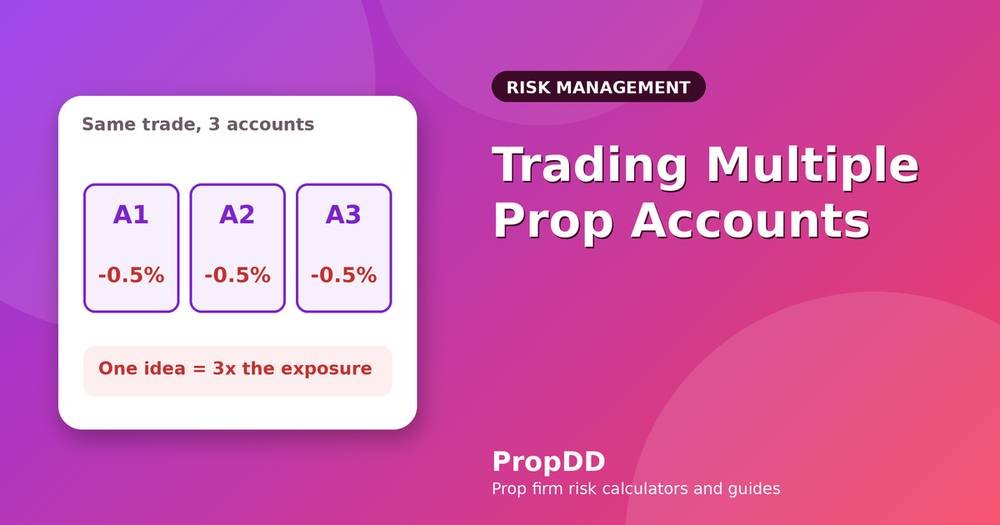
If you place the same trade on three accounts, you haven’t diversified. You’ve tripled your exposure to that idea. If the trade loses, all three accounts lose together, each by the same percentage. If your risk per trade is 0.5% on each, the total at stake across your capital is 1.5% of an average account, but your emotional load is that of a single event that hits three places at once. The accounts have separate limits, so each one stays within its own rules, but a bad day then happens to all of them on the same day.
An example of how it stacks
A trader runs three $50,000 accounts and takes the same four trades on each. Per account, risk is 0.5% ($250) per trade, and the daily limit is 5% ($2,500). On a bad day, all four trades lose. Each account loses $1,000, which is 40% of its limit, and the trader has lost $3,000 across the three. Nothing is breached, and it was an ordinary bad morning. Now double the risk to 1%. The same four losses cost $2,000 per account, 80% of each limit, in a single sitting, with $6,000 gone in total. One bad idea consumed most of the day’s room on three accounts at once.
| Risk per trade | Loss per account (4 losses) | Share of daily limit | Total across 3 accounts |
|---|---|---|---|
| 0.25% | $500 | 20% | $1,500 |
| 0.50% | $1,000 | 40% | $3,000 |
| 1.00% | $2,000 | 80% | $6,000 |
Each account has its own rules
The accounts may belong to different firms, with different daily bases, reset times, news rules and costs. A trade that’s fine on one may break a rule on another. A day that resets at midnight server time on one resets at a different hour on the next. A single position held over the reset may land in different “days”. Write a small table with each account’s size, daily limit, base, reset time in your time zone and overall limit type. Check it before you trade, not afterwards. The checklist in daily drawdown rules: what to check before you buy applies to each firm separately.
Trade copiers and the rules about them
Some firms allow copying between your own accounts, some restrict it, and some prohibit copying between accounts held by different people or with other firms. Rules on this vary and change, and breaking them can void profits or close accounts. Search each rulebook for “copy”, “copier”, “duplicate” and “multiple accounts”, copy the exact wording into your notes and ask support when it’s unclear. Even when allowed, think carefully about whether you want exactly the same position everywhere, since different account sizes and limits might call for different risk on each.
Size each account from its own numbers
Don’t copy lot sizes blindly. A $25,000 account and a $100,000 account need different lot sizes for the same percentage risk. Account currencies, contract specifications and commission structures also differ. Work out each account’s dollar risk and lot size from its own figures, using the method in position sizing for prop firm challenges. If you use a copier, check how it scales volume, and test it on a demo first.
Correlated failure is the real risk
With one account, a breach costs one fee. With several accounts all trading the same idea, a breach can arrive on all of them in the same hour. The worst case isn’t “one account fails”, it’s “every account fails together, and I’ve paid every fee”. If that happens, a single mistake costs several times what a single account would have cost. Staggering your attempts, using different setups on different accounts or keeping some accounts at lower risk reduces the chance of a simultaneous failure.
Staggering and diversifying
A few practical ideas: start the second account only after the first has been traded cleanly for a few weeks; use somewhat different risk or instruments on each; avoid placing the exact same trades; keep one account in a calmer mode. None of these removes risk. They make it less likely that one bad session ends everything at once.
Attention is a limited resource
Monitoring several accounts takes more attention than monitoring one. Daily floors, personal stops, open risk, reset times and news rules all multiply. If you notice you’re checking dashboards constantly or missing details, that’s a sign you’ve taken on too much. Scale back. The quality of your decisions on one well-run account is worth more than sloppy handling of three.
Keep separate records
Use a separate section or tab for each account in your trading journal, plus a combined view of total risk. Record the start-of-day equity, the floor, the personal stop and the daily limit used for each account. Take dashboard screenshots per account at the reset time. It sounds like admin, and it’s what lets you reconcile numbers when something goes wrong on one of them, as explained in how to read a prop firm dashboard.
Think about the money at risk, not only the percentages
Add up the fees you’ve paid across accounts, and treat the total as capital at risk. If the total is more than you can comfortably lose, you’ve over-extended, no matter how well each account is managed. A useful rule is to set a total budget for all attempts in advance and not exceed it. Decide while you’re calm, write it down and stick to it.
A sensible way to scale up
Begin with one account and trade it cleanly for a month or two, with zero rule breaks and daily limit use mostly under 40%. Add a second only if you’re comfortable, and treat it as a new routine, not a copy. Keep the same percentage risk per account, and do not raise it because you now have “more cushion” overall. Review after a month: has the second account made your discipline better or worse? Only then consider a third. Slow growth in the number of accounts matches how a sensible trader scales anything else.
Mistakes to avoid
Copying trades without checking each firm’s rules. Using the same lot size on different account sizes. Assuming copies diversify risk. Ignoring different reset times. Running more accounts than you can monitor. Not keeping a total budget. Adding accounts to recover from a failure.
A scenario: the day all three failed
Here’s an imaginary but plausible story. A trader runs three accounts and copies each idea across them. A major news release lands during the session. The trader holds a position on all three, with a stop 25 pips away on each. The market gaps past the stops by 30 pips. On each account, the loss is more than twice the planned amount. All three are now deep into their daily limits, and the trader, rattled, takes a recovery trade on each. By lunchtime all three have breached.
In a single-account world, this is a painful lesson. In a three-account world, it’s three fees gone and a considerable amount of confidence. Nothing about the story required poor skill. It required the same exposure in three places and one unexpected move. That’s what correlated failure looks like.
Rules that fit multiple accounts
A few extra rules help. A combined open-risk cap across all accounts, in dollars, so you can see the total. A combined daily stop: if the sum of today’s losses across accounts passes a set figure, you’re done on all of them. A rule that you never add a trade on one account that you haven’t added on the others, unless it fits that account’s own limits. And a no-news rule that applies to everything, so a single release can’t hit every account at once.
Be honest about why you want more accounts
If the reason is that you have a working routine and the capacity to manage more, that’s a sensible motive. If the reason is that you’re behind on your first account and think more attempts will compensate, that’s a recovery motive, and recovery motives have a poor record in trading. Ask the question plainly, write the answer down and check it against the facts in your journal. It’s an uncomfortable, useful exercise.
What the numbers say about attempts
More attempts increase the chance that at least one passes, but only if the attempts are independent. Attempts that follow the same strategy at the same time are strongly linked: if the strategy is out of sync with the market that week, all of them suffer. Truly independent attempts, spread over time and conditions, are a better use of the same fees. If you do add accounts, spread them across time as much as across firms.
A worksheet for several accounts
Make one row per account with these columns: firm, account size, daily limit and base, reset time in your time zone, overall limit type, today’s start-of-day equity, daily floor, personal stop, risk per trade in dollars and open risk right now. Add a final row that totals the dollars at risk across accounts. Look at the total row before every trade. If the total feels larger than you’d accept on a single account of your own money, it’s too large. The sheet takes ten minutes to build and transforms several accounts from a blur into a table you can actually read.
When to simplify
If you’re missing news windows, forgetting to update floors, or finding that one account’s rules have slipped from your notes, simplify. Close out or finish the weakest account, trade the rest cleanly and come back to more accounts later. Reducing complexity after a near miss isn’t a retreat. It’s what keeps the accounts that matter alive.
Frequently asked questions
Is it better to have several small accounts or one large one?
It depends on the fees and on your ability to manage them. A single well-run account is usually safer than several poorly managed ones.
Can I copy trades between accounts at different firms?
Rules vary, and some firms prohibit it. Read each firm’s terms and ask support before you try.
Do multiple accounts reduce my risk?
Not if they hold the same trades. They spread your capital but concentrate your exposure to a single idea.
How should I set risk across accounts?
From each account’s own limits, using the same percentage approach on each, and with a total budget for fees.
The short version
Several accounts can work, but copying one idea across them multiplies risk and creates correlated failure. Size each account from its own rules, check reset times and copier restrictions, keep separate records and add accounts slowly. For the rule at the heart of each account, read the prop firm max daily drawdown explained, and for general background, Investopedia’s page on risk management is a good neutral read.