It sounds like a footnote, and for most trades it is. Then one day you’re $11 from your daily floor, you check the history tab, and a stack of commissions and a swap charge you’d forgotten about turns out to be the difference. Costs are real money, and your equity doesn’t care whether a dollar left because of the market or because of a fee.
In this article
- The three costs, in plain terms
- Spreads: already in your equity
- Commissions: usually deducted from balance
- Swaps: the one that sneaks up
- How costs can end a day
- What to look for in the rulebook
- Building costs into your risk
- High-frequency styles feel it most
- Check costs by instrument
- Avoiding unnecessary swaps
- Compare the dashboard and the platform
- An example plan with costs
- Common slips
- A month of small costs, added up
- Raw-spread accounts versus standard accounts
- What to ask support
- A quick mental checklist
- Keep it in proportion
- Frequently asked questions
- The short version
So do they count toward the daily drawdown? The honest answer is: it depends on the firm, and you should find out before you trade, not after. This article explains how each cost works, why it matters more than it seems, and how to build a margin for it into your daily plan. If you want to see your own room with costs included, enter today’s equity-based result into the drawdown calculator.
The three costs, in plain terms
Spread is the gap between the price you can buy at and the price you can sell at. You pay it the moment you open a trade, and you see it as an instant small loss. Commission is a fee charged per lot, per side or per round trip, common on accounts with raw spreads. Swap (also called rollover or overnight financing) is a charge or credit for holding a position past the daily cutoff, which reflects the interest difference between the two currencies in a pair. Investopedia’s page on the spread is a decent neutral explanation of the first one.
Spreads: already in your equity
The spread is baked into the prices your platform shows. When you buy, the trade is valued at the bid, which is lower than the ask you paid, so equity drops a little at once. That means the spread always counts toward an equity-based daily loss, with no special rule needed. It isn’t “extra”. It’s part of the price.
On major pairs in calm hours the spread might be a pip or less. On exotics, gold or during news it can be many times that. A two-pip spread on a 20-pip stop is 10% of your risk before the market has done anything. For tight stops, that’s a big deal.
Commissions: usually deducted from balance
If your account charges commission, it’s normally deducted from your balance when the trade opens or closes. That reduces equity as well, so under most equity-based rules, commissions effectively count. Some firms state this explicitly in the rules; others say nothing and leave you to infer it. Don’t infer. Look it up, or ask.
The scale matters. A typical raw-spread account might charge a few dollars per lot per side. On a ten-lot trade, that’s tens of dollars each way. Run twenty trades a day and the costs reach hundreds of dollars, which on a $50,000 account with a $2,500 daily limit is a chunk you can see with your own eyes.
Swaps: the one that sneaks up
Swaps only appear if you hold a position through the rollover time, usually once a day (with a triple charge on one day of the week for most forex instruments, to account for the weekend). Depending on the pair and direction, a swap can be a small charge or a small credit. Gold and indices have their own financing rules.
Whether swaps count toward the daily loss depends on the rule. Some firms include them in the daily profit and loss, others leave them out of the daily calculation but apply them to the balance. Either way, a multi-day hold can produce a negative number that never shows on the chart, and if it lands right at the reset it may land in either “day”. Our guide to the daily drawdown reset time explains why that boundary matters.
How costs can end a day
Imagine a $100,000 account with a $5,000 limit. A trader has taken eight trades, losing $4,780 on closed results. They figure they have $220 of room. But commissions of $6 per lot on 12 lots across the day add up to $72, and a swap charge of $9 hits at rollover. Their real remaining room is $139, not $220. A single normal spread on the next entry takes another $20. They’re closer to the edge than they thought, and they got there through nothing but “small” things.
That’s a made-up example, but the pattern is real: costs rarely breach an account alone, they just shave the margin until the next ordinary loss finishes the job.
What to look for in the rulebook
Search for the words “commission”, “swap”, “fees”, “financing” and “daily loss”. Then answer these questions in your notes. Are commissions included in the daily profit and loss? Are swaps? Is the daily loss based on equity, which would include everything, or balance? When is the swap charged, and in what time zone? Does the dashboard show costs in real time?
If any answer is unclear, send support one short message and keep the reply. A written answer settles arguments. For a wider checklist, read daily drawdown rules: what to check before you buy a challenge.
Building costs into your risk
The simplest approach is a cost allowance. Take your planned risk per trade and add about 5% to 10% to cover spread and commission. If you plan to risk $400, think of it as $430 to $440. Over a day of several trades, the difference matters, and you’ll never get a nasty surprise from the last trade.
Another approach: include the spread in your stop distance when you size the position. If your stop is 20 pips away from your entry and the spread is 1.5 pips, size the trade as if the stop were 21.5 pips. It’s a tiny adjustment that keeps your real risk close to your planned risk. The formula for sizing is in position sizing for prop firm challenges.
High-frequency styles feel it most
If you scalp, costs are the biggest thing standing between you and profit. A strategy that makes 3 pips on average per trade with a 1-pip spread and a commission has already lost more than a third of its edge before the market has a say. Prop traders who scalp need to know their cost per round trip to the penny, and should test their strategy net of costs, not gross. Slower styles feel it less, though holding costs (swaps) matter more for them.
Check costs by instrument
Costs differ widely. Major forex pairs have the tightest spreads. Crosses and exotics cost more. Gold and indices have their own structure. Crypto CFDs, where offered, often carry wider spreads and larger swaps. Look at the contract specification on your platform for each instrument you trade: it lists the typical spread, the swap rates and the contract size. Spend ten minutes on this once, and write the costs for your top five instruments on a card.
Avoiding unnecessary swaps
If your strategy doesn’t need an overnight hold, close before the rollover. If it does, know which days carry the triple charge and which direction is paying. Some traders prefer positions that earn a small credit, though it’s rarely a reason to take a trade by itself. The point isn’t to save every cent. It’s to avoid being surprised.
Compare the dashboard and the platform
Costs sometimes appear on one screen before the other. If the equity on the firm’s dashboard doesn’t match your platform, screenshot both and ask support which figure drives the daily rule. This is especially worth doing around the rollover time, when swaps post and spreads widen. We cover the equity-versus-balance question in balance-based versus equity-based daily drawdown.
An example plan with costs
A $50,000 account, 5% daily limit: $2,500. Personal stop at 70%: $1,750. Planned risk $200 per trade. Cost allowance of 8%, so think of each trade as $216. Maximum five trades a day, so worst-case planned cost is $1,080, comfortably inside the personal stop. After the third loss, the trader checks the equity figure (which includes everything) against the soft stop. If it’s beyond, they’re done. The costs never became a surprise because they were part of the plan from the start.
Common slips
Assuming costs don’t count because the rules don’t mention them. Ignoring the swap on a weekend hold. Using a spread from the marketing page instead of the live one. Forgetting that tight stops make costs a larger share of risk. And trading exotic pairs with the same size as majors.
A month of small costs, added up
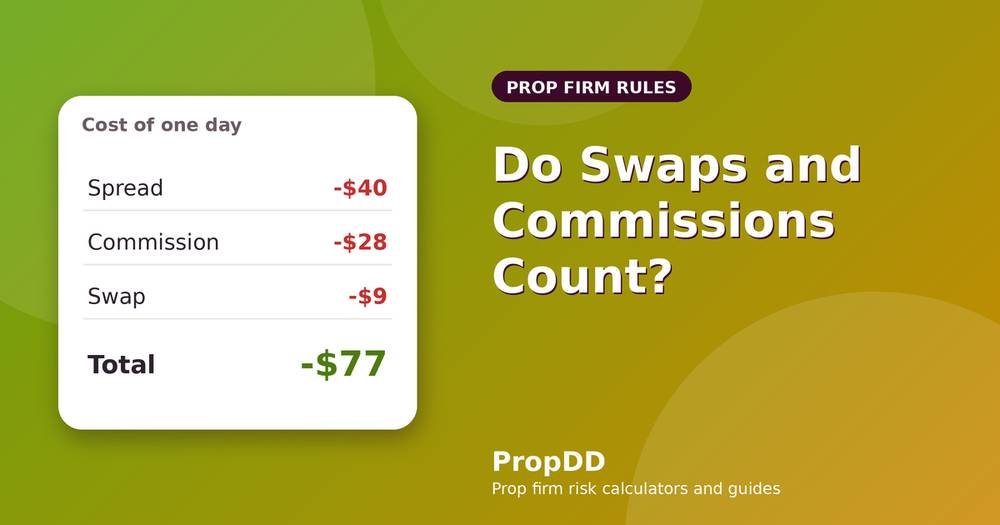
Take a trader who averages six trades a day on a $50,000 account, trading about 4 lots in total per day on a raw-spread account with a commission of $3.50 per lot per side. That’s $7 per lot round trip, so $28 a day. Over twenty trading days: $560. Add a spread cost of roughly $40 a day on average, another $800. And a handful of swaps, say $60. The month’s costs come to about $1,400, which is 2.8% of the account, before a single point of trading edge. A strategy that makes 4% a month gross is making 1.2% net. Seen that way, costs are part of the plan, not a rounding error.
Raw-spread accounts versus standard accounts
Many brokers offer two flavours. A standard account has wider spreads and no commission, so the cost is hidden in the price. A raw-spread account has tight spreads and charges commission separately. Neither is cheaper by default; it depends on how you trade. For scalpers, the raw-spread type usually wins. For occasional swing trades, the difference is small. What matters for the daily drawdown is that you know where the cost sits: in the spread (already in equity) or in a commission line that may or may not be counted by your firm’s rule.
What to ask support
A short message does the job: “Do commissions and swaps count toward the daily loss limit? Is the limit measured on equity or balance? At what time are swaps charged?” Three questions, one email. If the reply is vague, ask for the relevant sentence in the terms. A firm that can’t answer a question like this clearly is telling you something useful.
A quick mental checklist
Before a trading day: know the average spread for your pair at this hour, know the commission per lot, know whether you’re holding anything over the rollover. During the day: when you check your room, use equity, because it already includes costs. After the day: note how much of your result went to costs. It builds an instinct for what a trade really costs.
Keep it in proportion
None of this should make trading feel like accounting. Costs are one input among many, and for most traders on most days they’re background noise. The goal is only to make sure that when the day is tight, you’re looking at the real figure. A minute spent knowing your cost per trade is cheaper than any single “I can’t believe it was only $15” conversation with yourself later.
Frequently asked questions
Do commissions count toward the daily loss?
Often yes, because they reduce balance and equity. Confirm the exact wording for your firm.
Is the swap included in the daily profit and loss?
Some firms include it and some don’t. Ask, and note the time the swap posts.
Why does my equity drop when I open a trade?
The spread. The trade is valued at the price you could close it at, which is worse than the price you opened at by the size of the spread.
Can I avoid swaps completely?
Yes, by closing before the rollover each day. Whether that suits your strategy is a separate question.
The short version
Spreads always count, commissions usually do, and swaps depend on the firm. Find out which, add a small allowance to your risk and enter your equity-based figure into the calculator so you see what the firm sees. For the broader rule these costs sit inside, read the prop firm max daily drawdown explained, and for more on handling fast, costly moments, news trading and daily drawdown. The free lessons at BabyPips also cover spreads and rollover if you want the basics from another source.