Prop firm marketing pages are written to sell, and the part of the rulebook that decides whether you keep your account is rarely the part they put in big letters. You’ll see the profit split, the payout speed and a nice round number for the daily drawdown. What you won’t see on the front page is how that number is measured, from when, and what counts toward it.
In this article
- Where to read, and what to ignore
- 1. The size of the daily limit
- 2. What the percentage is applied to
- 3. Balance or equity
- 4. The reset time
- 5. Which costs count
- 6. The overall limit and whether it trails
- 7. What happens when you breach
- 8. News trading rules
- 9. Weekend and overnight holding
- 10. Trading style restrictions
- 11. Time limits and minimum days
- 12. What changes after you pass
- A comparison table you can copy
- Red flags
- Test support before you pay
- Do your own maths before you buy
- Keep records
- Reading a rule sentence slowly
- Questions people forget to ask
- Keeping your notes alive
- When to walk away
- A word on reviews and affiliate links
- Make the decision with a cool head
- Frequently asked questions
- The short version
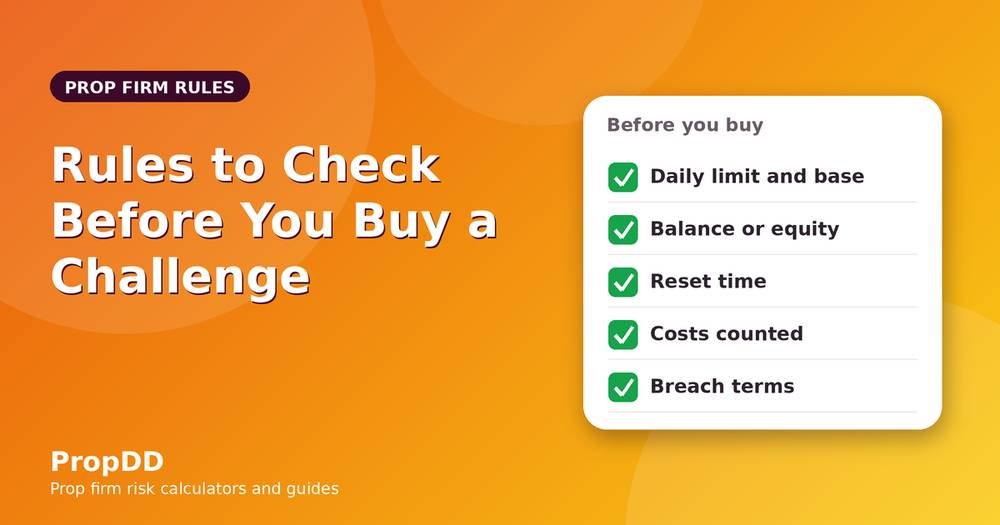
Before you pay for a challenge, spend half an hour with the real terms. This article is the list I’d work through, in the order I’d work through it. None of it is about any one firm, since rules change and I’d rather you read the current ones than trust my summary. The goal is simply that nothing in the daily rule surprises you after you’ve paid.
Where to read, and what to ignore
Read the firm’s official rules page, its FAQ and its terms and conditions, in that order. Ignore forum posts, video descriptions and affiliate reviews for the actual numbers. They’re often out of date, and some are written by people who are paid when you buy. Keep a plain text file open and copy every relevant sentence into it as you go. When something is unclear, you’ll want the exact wording to quote to support.
1. The size of the daily limit
Is it a percentage or a fixed dollar figure? And is it the same for every account size and every phase? A five percent limit on a small account is a very different proposition from a five percent limit on a large one, mainly because the dollar amount changes how a loss feels, even when the percentage is identical. Some firms also tighten the limit once you’re funded. Write down both numbers, evaluation and funded.
2. What the percentage is applied to
This is the single most misunderstood detail. The firm might take the percentage from your initial account size, from your balance at the start of the day, or from your equity at the start of the day. When you’re flat, they all look the same. When you’re in profit, they diverge, and the divergence grows as your account grows. The arithmetic is in how to calculate max daily loss.
3. Balance or equity
Does the daily loss count open trades? An equity-based rule does, and it’s the stricter one. If the rules say nothing, assume it does. The difference can decide a day, as the examples in balance-based versus equity-based daily drawdown show.
4. The reset time
When does one trading day end and the next begin, and in which time zone? If it’s server time, find out what the server offset is and whether daylight saving moves it. A reset in the middle of your trading session means you effectively get two days in one sitting, or one very long one. The details are in the daily drawdown reset time guide.
5. Which costs count
Spreads are always in your equity. Commissions and swaps may or may not be counted toward the daily loss, depending on the firm. Look for the words commission, swap and fees near the daily rule. We unpack this in swaps and commissions.
6. The overall limit and whether it trails
The daily rule is only half the story. Is the overall drawdown static, or does it follow your highest balance or equity? Does a trailing floor ever lock? A friendly overall rule can make a tight daily one livable, and the reverse is also true. See static versus trailing drawdown for how to tell the types apart, and daily versus overall drawdown for how the two work together.
7. What happens when you breach
Closed for good? Paused until tomorrow? Reset available for a fee? It sounds like a detail, and it changes how much risk you’re comfortable with. Also check what happens to profits you’ve already earned on a funded account: some firms void them on a breach, which is a very different kind of loss from a failed challenge.
8. News trading rules
Many firms limit trading around major releases, particularly on funded accounts. The usual forms are a time window around listed events in which you can’t open or close trades, or a rule that profits made in that window don’t count. This is separate from drawdown, and breaking it can end the account all the same. See news trading and daily drawdown for how slippage interacts with it.
9. Weekend and overnight holding
Some firms ban weekend holding. Others allow it but warn about gaps. If your style involves holding trades for days, this one rule can make a firm unusable for you, so check it before you check the price.
10. Trading style restrictions
Look for sections on expert advisors, copy trading, high-frequency strategies, hedging and trading across accounts. The restrictions differ widely, and a strategy that’s fine at one firm can be prohibited at another. If you use any automation, read this section twice.
11. Time limits and minimum days
Some challenges have a maximum duration, others none. Some require a minimum number of trading days. If there’s a time limit, your pacing changes: a loose deadline lets you risk less per trade, while a tight one pushes you toward the kind of rushing that causes breaches. Our plan for passing a challenge with small daily risk works best when there’s room to be patient.
12. What changes after you pass
Do the limits change? Does the reset time? Does the base change once you’re funded or after a payout or scaling step? The answers shape your whole plan, and they’re easy to miss because they live in a different section of the terms. More on that in scaling plans and drawdown on funded accounts.
A comparison table you can copy
| Item | Firm A | Firm B |
|---|---|---|
| Daily limit and base | ||
| Balance or equity | ||
| Reset time (my time zone) | ||
| Costs counted? | ||
| Overall limit type | ||
| News rule | ||
| Weekend holding | ||
| Breach consequence |
Fill it in for every firm you’re considering. By the time you’ve finished two, you’ll know which one fits your style, and you’ll have noticed how often the answers are hard to find. That alone is informative.
Red flags
Rules that contradict each other between pages. Examples missing from the drawdown explanation. A support team that answers a precise question with a generic link. Terms that can be changed without notice and no archive of old versions. Pressure to buy before a discount expires. Any one of these isn’t proof of a problem, but several together are a reason to walk away.
Test support before you pay
Send one specific question: “Is the daily loss limit calculated on start-of-day equity or on the initial balance, and what time does it reset?” See how long they take, and whether the answer is clear. It’s a free preview of how they’ll behave if something goes wrong later. Keep the reply with your notes, because rules and staff both change.
Do your own maths before you buy
Once you know the rule, plug it into the drawdown calculator for the account size you’re considering, and see how many losing trades fit inside the daily limit at the risk you’d normally take. If the number is below five or so, the account is probably too small for your style, or the rule too tight. Better to learn that on paper than with a fee already spent.
Keep records
Save a PDF or screenshot of the rules page on the day you buy, with the date visible. Terms change, and a record of what applied when you signed up is useful if there’s ever a dispute. It takes a minute, and it’s the sort of thing people only regret not doing.
Reading a rule sentence slowly
Here’s the kind of sentence you might find in a rulebook, written by me for illustration: “The maximum daily loss is 5% of the account’s starting balance for the day, measured on equity, and resets at 00:00 server time.” Take it apart. “Starting balance for the day” suggests the base moves with your balance, not the initial size. “Measured on equity” means floating profit and loss count. “00:00 server time” means you need the server’s offset from your own clock, and daylight saving rules for that server. One short sentence, four things to look up. If a rulebook gives you only half a sentence, you can assume the other half is somewhere else, and finding it is part of the job.
Questions people forget to ask
Beyond the headline rules, a few questions come up late and annoy people. Does a trade open across the reset count on both days? What’s the minimum lot size, and does it make small risk per trade impossible on a small account? Are there restrictions on the number of open positions or total lots? Can I trade during the first and last minutes of the week, when spreads are wide? Does the dashboard show my daily loss in real time, and what time zone does it use? Send these along with your first question if the rulebook is silent. Good support teams answer them in one go.
Keeping your notes alive
Treat your notes as a living document. Put the date at the top. When you check the rules again in three months, add the new date and highlight what changed. Keep the dated screenshots in a folder with the firm’s name. It sounds fussy, and it’s genuinely useful, because rules shift quietly and the version you signed up under is the one you want to point to.
When to walk away
If a firm’s rules need three emails to decode, if the daily limit looks generous but the base and the equity treatment make the real room much smaller, or if your own style, say holding over weekends or trading news, is banned, then the firm isn’t wrong, it just isn’t for you. There are many firms. There’s no prize for forcing a style into a rulebook that doesn’t suit it, and the fee is the same whether you fail on day one or day thirty.
A word on reviews and affiliate links
Most “best prop firm” lists earn money when you click through and buy, and that doesn’t automatically make them wrong, but it does mean they rarely lead with the awkward rules. Treat them as a way to discover names. Then do the reading yourself, from the source, with a pen. The firms that behave well tend to survive this kind of scrutiny easily, and the ones that don’t tend to reveal themselves quickly.
Make the decision with a cool head
Don’t buy on the day you read a flashy thread or in the last hour of a discount. Sleep on it, fill in the table, and ask yourself whether you’d still choose the firm if there were no discount at all. A calm purchase, after reading the rules properly, is one of the cheapest ways to improve your odds before you’ve placed a single trade.
Frequently asked questions
Which rule matters most?
Probably the base the daily percentage applies to, together with whether open trades count. Between them they decide how much room you really have.
Can I trust a comparison site?
Use it to discover firms, not to learn their rules. Always confirm the numbers on the firm’s own pages, since comparison sites can lag behind changes and may earn commission.
What if the rules and the support answer disagree?
Ask for the answer in writing and for the relevant sentence in the terms. If they won’t give it, treat that as a reason to reconsider.
How often do rules change?
Often enough that you should re-read them every few months, and always before a new purchase or a scaling step.
The short version
Check twelve things: the limit, the base, balance or equity, the reset time, costs, the overall limit, breach terms, news rules, weekend holding, style restrictions, time limits and what changes after you pass. Write the answers down, ask support one precise question and run the numbers through the calculator. For the rule underneath all of this, start with the prop firm max daily drawdown explained, and for free background reading on trading basics, BabyPips is a good place to keep learning. If you want a neutral definition of the term itself, see Investopedia’s drawdown entry.