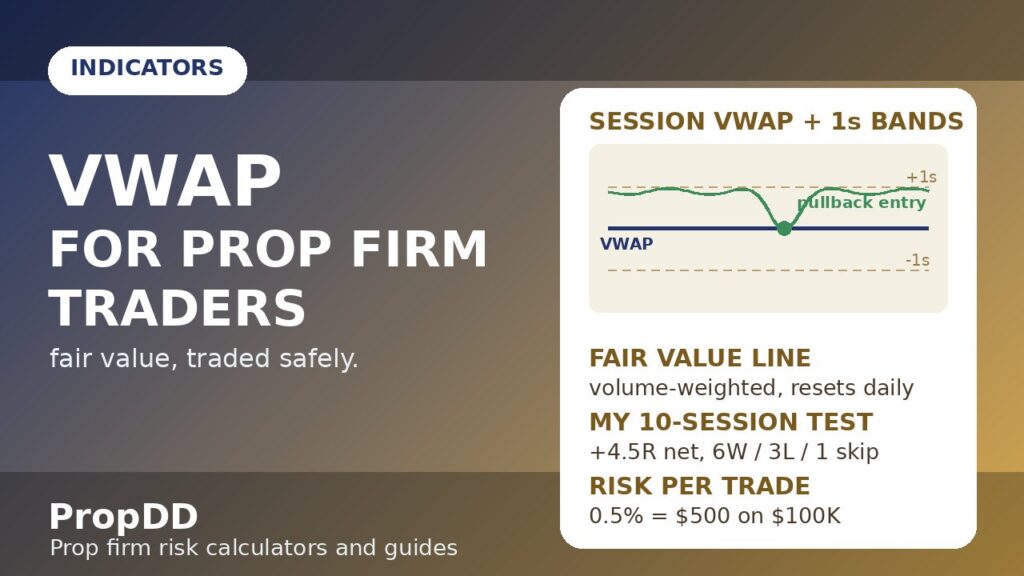
I ignored VWAP for my first year of funded trading because it looked like a moving average wearing a lab coat. Then one Tuesday in the New York session, EURUSD ripped 40 pips above the day’s VWAP on thin volume, rolled over, and bled straight back to the line — and I watched three traders in my accountability group short the top while I sat flat, because my EMA said “trend still up”. They banked the mean reversion. I banked a lesson: VWAP is the one intraday line that tells you where the real money actually traded today, not where the last tick printed. On a prop firm account, where every pip of drawdown is borrowed time, that distinction is the difference between a planned pullback entry and a chase. This guide is everything I now do with VWAP on funded capital: what it measures, the formula worked by hand, the exact settings, the four signals I trade, a 10-session test with real numbers, and the mistakes that turn this innocent line into a breach machine.
In this article
- What VWAP Actually Measures (and the One Thing It Can't Do)
- The VWAP Formula, Worked by Hand
- The Settings I Use on a Funded Account
- How I Read VWAP's Four Signals
- I Tested It: 10 VWAP-Pullback Sessions on EURUSD
- The Mistakes That Turn VWAP Into a Breach Machine
- How VWAP Fits Prop Firm Rules
- Frequently Asked Questions
What VWAP Actually Measures (and the One Thing It Can’t Do)
VWAP — volume weighted average price — is the average price of everything traded so far today, with each price weighted by how much volume changed hands there. A 5-pip spike on tiny volume barely moves it; an hour of heavy two-way business at one level drags it there and keeps it there. That is why institutions use it as an execution benchmark: a desk that bought below VWAP got a good fill, one that bought above it overpaid. For a funded intraday trader, VWAP is the market’s own fair-value line for the session — the price the day’s business agrees on.
The one thing it cannot do is predict. VWAP is a historical average, not a forecast. It will not tell you whether price breaks up or down from here; it tells you where the bulk of today’s volume already agreed price was fair. I use it the way a carpenter uses a chalk line: not to decide what to build, but to check whether the cut is straight. Every signal in this guide pairs VWAP with a trigger — a candle, a level, a rejection — because the line alone is context, never a trade.
The VWAP Formula, Worked by Hand
You will never calculate VWAP by hand live — the indicator does it tick by tick — but doing it once by hand is what stops you treating it as magic. The formula accumulates from the session open and resets every day, which is exactly why it is an intraday tool and not a trend indicator for your H4 charts.
VWAP = Σ (Typical Price × Volume) ÷ Σ (Volume), accumulated from the session open
Typical Price = (High + Low + Close) ÷ 3
Bands: VWAP ± (1 or 2 × rolling standard deviation of price)
Worked: three 5-minute bars — (1.0850, vol 100), (1.0860, vol 300), (1.0845, vol 100). Numerator = 1.0850×100 + 1.0860×300 + 1.0845×100 = 108.50 + 325.80 + 108.45 = 542.75. Denominator = 500. VWAP = 1.08550. Notice the heavy 300-volume bar at 1.0860 pulls the average up toward itself — volume decides the weighting, not recency.
Two honest footnotes before you touch the settings. First, forex has no central volume — your MT5 VWAP indicator uses tick volume as a proxy. Tick volume correlates well with real volume on majors, but it is a proxy, and on exotic pairs in thin hours it can lie. Second, MT5 ships with no built-in VWAP; you will add a session-VWAP indicator yourself. Both facts matter less than traders think — what matters is using the line consistently, the same way, every session. For a deeper reference on the formula and its institutional roots, this VWAP explainer walks through the calculation with worked examples.
The Settings I Use on a Funded Account
VWAP has almost no settings to argue about — that is one of its virtues on a prop account, where indicator-fiddling is usually procrastination. There are three decisions, and I made each of them once and never touched them again:
| Setting | My choice | Why it fits a funded account |
|---|---|---|
| VWAP type | Session VWAP, reset at day open (00:00 server) | Matches the daily loss limit cycle — one day, one fair-value line, one clean reset |
| Standard deviation bands | 1σ and 2σ shown, entries only at the line or 1σ | 2σ touches are lottery tickets; the line and 1σ are where funded-account math survives |
| Anchored VWAP | Anchored to red-folder news spikes and swing origins only | Gives a multi-day fair value after events that reprice the market; not for everyday use |
| Timeframe | M15 and H1 for signals, never below M5 | VWAP on M1 is noise with a fancy name; the spread cost alone breaches challenges |
| Volume source | Tick volume (MT5 default) | Honest proxy on EURUSD/GBPUSD/XAUUSD; I distrust it on exotics and size down there |
The anchored variant deserves one extra sentence because it is the only “advanced” VWAP I use. After a red-folder release reprices EURUSD 80 pips in a minute, the session VWAP is polluted by the spike. Anchoring a fresh VWAP to the news candle gives me the new fair value the market is actually trading around — and it keeps me from shorting “overbought” into a repriced trend, which is how I lost $380 in March.
How I Read VWAP’s Four Signals
Four setups, in the order I trade them. Each one has the same skeleton: VWAP provides the location, a candle provides the trigger, the daily loss limit provides the invalidation. No trigger, no trade — the line by itself is never enough.
| Signal | The read | Trigger and invalidation |
|---|---|---|
| 1. Trend pullback to VWAP | Price holds above VWAP all session = institutional bid underneath; the line is dynamic support | Enter on a bullish rejection candle (pin bar, engulfing) at the line; stop 5–10 pips beyond the wick, sized to 0.5% risk |
| 2. VWAP as bias filter | Above VWAP: longs only. Below VWAP: shorts only. Flat at VWAP: no bias, no trade | Not an entry — a permission slip. It killed half my counter-trend losses the month I adopted it |
| 3. First touch of the 1σ band | Stretch from fair value on rising volume = exhaustion, not strength | Enter on the rejection candle back inside the band; stop beyond the band extreme; target the VWAP line |
| 4. VWAP reclaim after a fake break | A break of VWAP that closes back through within 2–3 candles = trapped breakout traders | Enter on the reclaim close; stop beyond the fake-break extreme; this is the highest-conviction signal I take |
Signal 1 is the workhorse and the only one I take more than twice a week. Signals 3 and 4 are sniper setups — two or three a month, but the win rate justifies the patience. Signal 2 is not a trade at all; it is the filter that stops me donating money to the wrong side of the line. If you trade pin bars already, signal 1 will feel familiar — it is the same rejection logic as my pin bar reversal strategy, with VWAP supplying the level the wick has to touch.
I Tested It: 10 VWAP-Pullback Sessions on EURUSD
For two weeks in September I traded only signal 1 — trend pullbacks to the session VWAP on EURUSD, M15, London and New York sessions only. Rules: price above VWAP for the bias, entry on a bullish pin bar or engulfing candle touching the line, stop beyond the wick, 0.5% risk on a $100,000 account ($500), target 2R or the 1σ band, whichever came first. I ran every entry’s sizing through my pin bar reversal calculator — the wick check confirmed the candle, and the calculator set the entry, stop and lot size from the risk budget. Ten sessions, ten trades, no discretion:
| # | Session | VWAP touch | Entry → Stop | Size | Result |
|---|---|---|---|---|---|
| 1 | London | 1.0852, pin bar | 1.0854 → 1.0846 | 0.62 lots | +2.0R (+$1,000) |
| 2 | New York | 1.0871, engulfing | 1.0873 → 1.0864 | 0.55 lots | +1.4R (+$700) |
| 3 | London | 1.0838, pin bar | 1.0840 → 1.0831 | 0.55 lots | −1.0R (−$500) |
| 4 | New York | 1.0890, pin bar | 1.0892 → 1.0882 | 0.50 lots | +2.0R (+$1,000) |
| 5 | London | 1.0852, doji | Calculator verdict: SKIP (wick 1.8× body) | No trade | |
| 6 | New York | 1.0915, engulfing | 1.0917 → 1.0906 | 0.45 lots | −1.0R (−$500) |
| 7 | London | 1.0888, pin bar | 1.0890 → 1.0880 | 0.50 lots | +2.0R (+$1,000) |
| 8 | New York | 1.0932, pin bar | 1.0934 → 1.0923 | 0.45 lots | +1.1R (+$550) |
| 9 | London | 1.0905, pin bar | 1.0907 → 1.0898 | 0.55 lots | −1.0R (−$500) |
| 10 | New York | 1.0944, engulfing | 1.0946 → 1.0937 | 0.55 lots | +2.0R (+$1,000) |
Nine trades taken, one skipped by the calculator’s shape check (trade 5 — a doji masquerading as a pin bar that would have lost). Six wins, three losses, +4.5R net, +$3,750 on the $100,000 account — and not a single day’s drawdown beyond $500, because the sizing was mechanical. The honest caveats: ten trades prove nothing statistically, September trended cleanly (VWAP pullbacks love trends and hate chop), and I skipped two additional touches that happened within 30 minutes of red-folder news per my rules. But the test proved the process point that matters for this guide: VWAP plus a trigger plus fixed sizing is a complete, breach-proof intraday plan. My personal daily stop sat at $2,500 all fortnight and was never touched — the worst day was −$500.
The Mistakes That Turn VWAP Into a Breach Machine
VWAP looks harmless, which is exactly why it breaches accounts. Every one of these cost me or someone I mentor real money:
| Mistake | Why it breaches funded accounts |
|---|---|
| Trading every touch of the line | VWAP gets touched a dozen times on chop days; each “harmless” 0.5% risk stacks into a 3% day. The trigger candle is mandatory, not optional |
| Using VWAP on H4 or Daily charts | It resets daily — on higher timeframes it is a flat, meaningless line. VWAP is intraday or it is nothing |
| Forgetting the reset | Yesterday’s VWAP level is not support today. I have seen traders draw “VWAP support” from last Tuesday and average into a trend day |
| Counter-trend band fades without volume | Shorting the 2σ band in a news-driven trend is stepping in front of institutional flow. Bands stretch; accounts don’t |
| Widening the stop when price rides the wrong side | “It’s extended, it has to come back” — the four most expensive words in intraday trading. The bias filter exists to prevent exactly this |
The common thread: every mistake is really a position-sizing or bias mistake wearing a VWAP costume. The indicator didn’t fail in any of these — the trader’s plan around it did. That is why the next section, the prop firm fit, matters more than any signal.
How VWAP Fits Prop Firm Rules
VWAP earns its place on a funded chart for three structural reasons, not just the signals. First, it enforces the daily loss limit by construction: every signal in this guide has its stop defined before entry, sized from the same 0.5% risk, which means the worst possible day is arithmetically capped — run the numbers on my max daily drawdown calculator and you will see the plan cannot breach a 5% daily limit even on a five-loss day. Second, it satisfies consistency rules: same setup, same size, same sessions — the EMA trend filter I pair it with never changes either, so no single day can spike the account. Third, it has a built-in news rule: VWAP whipsaws violently around red-folder releases as volume spikes distort the average, so the 30-minute blackout is not optional here — it is part of the indicator’s operating manual.
One last fit note: VWAP keeps you trading with the day’s institutional flow instead of against it, and flow-following is statistically kinder to trailing drawdown than counter-trend heroics. My trailing floor survived September untouched while running this plan. The indicator did not make me profitable — the structure around it did. But the structure is a lot easier to hold when one honest line on the chart keeps reminding you where fair value actually is.
Frequently Asked Questions
What is VWAP in simple terms?
The volume weighted average price: the average price of everything traded today, weighted by volume. Think of it as the market’s agreed fair price for the session — institutions benchmark their fills against it, and intraday traders use it as dynamic support/resistance and a trend-bias filter.
What are the best VWAP settings for prop firm trading?
Session VWAP resetting at the day open, 1σ and 2σ standard deviation bands shown, entries at the line or first 1σ touch only, on M15–H1 timeframes. Add an anchored VWAP for post-news repricing. There is almost nothing to optimise — consistency of use beats clever settings.
Does VWAP work on MT5 for forex?
Yes, with two caveats: MT5 has no built-in VWAP so you add a session-VWAP indicator, and forex has no central volume so the indicator uses tick volume as a proxy. On majors the proxy is reliable; on exotics in thin hours, trust it less and size down.
Is VWAP better than EMA for funded accounts?
They do different jobs. VWAP is a session fair-value line that resets daily — ideal for intraday entries and bias. EMA is a persistent trend filter that works across timeframes. I use both: EMA for the higher-timeframe regime, VWAP for the intraday execution. Neither replaces the other.
Can VWAP alone keep me inside the daily loss limit?
No indicator can — only position sizing does that. What VWAP gives you is a plan where every signal has a pre-defined stop and fixed risk, which makes the daily limit mathematically enforceable. Pair it with a personal daily stop below the firm’s limit and the arithmetic holds.
Why did my VWAP trade fail on a news spike?
Because volume spikes during red-folder news distort the average and price whipsaws across it. VWAP is a fair-value tool for normal auction conditions, not for repricing events. The rule is a 30-minute blackout around high-impact news — no exceptions, no “just this once”.
Risk note: this guide is educational content about an indicator, not financial advice. Backtest any VWAP plan on your own data, respect your firm’s daily loss limit on every trade, and never trade money you cannot afford to lose.


4 comments
[…] the way an RSI reading does. And it does not measure volume or institutional flow, the way VWAP does. A green line in a weak, drifting market is still a green line, and a trader who treats every […]
[…] My cap is two ribbon positions at a time, on uncorrelated pairs, each sized from its own stop. The VWAP funded-account article covers the intraday fair-value side of the same discipline, and pairing a daily VWAP bias with an […]
[…] one. The Weighted Moving Average guide weights bars by recency too, with the same blind spot. The VWAP guide is the closest relative: it is also volume-weighted, but it resets at the start of every session […]
[…] already covered session VWAP in my VWAP guide for prop firm traders, and I still use it every morning. It is the right tool for one job: judging whether today, right […]