The trade that taught me turtle soup cost me $612 in eleven minutes. It was a Thursday in March, GBPUSD had spent two days grinding toward the same swing high, and my plan was textbook: buy the breakout, stop below the level, target 2R. The breakout came, my buy stop filled at the top of the candle — and then price printed a 4-pip wick above the high, reversed, and collapsed 60 pips straight down without looking back. My stop died at -$612, the day ended early, and the account that was supposed to carry me to payout went quiet.
I had been eaten. That is the whole point of the turtle soup: somebody’s breakout becomes somebody else’s liquidity, and the reversal that follows is one of the most repeatable moves in intraday forex. I spent the next six weeks studying it instead of cursing it, then another month trading it on a $100k demo with fixed rules. This guide is that plan: what a turtle soup actually is, the 6-rule checklist I use to trade it, the position-sizing maths that keeps it inside a prop firm daily loss limit, my 10-trade demo log, and exactly when the setup fails — because fading breakouts is the fastest way to breach a drawdown rule if you do it without a filter. You can run the numbers on the Turtle Soup Calculator page.
What a Turtle Soup Actually Is
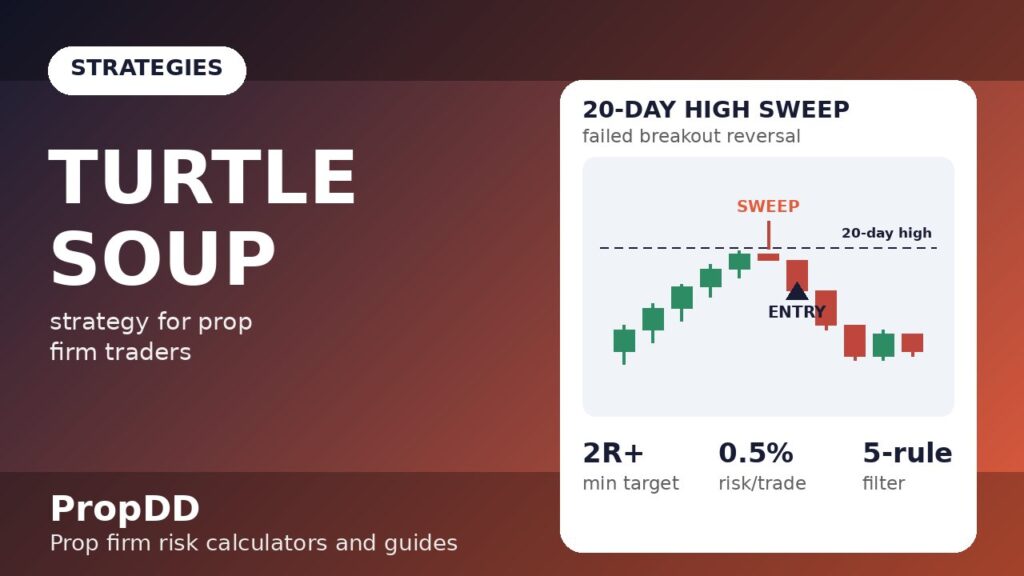
The name comes from the Turtle Traders of the 1980s: their breakout system bought 20-day highs, and the soup was the joke about what happened to the turtles who got caught when the breakout failed. A turtle soup is a failed breakout that reverses hard enough to become a trade of its own. The structure is always the same: price approaches a well-defined liquidity pool (a 20-day high or low, equal highs, a round number), sweeps through it, fails to hold, and reverses with displacement.
The reason it matters for prop firm traders is the risk-reward geometry. The stop sits just beyond the sweep extreme — a few pips past the wick that took the liquidity — while the target is the opposing liquidity pool, often 2R to 4R away. A turtle soup turns the worst moment of a breakout trade into the best entry of a reversal trade, with defined risk from the first second. That is the opposite of how most traders use breakouts on funded accounts: wide stops, hope-based targets, and a position that can drift into the daily loss limit while they wait.
The 20-period version of the rule is documented in the Turtle Soup indicator documentation on TradingView, which traces the setup to the Street Smarts framework: a new 20-period low at least four sessions after the last one, a buy stop just above it, and the stop one tick below the day’s low. My version below adapts that skeleton to intraday liquidity pools and prop firm risk rules.
Why Breakout Chasers Keep Feeding the Soup
Every turtle soup needs fuel, and the fuel is always the same: stops. When price pushes into a 20-day high, two groups of orders sit there waiting to be harvested — the buy stops of breakout traders and the sell stops of everyone who shorted the level earlier. Smart money (or just the larger order flow of the session) sweeps both, fills at good prices, and reverses. If you have ever watched a level break by 3 pips and then watched price run 50 pips the other way, you have watched the whole mechanism.
| What the breakout chaser does | What the turtle soup trader does |
|---|---|
| Buys the break of the 20-day high on the first push | Waits for the sweep, then watches for the failure |
| Stop 15-25 pips wide, placed “safely” below | Stop just beyond the sweep wick, 8-14 pips total |
| Target is a guess — next resistance, maybe 1R | Target is the opposing liquidity pool, planned for 2R+ |
| Enters while momentum is hot, exits in panic | Enters after the failure prints, exits at the plan |
| One failed breakout can cost half a day’s risk | One failed soup costs 0.5% — the rule, not the hope |
I traded the left column for my first year. My London breakout guide covers the session-high version of this trap — the Asian-range edge that sweeps stops into the London open — and it is the same pool of liquidity, just a different clock. The soup is the intraday answer to it.
My 6-Rule Turtle Soup Checklist
A turtle soup without rules is just revenge trading in a costume. Mine has six checks, and I take the trade only when all six pass. The first three define the setup, the last three define the execution — and rule six is the one that keeps the setup legal on a funded account.
| Rule | The check | My number |
|---|---|---|
| 1. Liquidity pool | A visible 20-day high/low, equal highs/lows, or round number that the whole market can see | At least 2 touches in the last 5 sessions |
| 2. The sweep | Price pushes through the level, takes the stops, and CLOSES back inside the range on the entry timeframe | Wick beyond the level: 2-15 pips, close back inside |
| 3. Displacement | The next 1-2 candles move away from the level with real bodies — the failure is confirmed, not hoped for | Close at least 50% of the sweep candle’s range away from the level |
| 4. Entry | Market entry on the displacement close, or limit at the swept level on a shallow retest | No chasing more than 40% of the displacement candle |
| 5. Stop and target | Stop beyond the sweep extreme; target the opposing liquidity pool | Stop 8-14 pips; minimum 2R to the target, else skip |
| 6. Session filter | Trade only during real liquidity hours, when sweeps actually mean something | London open to New York lunch only; no Asian chop |
Rule 2 is where most soup traders fail: they fade the first touch of the level instead of the sweep. Fading the level itself is just counter-trend guessing — the edge only exists after the stops have been taken. My break-of-structure guide explains the confirmation-first habit that rule 3 comes from: the structure has to prove the failure before I risk a dollar on it.
Position Sizing Under a 5% Daily Loss Limit
On a $100,000 funded account with a 5% daily loss limit, the day ends at -$5,000. My per-trade risk for turtle soups is 0.5% — $500 — which means ten straight losers would end the day, and my demo log below never got past three. The sizing is fixed and mechanical, because a soup with emotional size is how a 12-pip stop becomes a breached daily limit.
The formula box I keep taped to my monitor:
| Step | Maths | Worked example ($100k, 0.5% risk) |
|---|---|---|
| 1. Risk dollars | Account × risk % | $100,000 × 0.005 = $500 per trade |
| 2. Stop in pips | Sweep wick + 2-pip buffer | 12-pip wick + 2 = 14 pips |
| 3. Lot size | $500 ÷ (stop pips × $10 per pip per lot) | $500 ÷ 140 = 3.57 → 3.5 lots |
| 4. Day check | Daily limit ÷ risk per trade = max losers | $5,000 ÷ $500 = 10 losers before the day ends |
| 5. Target check | Skip the trade if target < 2R | 14-pip stop needs a 28-pip minimum target |
I run these numbers through my max daily drawdown calculator before every session so the lot size is settled before the first sweep prints — deciding size mid-setup is how traders round up. If the maths says the 2R target does not reach the opposing pool, I skip the trade; a soup with a 1.4R target is a coin flip with extra steps.
I Tested It: 10 Turtle Soups on a $100k Demo
Over four weeks in April and May I logged ten turtle soups on a $100k demo, same rules every time, 0.5% risk per trade, stops beyond the sweep extreme, targets at the opposing pool. The sizing for every trade came from the calculator link above, and the session filter kept me out of three more setups that printed in dead Asian hours (two of those would have stopped out — the filter earned its keep).
| # | Pair / pool swept | Stop (pips) | Lots | Result | R |
|---|---|---|---|---|---|
| 1 | GBPUSD 20-day high | 14 | 3.5 | +$1,232 | +2.5R |
| 2 | EURUSD equal highs | 11 | 4.5 | +$1,485 | +3.0R |
| 3 | XAUUSD round number 2400 | — | — | Skipped (1.6R) | 0R |
| 4 | USDJPY 20-day low | 13 | 3.8 | -$494 | -1.0R |
| 5 | GBPUSD Asian high | 10 | 5.0 | +$1,050 | +2.1R |
| 6 | EURUSD 20-day low | 12 | 4.2 | +$1,386 | +2.8R |
| 7 | US30 round number | — | — | Skipped (news window) | 0R |
| 8 | GBPUSD equal lows | 9 | 5.5 | -$495 | -1.0R |
| 9 | EURUSD 20-day high | 14 | 3.5 | +$1,715 | +3.5R |
| 10 | USDJPY equal highs | 11 | 4.5 | +$980 | +$2.0R |
Eight trades taken, two skipped, six winners and two losers: net +12.9R, about $6,350 on the $100k demo. Trade 9 was the cleanest soup of the month — a 6-pip sweep of the EURUSD 20-day high at the London open, a displacement candle that closed 11 pips back inside, and a 49-pip run to the overnight low. Trade 4 was the honest loss: the sweep was real, the displacement printed, and then a surprise headline reversed it straight into my stop. That is the soup’s tax — roughly one in four fails cleanly, and the maths only works if you pay it without doubling the next size.
When Turtle Soup Fails
The soup fails in predictable ways, and every one of them is visible before you enter if you know what to look for. The dangerous failure is not the clean stop-out (that is priced in at 0.5%); it is the almost-soup that tempts you to bend a rule.
| Failure mode | What it looks like | The fix |
|---|---|---|
| The real breakout | Price sweeps, pulls back 5 pips, then rips through again with volume — the level was a pause, not a top | Rule 3: no displacement, no trade. Take the -1R only when all rules passed |
| The shallow retest trap | You wait for a retest to the level; price retests 3 pips deep and runs without you | Rule 4: market entry on displacement is allowed — chasing is not |
| News-driven sweep | A red-folder release sweeps the level with 40-pip wicks; your 14-pip stop is decoration | No soups 30 minutes either side of high-impact news — the news-trading article’s blackout, applied here |
| Asian chop soups | Thin liquidity prints textbook sweeps that reverse and re-reverse twice before London | Rule 6: session filter is a rule, not a suggestion |
| The widened stop | You move the stop “one more candle” past the wick and turn 0.5% risk into 1.2% | Size is set before entry; a moved stop is a new trade that fails rule 5 |
The widened-stop row is the one that breaches funded accounts. My pin bar reversal guide covers the rejection-candle read that rule 3 relies on — a soup with a proper pin bar at the sweep extreme fails less often than one built on a doji in chop, and my log backs that up: both losers printed on indecisive displacement candles I should have weighted down.
How Turtle Soup Fits Prop Firm Rules
Turtle soup is a prop-firm-friendly strategy for one reason above all: the risk is small, known, and capped before the trade exists. A 0.5%-risk trade with a 9-14 pip stop cannot threaten a 5% daily limit by itself, which means the strategy’s failure mode is a slow bleed of small losers, not a single account-ending candle. Three things keep it compliant in practice.
First, the consistency rule: soups produce lumpy returns — trade 9’s +3.5R day can easily become your best day of the month, and some firms cap your best day at 30-40% of total profit. I track my best-day share weekly with the consistency rule calculator and shrink size if one soup day starts carrying the month. Second, the news blackout: soups during high-impact releases are not the same setup — the sweep wicks triple and the stop math breaks. Third, the session filter doubles as an overtrading filter: London-to-New-York-lunch is a four-hour window, which means two soups a day is a busy day, and the strategy physically cannot generate the trade count that breaches overtrading flags.
One caution from my kill zone guide: turtle soups cluster at session opens, when liquidity is deepest and sweeps are most deliberate. If your firm restricts trading around specific session events, the same filter applies here — the setup at 08:30 New York time during NFP week is a different animal from the setup on a quiet Tuesday.
Frequently Asked Questions
Is the turtle soup strategy allowed on prop firm accounts?
What timeframe works best for turtle soups?
How is a turtle soup different from a pin bar reversal?
Can I trade turtle soups on gold or indices?
What win rate does turtle soup need to be profitable?
Should beginners trade turtle soups on a challenge?
Risk disclaimer: Trading foreign exchange and CFDs carries a high level of risk and may not be suitable for all investors. Prop firm accounts add rule-based termination risk on top of market risk. The results above are from a demo account and are not a promise of future performance. Never trade with money you cannot afford to lose.



5 comments
[…] traders have a whole strategy built on hunting my stop — I wrote about their playbook in my turtle soup strategy guide, and every triangle breakout trader should read it as the other side of this trade. The […]
[…] on this site. My kill zone strategy maps the time windows where each act usually plays out. The turtle soup strategy trades the manipulation act itself. PO3 is the bigger frame containing both: it tells you which […]
[…] the rule I will never bend again. If you want a related trap pattern with even tighter rules, the turtle soup strategy trades the same idea at previous-day extremes, with its own entry […]
[…] Turtle Soup […]
[…] you trade the turtle soup strategy, do not run both systems on the same market on the same day. A breakout that fails is a soup trade, […]