I shorted a spinning top because it looked like a top, and that is the exact mistake this strategy exists to prevent. EURUSD had climbed for five days into a resistance level I had marked all week, and then printed a candle with a tiny body and long shadows on both sides. Buyers had pushed higher and failed, sellers had pushed lower and failed, and price closed almost exactly where it opened. I read that as exhaustion, sold at the close, and watched the next candle break above the spinning top’s high and stop me out for 500 dollars. The candle had not told me to sell. It had told me nobody was in control, and I had invented a direction for it. A spinning top is an indecision candle, not a reversal candle, and the funded-account way to trade it is to let the next candle choose the direction, then trade the break with a stop beyond the other side. In this guide I set out the full rules: the setup, the validity test, the confirmation entry, the stop and the targets, the session and news filter, the position-sizing maths under a 5,000-dollar daily loss limit, a five-trade log, and the filter test that shows what happens when you trade every spinning top instead of only the confirmed ones at levels. Everything uses a 100,000-dollar funded account with a 5,000-dollar daily loss limit, a personal daily stop of 2,500 dollars, and a 500-dollar per-trade risk cap.
In this article
A spinning top is easy to confuse with its neighbours, so the distinctions matter before the rules do. The dragonfly doji guide covers a candle with a long lower wick and almost no body, a one-sided rejection at a low. A spinning top has long shadows on both sides and a small but visible body, which makes it neutral rather than directional. The outside bar guide covers the opposite construction: a candle that engulfs the previous range entirely. A spinning top is a small-range candle, not a range-engulfing one, and it earns its trade only when the next candle breaks its high or its low. The general anatomy is set out in BabyPips’ spinning top definition: a small real body with long upper and lower shadows, signalling indecision, with the colour of the body carrying no real meaning.
What a spinning top actually is
A spinning top is a single candle where buyers and sellers both had their turn and neither kept control. The real body, the distance between open and close, is small. The upper shadow, from the body to the high, is long. The lower shadow, from the body to the low, is long. Price travelled far in both directions and finished near where it started: a draw, not a win for either side. Location gives the draw its meaning. A spinning top after a five-day climb into resistance means the buyers who carried the trend could no longer push price into new ground uncontested. A spinning top in the middle of a flat range means nothing at all, because flat ranges print indecision candles all day. That is the first rule of this strategy and the one most traders skip: a spinning top without a level is just noise. My validity test is mechanical, so I cannot talk myself into a borderline candle. The body must be no more than 30 percent of the candle’s total high-to-low range, each shadow must be at least twice the body, and the candle must sit at a marked level: a prior swing high or low, a round number, or a resistance or support zone that has held at least twice before. If any of those three checks fails, there is no trade, however pretty the candle looks.
| Validity check | Rule | Worked candle |
|---|---|---|
| Body size | At most 30 percent of the high-to-low range | 5 pips of a 50-pip range = 10 percent, passes |
| Upper shadow | At least twice the body | 15 pips vs a 5-pip body, passes |
| Lower shadow | At least twice the body | 30 pips vs a 5-pip body, passes |
| Location | At a level held at least twice before | Resistance tested twice across the five-day climb |
| Prior move | A clear trend into the level, not a flat range | Five-day climb into resistance |
The full rules: setup, entry, stop, targets
The setup starts the day before the trade. I mark my levels, then I wait for a trend to arrive at one of them and print a valid spinning top there. The entry never happens on the spinning top candle itself. I wait for the next candle to close beyond the spinning top’s high for a long trade, or below its low for a short trade, and that close is the confirmation. Entry goes two pips beyond the broken extreme, so a long enters at the high plus two pips and a short enters at the low minus two pips. The stop goes beyond the opposite extreme, so a long stops below the spinning top’s low and a short stops above its high, with the same two-pip buffer. The stop sits where the indecision story is proven wrong, beyond the full range of the candle. Targets are measured from the entry, not from the level. First target is one times the stop distance, where I close half the position. Second target is two times the stop distance, where I close the rest. A trade that reaches both targets banks 1.5R. A trade that fails at the first target still banks 0.5R if I move the stop to breakeven after the first target fills, which is my standing rule. Never trade the candle. Trade the break of the candle. That sentence is the whole strategy, and every loss in my journal from this pattern traces back to breaking it.
The session and news filter
Spinning tops print constantly, so the filter does most of the work. I only take entries in the London morning, roughly 08:00 to 12:00 London time, and the London to New York overlap, when ranges break with follow-through. The Asian session is excluded entirely: ranges are flat, spinning tops appear every hour, and breaks out of them reverse before lunch. I take no trade within 30 minutes either side of a high-impact release on either currency in the pair, because a news spike can break a spinning top’s high, trigger my entry, and reverse through my stop in the same minute, and no confirmation rule survives that. I take at most two spinning-top trades a day, and I stop after two losses or at the personal daily stop, whichever comes first. Friday afternoons are excluded for new positions, because weekend gap risk turns a well-placed stop into a suggestion. These filters are the point: a strategy built on a candle that appears daily becomes an overtrading machine without them.
The worked trade: breaking the top of the top
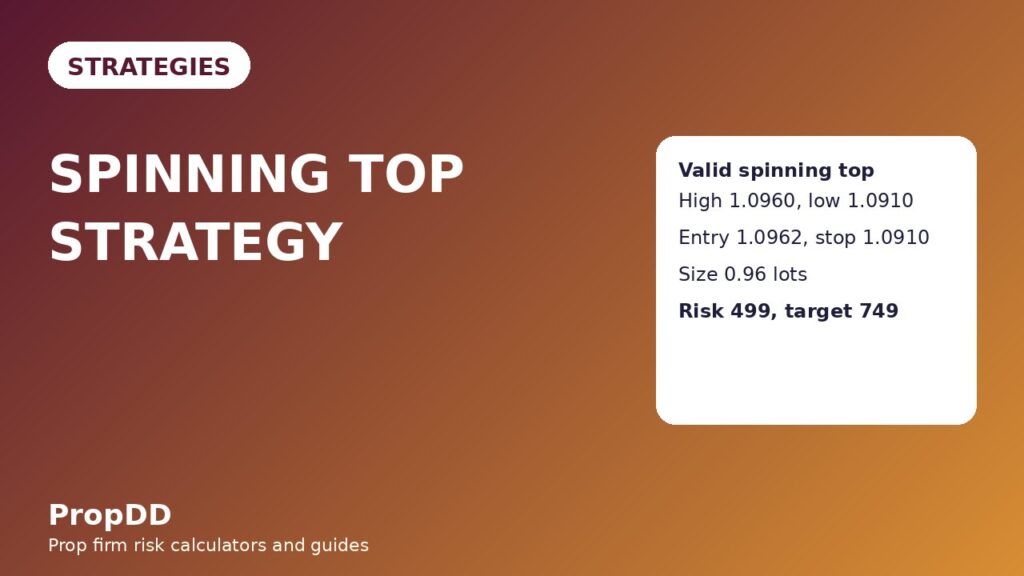
Here is a real-structure trade with the maths shown end to end. EURUSD climbs for five days into resistance and prints a spinning top: high 1.0960, low 1.0910, open 1.0940, close 1.0945. The body is 5 pips in a 50-pip range, 10 percent, and both shadows are at least twice the body, so the candle passes the validity test at a twice-tested resistance level. The next hourly candle closes above the high, confirming the long side. Entry is the high plus two pips, 1.0962. Stop is below the low, 1.0910, which is 52 pips. Size equals risk divided by stop distance times pip value: 500 divided by 52 times 10 dollars, which is 0.96 lots. Risk is 0.96 lots times 52 pips times 10 dollars, which is 499.20 dollars, inside the cap. First target is one stop distance above entry, 1.1014: I close half there for 249.60 dollars and move the stop to breakeven. Second target is two stop distances above entry, 1.1066: the rest closes for 499.20 dollars. Total profit is 748.80 dollars, which is 1.5R on 499.20 dollars of risk. If the break fails instead, the loss is 499.20 dollars and the day still has room, because my personal daily stop is 2,500 dollars, five such losses, and the firm’s daily limit is 5,000 dollars. Check the sizing against the max daily drawdown calculator before scaling this up: a spinning-top break that fails twice in a row is an ordinary day for this strategy, and the maths has to survive both.
| Worked trade step | Number |
|---|---|
| Setup | Valid spinning top at twice-tested resistance, five-day climb |
| Confirmation | Next hourly candle closes above the 1.0960 high |
| Entry | 1.0962 long (high + 2 pips) |
| Stop | 1.0910, 52 pips below entry |
| Size | 500 / (52 × 10) = 0.96 lots |
| Risk | 0.96 × 52 × 10 = 499.20 dollars |
| Target 1 (half) | 1.1014, +249.60 dollars, stop to breakeven |
| Target 2 (rest) | 1.1066, +499.20 dollars |
| Total | +748.80 dollars = 1.5R |
Five trades, trade by trade
The log below follows five consecutive valid setups from my journal, each risking 500 dollars, to show the rules across wins and losses, not one cherry-picked example. Trade 1 is the worked trade’s twin: a long break that reaches both targets for +1.5R. Trade 2 is a short break that reverses before the first target and stops out for −1R. Trade 3 is another long break for +1.5R. Trade 4 is a short break into a news-adjacent session I should have filtered harder, stopped out for −1R. Trade 5 is a long break that runs to the second target and beyond, banked at the rule for +1.5R rather than ridden further. Three winners and two losers, net +2.5R, or +1,250 dollars at a flat 500-dollar risk. The log’s lesson is unglamorous: the strategy wins by letting the second target pay for the losers, not by winning most trades.
| Trade | Direction and level | Outcome | Result |
|---|---|---|---|
| 1 | Long break, EURUSD resistance | Both targets hit | +1.5R (+750 dollars) |
| 2 | Short break, GBPUSD support | Break reverses before target 1, stopped out | −1R (−500 dollars) |
| 3 | Long break, USDJPY resistance | Both targets hit | +1.5R (+750 dollars) |
| 4 | Short break, EURUSD support | News-session reversal, stopped out | −1R (−500 dollars) |
| 5 | Long break, GBPUSD resistance | Both targets hit, run beyond target 2 banked at the rule | +1.5R (+750 dollars) |
| Net | Five trades, three winners, two losers | Rules followed throughout | +2.5R (+1,250 dollars) |
What I tested: filtered vs unfiltered
I ran the same spinning-top idea two ways over 38 trades in my journal, and the gap is the whole argument for the filters. The filtered version only traded valid candles at marked levels, waited for the confirmation close, traded London and overlap hours only, skipped news windows, and stopped after two losses. The unfiltered version traded every spinning top the moment it printed, in either direction, in any session, with no level and no confirmation. The filtered version made 4,500 dollars across 16 trades, ten winners and six losers, with the best day at 750 dollars, which is 16.7 percent of the net profit and inside the 30 percent consistency ceiling. The unfiltered version lost 3,000 dollars across 22 trades, eight winners and fourteen losers, because most spinning tops print in flat ranges where neither break follows through. The filter was worth 7,500 dollars across the 38 trades. Indecision is the most common candle on the chart, and a strategy that trades all of it trades noise at full size.
| Test version | Trades | Win / loss | Winners minus losers | Net |
|---|---|---|---|---|
| Filtered (level + confirmation + session + news filter) | 16 | 10 / 6 | 10 × 1.5R − 6 × 1R | +4,500 dollars = +9R |
| Unfiltered (every spinning top on sight, any session) | 22 | 8 / 14 | 8 × 1R − 14 × 1R | −3,000 dollars = −6R |
When the strategy fails
The strategy fails in four recognisable ways, and naming them is what keeps the losses at one unit each. First, mid-range chop: a valid-looking spinning top in the middle of a range breaks one side by a few pips, triggers the entry, and reverses, because there was no level for the break to mean anything. Second, news spikes: a release breaks the high or low with a wick, triggers the entry, and reverses before the confirmation candle even closes properly, which is why the 30-minute news exclusion is a hard rule rather than guidance. Third, trend continuation: after a strong trend, a spinning top pauses the move for one candle and the trend resumes through the other side, stopping out the reversal break. The stop beyond the opposite extreme is sized for exactly this case, and the two-loss rule stops it becoming a day-ruining sequence. Fourth, impatience: trading the spinning top candle itself, before confirmation, which is not this strategy at all but the mistake from my opening story wearing a new date. Every failure mode here costs one unit when the rules hold, and several units when they do not. That asymmetry is the real edge: the strategy does not need to predict direction, it needs the trader to respect the stop.
My daily spinning-top routine
The routine is deliberately short, because the candle is common and the discipline has to be automatic. I mark levels before the London session, scan for valid spinning tops only at those levels, and cross off every candle that fails the body, shadow, or level test. For survivors I wait for the confirmation close, size from the full candle range, and place the stop beyond the opposite extreme before I think about targets. I take at most two trades, I stop at two losses or at the personal daily stop, and I never move a stop further away because a break “looks like it will come back”. A spinning-top trade that needs its stop moved was a trade taken on hope, and hope is not a filter. Kept inside these rules, the strategy fits funded-account constraints cleanly: each trade risks about a tenth of the daily limit, the best day stays inside the consistency ceiling, and no single candle can end a challenge.
| Routine step | Action |
|---|---|
| 1. Mark levels | Prior swings, round numbers, zones held at least twice, before London |
| 2. Test the candle | Body at most 30 percent of range, each shadow at least twice the body, at a level |
| 3. Wait for confirmation | Next candle closes beyond the high or low; no entry on the spinning top itself |
| 4. Size from the full range | Stop beyond the opposite extreme, 500-dollar cap, sized by formula |
| 5. Manage by the rules | Half at 1R, stop to breakeven, rest at 2R, max two trades a day |
| 6. Stop rules | Two losses or 2,500-dollar personal daily stop, then done; no Friday-afternoon entries |
Frequently asked questions
Is a spinning top a reversal signal?
No. It is an indecision signal. It says buyers and sellers fought to a draw, not that the trend is ending. I only trade it after the next candle closes beyond its high or low, which is the market choosing a direction.
How is a spinning top different from a doji?
A doji has almost no body at all, while a spinning top has a small but visible body with long shadows on both sides. The doji is a one-candle standoff at a point; the spinning top is a standoff fought across a range, which is why its high and low make usable entry and stop levels.
Why must the stop go beyond the opposite extreme?
Because the opposite extreme is where the indecision story is proven wrong. A stop inside the candle’s range gets taken out by the same two-sided noise that created the candle, before the break has had any chance to follow through.
Can I trade spinning tops in the Asian session?
I do not. Flat Asian ranges print spinning tops constantly, and breaks out of them usually reverse before London. The strategy’s test results come from London and overlap hours only, and the Asian exclusion is part of the edge.
What size should a valid spinning top body be?
At most 30 percent of the candle’s high-to-low range, with each shadow at least twice the body. In the worked trade the body was 5 pips of a 50-pip range, 10 percent, with 15-pip and 30-pip shadows, so it passed comfortably.
How many spinning-top trades should I take per day?
At most two, with a stop after two losses or at the personal daily stop. Spinning tops appear daily, so without a hard cap the strategy becomes an overtrading machine, and the daily limit, not the pattern, decides the outcome.
Risk disclaimer: This article is for education only and is not financial advice. Prop firm accounts carry strict loss limits, and a single oversized trade can end a challenge. Always size from your firm’s published rules and your own daily stop before trading.