There’s a particular kind of Monday morning that traders don’t forget. You close the week with a trade you like, a sensible stop in place and a comfortable amount of room against your daily limit. Over the weekend something happens, the market reopens on Sunday evening at a very different price, and your stop, instead of closing the trade where you put it, closes it wherever the first available price happens to be. The loss is larger than the one you planned, and it arrives before you’ve had your first coffee.
In this article
- What a gap actually is
- Why a stop loss doesn't fully protect you
- A worked example
- How firms treat weekend trades
- Which "day" does the gap loss count in?
- Equity rules make it worse
- Should you hold at all?
- Sizing for the gap
- Reducing the exposure without closing everything
- Know what's on the calendar
- Gaps on other days
- Swap charges over the weekend
- A Friday routine
- What to do if you're caught by a gap
- Gap sizes in perspective
- Two traders, one Friday
- If you forget about an auto-close rule
- A weekend checklist
- A final word on risk appetite
- Write down your answer in advance
- Frequently asked questions
- The short version
That’s gap risk, and it’s the main reason some prop firms restrict or ban weekend holding. This article explains how gaps work, why a stop can’t fully protect you, how firms usually handle weekend trades, and how to decide whether holding over the weekend suits your account. If you’d like to see how a gap would eat into your daily room, the drawdown calculator lets you try a few figures.
What a gap actually is
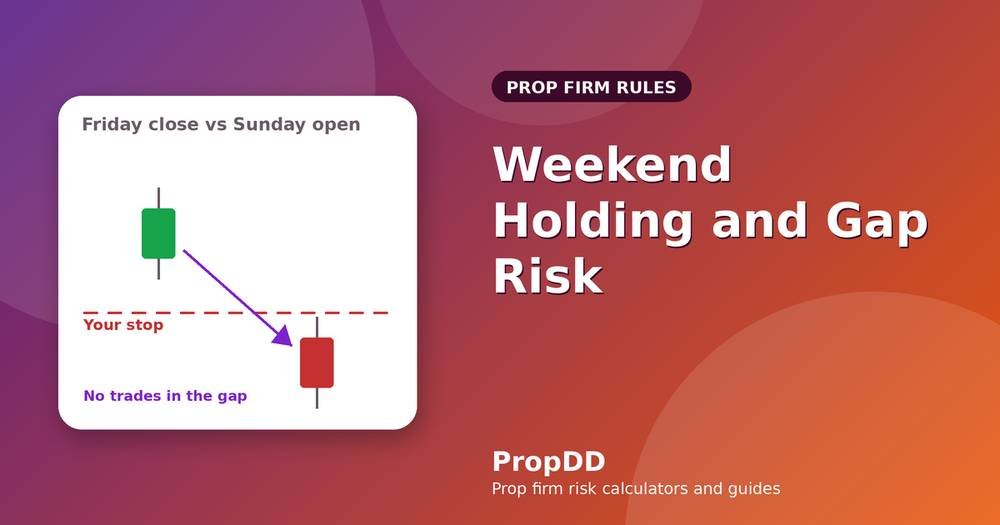
Forex and many other markets close on Friday evening and reopen on Sunday evening (the exact times depend on your broker and time zone). While they’re closed, news keeps arriving: elections, announcements, geopolitical events, central bank comments. When trading resumes, the first price can be quite different from Friday’s close. The chart shows an empty space between the two candles. That’s the gap, and no trade happened inside it.
Gaps can happen on other days too, around major releases or when a particular market closes and reopens, but weekends are the classic case because they’re the longest break.
Why a stop loss doesn’t fully protect you
A stop-loss order isn’t a promise that you’ll exit at a particular price. It’s an instruction to close the trade at the next available price once the level is reached. In a gap, the market skips your level entirely, so the next available price might be well beyond it. If you were long at 1.0900 with a stop at 1.0850 and the market reopens at 1.0790, you’re out at about 1.0790, a loss of 110 pips instead of 50. Investopedia’s explanation of the stop-loss order covers the mechanics.
A worked example
A trader holds 3 lots of EURUSD over a weekend on a $100,000 account with a $5,000 daily limit. The stop is 40 pips away, so the planned loss is 3 × 40 × $10 = $1,200. The market gaps 90 pips through the stop. The actual loss: 3 × 90 × $10 = $2,700, which is 54% of the daily limit, in a single moment, before the week has begun. Add a wide spread on the Sunday open and the number grows. Nothing the trader did was reckless. The plan just assumed the stop would work the way it works on a Wednesday.
How firms treat weekend trades
Practice varies. Some firms prohibit holding trades over the weekend entirely and may close them automatically, or treat it as a rule violation. Others allow it but make no promises about gaps. A few allow it for some account types only. Search the rules for “weekend”, “overnight” and “gap”, copy the exact wording into your notes and, if it’s unclear, ask support. The checklist in daily drawdown rules: what to check before you buy includes this question for a reason.
Which “day” does the gap loss count in?
A subtle question: if the gap happens at the Sunday open, which daily limit does the loss use? It depends on how the firm defines the trading day and its reset time, and a Sunday evening open might belong to Monday’s day or to a short “Sunday” day. This matters because you might start the week with a chunk of your allowance already gone. The guide to the daily drawdown reset time explains how to find the boundary.
Equity rules make it worse
Under an equity-based rule, floating losses count the moment they appear, so a gap hits your equity in an instant, and there’s no chance to react. Even if the trade would have recovered by lunchtime, the equity line has already crossed the floor. We cover the balance-versus-equity question in balance-based versus equity-based daily drawdown.
Should you hold at all?
It depends on your style and the numbers. For a swing trader whose method needs days to play out, closing every Friday may be unnatural and costly. For a day trader, the question doesn’t arise. A useful way to think about it is as a price: holding over the weekend gives you the chance of a bigger move in your favour, at the cost of a risk of a gap against you that your stop can’t control. If your account can afford the worst plausible gap, and the firm allows it, holding can make sense. If a gap of a typical size would use half your daily limit, it probably doesn’t.
Sizing for the gap
The simplest approach is to size down on Friday. Decide the largest loss you’d accept from a gap, say 1% of the account, and work backwards. If you think a bad gap could be two to three times your stop distance, size as if the stop were two to three times as far away. With a 40-pip stop and an assumed 100-pip gap, $1,000 of risk means $1,000 ÷ (100 × $10) = 1 lot, not 2.5. It looks timid, and it’s the arithmetic of a gap-proof trade. Our guide to position sizing for prop firm challenges has the formula.
Reducing the exposure without closing everything
Options short of flattening: close half the position before the weekend, tighten the stop to lock a profit, avoid holding pairs tied to events scheduled over the weekend (elections, summits), or choose instruments less prone to gaps. None removes the risk entirely. They just make the worst case more tolerable.
Know what’s on the calendar
Look at what’s scheduled for the weekend and the early part of the week: elections, major speeches, rate decisions in Asia on Monday, political deadlines. A calendar such as the one at TradingView won’t list every surprise, but it shows the planned ones. A Friday close before an election weekend deserves more caution than a quiet one.
Gaps on other days
Weekends aren’t the only risk. Markets can gap at the daily rollover, around news, or when a particular exchange opens. Indices and some metals gap more often than major forex pairs, since their markets close daily. The same logic applies: a stop is a plan, not a guarantee, and size should allow for the market skipping past it.
Swap charges over the weekend
Holding positions over the weekend usually means a triple swap charge or credit on one day of the week, to account for the weekend. That’s a cost to add to your estimate if the firm counts swaps in the daily loss, and it may show up in Wednesday’s totals or Friday’s, depending on the broker. Check the detail in swaps and commissions.
A Friday routine
An hour before your usual close, list your open trades and ask for each one: would I open this now, with the weekend ahead? If the answer is no, close it. Then check the firm’s weekend rule, add up the worst-case gap loss across open trades, and compare it with your daily room. If it’s more than a quarter of the limit, trim. Finally, write the weekend position in your journal, so on Monday you know exactly what you’re returning to.
What to do if you’re caught by a gap
Don’t take another trade to recover. Look at where your equity stands against the floor, close or protect anything that’s still open and use the remaining room carefully, or not at all. A gap is a clean example of a loss that isn’t your fault, and still has to be respected. Treat it as information about the real size of your risk and adjust next Friday accordingly.
Gap sizes in perspective
Most weekends produce small gaps or none at all, which is exactly why people get relaxed about holding. The danger lives in the tail: the one weekend in a while when something significant happens. Gap sizes vary by instrument, by broker and by what’s going on in the world, so I won’t quote a “typical” figure. What matters is that you decide in advance what size of gap you’d survive, and size so that the answer is “a large one, comfortably”.
Two traders, one Friday
Imagine two traders with $100,000 accounts and a $5,000 daily limit, both long EURUSD into the weekend with a 40-pip stop. The first holds 3 lots, planned risk $1,200. The second holds 1 lot, planned risk $400, because they sized for a possible 100-pip gap: $400 plus the extra 60 pips at $10 is $1,000, which is what they were willing to lose in the worst case.
The market gaps 100 pips. The first trader loses 3 × 100 × $10 = $3,000, which is 60% of the day’s limit before Monday’s first trade. The second loses $1,000, which is 20%. Both did the same trade. The second is still comfortable on Monday morning, with room to trade properly. The first is on the defensive, and defensive traders make mistakes.
If you forget about an auto-close rule
Where a firm prohibits weekend holding, it may close trades automatically before the weekend, or flag the breach and close the account. Either way, “I forgot” isn’t a defence. Put a recurring reminder on your phone for an hour before the Friday cutoff in your time zone, and check the cutoff against the firm’s server time. It’s one of the more embarrassing ways to lose an account, and one of the most preventable.
A weekend checklist
Is weekend holding allowed? What’s the cutoff, in my time zone? What’s my worst-case gap loss across open positions? Is it under a quarter of my daily limit? What’s on the calendar for the weekend and Monday’s open? Do I have a note about each open trade? Six questions. If you can’t answer all six, close the trade. Peace of mind over a weekend is worth more than the extra pips.
A final word on risk appetite
Some traders sleep fine with trades open over a weekend and some don’t, and neither is wrong. What matters is that the position’s worst case fits your account and your nerves. If you catch yourself checking your phone on Saturday night, the size was too big for you, whatever the maths said. Next Friday, close earlier or trade smaller, and enjoy the weekend. The account will still be there on Monday, which is the whole objective.
Write down your answer in advance
Before you ever hold a trade over a weekend, write one sentence: “The largest weekend loss I’ll accept is $___, which is ___% of my daily limit.” Then size every Friday position to that number, not to the mood you’re in on Friday afternoon. It sounds trivial, and it removes a decision from the moment when you’re most likely to talk yourself into a bigger position.
Frequently asked questions
Can I hold trades over the weekend on a prop account?
It depends on the firm and sometimes on the account type. Read the rulebook and confirm with support.
Will my stop protect me from a gap?
Not fully. A stop becomes a market order when triggered and fills at the next available price, which can be far beyond your level.
Does a gap count toward my daily drawdown?
Yes, the loss hits your equity. Which day it counts in depends on how the firm defines its trading day.
How can I reduce weekend risk?
Size down on Friday, close part of the position, avoid event-heavy weekends and make sure the worst-case gap loss fits inside your daily room.
The short version
Gaps skip stops, and weekends are where they happen most. Know your firm’s weekend rule, size for a gap bigger than your stop, check what’s on the calendar and keep the worst case well inside your daily room. For the rule underneath all of this, read the prop firm max daily drawdown explained, and for a refresher on forex basics, the free lessons at BabyPips are a good start.