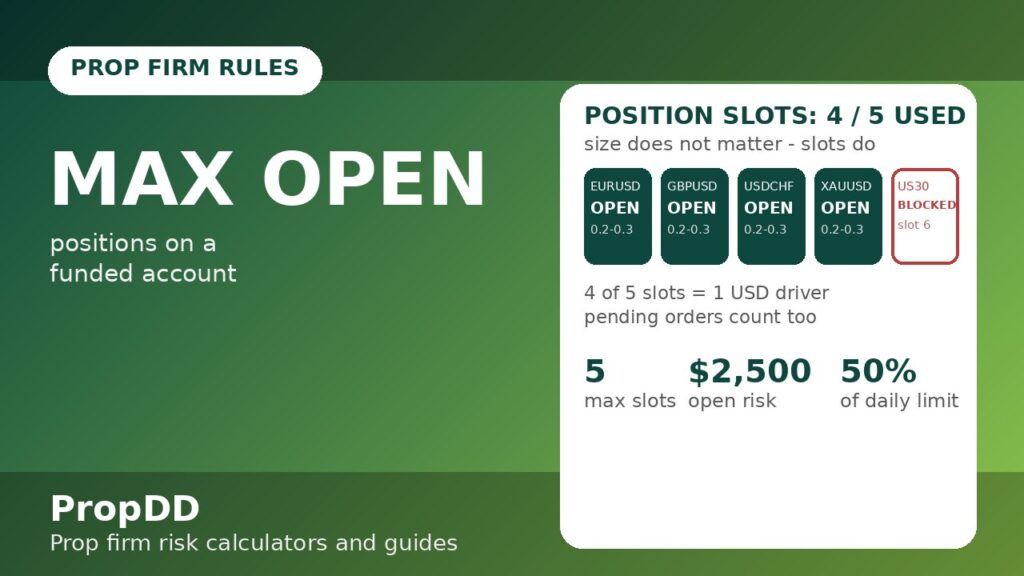
My best evaluation week ended with an email, not a trade. Thursday afternoon, I was up $6,200 on a $100,000 two-step challenge — 6.2% in eleven trading days, every single loss under 0.5%, the daily drawdown never even twitched. I had four positions open: two longs on EURUSD, a long on GBPUSD and a short on USDCHF — small sizes, all planned, all inside my risk plan. Then I saw a fifth setup forming on gold, tapped buy on 0.05 lots, and walked to the kitchen to make coffee. Ten minutes later the “Account Terminated” email was sitting in my inbox. Not a drawdown breach. Not a consistency violation. The reason line said: maximum open positions exceeded. My firm allowed five open positions. The gold trade was my sixth — and I had no idea the rule even existed. I had read the rulebook twice, memorised the daily loss limit and the max drawdown, and skimmed straight past one quiet paragraph near the bottom of page four. That $99 challenge fee taught me something no drawdown guide ever did: on a funded account, the number of trades you hold open at the same time is itself a rule, and it counts trades — not lots, not dollars, not how careful you were.
In this article
- What the rule actually counts
- The four ways firms write this rule
- Why the rule exists — the firm's side of the desk
- The exposure maths: why five tiny trades can breach you
- I tested it: the nine-trade correlation trap
- My pre-trade position-count routine
- The mistakes that break this rule
- Frequently asked questions
What the rule actually counts
Maximum open positions is a hard cap on how many trades can be open on your account at the same moment. That is all it is — and that simplicity is what makes it dangerous, because traders keep assuming it works like every other rule they know. It does not scale with size. A 0.01 micro-lot counts exactly the same as a 3-lot full position. It does not care about direction: three longs and two shorts is five positions. And at many firms, pending orders count too — a stop order resting above the market occupies a slot even though no money is at risk yet. When I went back and re-read that paragraph on page four, it said “open positions and pending orders” in one breath. My gold buy was actually my sixth open slot only because a limit order I had placed on US30 two days earlier was still sitting there, forgotten. I thought I had four trades. The firm counted six.
The second trap is subtler: the cap can differ between the challenge and the funded phase. Plenty of firms run a relaxed rulebook during evaluation and tighten it once real payouts are on the line — the exact pattern I keep warning about in the challenge reset rules guide. One firm I trade with publishes no position cap during the two-step evaluation at all, then applies a five-position cap the day the funded account opens. Passing the challenge proves nothing about the funded rulebook. Read both versions, and read the funded one twice.
The four ways firms write this rule
There is no industry standard, which is why “maximum open positions” means four different things depending on whose rulebook you open. Learn which version your firm uses before you plan a single trade around it.
| Rule version | What it caps | Real-world example |
|---|---|---|
| Concurrent open positions | A fixed number of open trades at any moment, regardless of size | One firm caps funded accounts at 5 open positions; another allows 20 |
| Concurrent open lots per symbol | Total open lot volume, per asset or asset class — size matters here | Maximum 1.00 open lot on ETHUSD, 0.50 on NAS100, 0.30 on US30 — each cap independent |
| Trades per month | Cumulative trade count over a calendar month, not concurrency | 100 trades per calendar month across both challenge and funded phases |
| Contract progression ladder | Max contracts scale with account balance and profit | A $50k futures account allows 2 contracts; at $1,501+ profit it allows 4 — dip below and the extra slots vanish |
Notice what the table hides: versions 2 and 4 care about size, versions 1 and 3 do not. If your firm uses version 1 — the simple “five open positions” type — then splitting one 1-lot trade into five 0.2-lot trades burns your entire allowance for zero benefit. For a concrete example of how one firm writes the monthly version of this rule, see XpertFunding’s excessive open positions policy (100 trades per month, enforced as a hard breach). That is the single most common way traders break this rule without doing anything that feels risky. The rule punishes trade count, and every scale-in, every hedge leg, every “just adding a little” counts as a brand new trade.
Why the rule exists — the firm’s side of the desk
Firms do not write this rule to annoy you. They write it because a funded account with thirty open micro-positions is unmanageable risk wearing a safe-looking costume. Thirty 0.01-lot trades feel tiny in the position-size column, but if they are all long the US dollar across correlated pairs, they are one 0.30-lot directional bet that nobody sized properly. The firm cannot tell the difference between a carefully hedged book and a correlated pile-on until the news hits — so it caps the pile. The rule also exists to catch automation abuse: grid and martingale EAs can spray dozens of small orders across the book in minutes, which is why my martingale on prop firm accounts piece and this one are cousins. Same family of behaviour, different rule that catches it.
There is a second, quieter reason. Every open position is operational surface area for the firm’s risk engine: margin checks, swap calculations, weekend-gap exposure, news-window monitoring. A trader running two clean swing positions is cheap to risk-manage. A trader running nineteen micro-scalps across seven instruments at 2am is not. The cap keeps your book legible — which, once I stopped being angry about the termination, I realised was also in my interest. A book I cannot explain in one sentence is a book I cannot manage.
The exposure maths: why five tiny trades can breach you
Here is the maths that makes the position cap matter more than it looks. The cap counts trades, but your drawdown counts dollars — and the bridge between them is correlation.
| Step | Formula | Worked example ($100k account, 5% daily limit) |
|---|---|---|
| Total open risk | Sum of (stop distance × pip value × lots) across all open trades | 5 trades × $500 planned risk = $2,500 |
| As % of daily limit | Total open risk ÷ daily loss limit | $2,500 ÷ $5,000 = 50% of the daily allowance |
| Correlation multiplier | If N trades share one driver, treat them as ONE trade of N× size for news events | 4 USD-long pairs = one 4× USD bet through NFP |
| Worst realistic day | Total open risk × correlation overlap | A 2% USD spike costs ~$2,500 on five “small” trades at once |
The last row is the one that ends accounts. Each of my five Thursday trades risked about 0.5% — textbook sizing, the same discipline I describe in the position sizing guide. But four of them were dollar-directional: long EURUSD twice, long GBPUSD, short USDCHF. When US data surprised that afternoon, all four moved against me together. My “0.5% per trade” plan was actually a 2% single-driver bet wearing five separate tickets. The position cap had been trying to tell me this: five slots is not permission to run five trades — it is a ceiling on how many ways you can be wrong at once. I now size as if correlated positions are one position, because on news days, that is exactly what they are.
I tested it: the nine-trade correlation trap
After the termination, I rebuilt the exact scenario on a demo with the same five-position cap written on a sticky note above my monitor — and then deliberately stress-tested what happens when you fill every slot. Over two weeks I logged every open position, its driver, and the floating P&L at each New York close, checking the exposure against the max daily drawdown calculator each evening. The table below is the worst day, and it is the day that changed how I trade.
| Slot | Trade | Size | Planned risk | Shared driver |
|---|---|---|---|---|
| 1 | EURUSD long | 0.30 lots | $450 | USD weakness |
| 2 | GBPUSD long | 0.25 lots | $400 | USD weakness |
| 3 | AUDUSD long | 0.25 lots | $400 | USD weakness |
| 4 | USDCHF short | 0.20 lots | $350 | USD weakness |
| 5 | US30 long | 0.10 lots | $500 | Risk-on sentiment |
Five slots full, $2,100 of planned risk — 42% of a $5,000 daily limit, and I felt diversified. Then a hot CPI print hit. Slots 1–4 are all the same USD-weakness bet in different costumes, and slot 5 (US30 long) is risk-on, which usually sells off on hot inflation too. Within forty minutes the floating loss was $2,480 — a hair under half the daily limit — from five trades that each looked “only 0.4–0.5%” in isolation. The demo survived because it was a demo. On a live funded account, one more push and the day is over by 9am, and no stop-loss discipline saves you because every stop was correctly placed. The lesson was not “trade fewer positions” — it was “count drivers, not tickets.” My live rule ever since: no more than two positions sharing one macro driver, no matter how many slots the firm gives me. The cap is the firm’s ceiling. My driver count is my floor.
My pre-trade position-count routine
I run this checklist before every entry now. It takes ninety seconds, and it has kept every account I have touched since that Thursday email inside every position rule I have traded under.
| Step | What I check | Where |
|---|---|---|
| 1 | How many open positions right now — including pending orders | Platform terminal, open-orders tab |
| 2 | Today’s cap for THIS account phase (challenge vs funded rulebooks differ) | Firm rulebook, funded-phase section |
| 3 | How many of the open trades share one macro driver with the new trade | My journal’s driver column — max two per driver |
| 4 | Total open risk as % of the daily limit if every stop fills at once | My sizing sheet, same maths as the table above |
| 5 | Any EA or copier running that could open positions on its own | Platform experts tab — automation burns slots silently |
Step 5 deserves its own warning. A trailing-stop EA, a partial-close script, or a trade copier mirroring another account can open or split positions while you are away from the desk — and the firm counts every one of them. I once watched a copier duplicate a single manual entry into three tickets because of a symbol-suffix mismatch, and three slots vanished before London opened. If you run any automation at all, the personal daily stop is not the only guardrail you need — you need a position-slot guardrail too. And if you are the kind of trader who stacks many small trades in a session, read the trade caps guide next: daily trade-count limits and concurrent-position limits are two different rules, and firms are happy to enforce both on the same account.
The mistakes that break this rule
Every breach story I have heard about this rule — including mine — is one of five mistakes. None of them feels like rule-breaking in the moment, which is exactly why the rule keeps collecting accounts.
1. Forgetting pending orders. The limit order you placed Tuesday and forgot is still occupying a slot on Friday. Cancel stale pendings every evening, or the rule will count them for you.
2. Scaling into a winner as separate tickets. Adding to a position three times turns one trade into four slots. If your firm uses the simple concurrent-positions version of the rule, scale with one ticket or accept the slot cost in advance.
3. Hedging both sides of the same pair. Long and short EURUSD at once is two positions, two slots, and usually one net exposure near zero — you pay the slot cost and gain nothing. The multiple accounts guide covers the cross-account version of the same trap.
4. Letting EAs and copiers open freely. Grid, martingale and recovery EAs are position-count machines. If your firm caps concurrent positions, an EA without a max-orders setting is a termination waiting for a volatile session.
5. Assuming the challenge rulebook is the funded rulebook. Some firms publish no cap during evaluation and add one at funding — the phase where payouts are real and the rule actually costs you money. Read the funded-phase rules before your first funded trade, not after your first funded week.
Frequently asked questions
Do pending orders count toward the maximum open positions?
At most firms, yes — the rule usually says “open positions and pending orders” in one phrase. A stop order or limit order resting in the market occupies a slot even though it has no floating P&L yet. The only way to be sure is your firm’s exact wording; if the rulebook does not say either way, assume pendings count and cancel stale ones nightly.
Does partially closing a position free up a slot?
No. A partial close reduces the size of a position but the position itself stays open, so it still occupies one slot. The slot only frees when the position is fully closed — or when the pending order is cancelled or filled.
Is the position cap the same on challenge and funded accounts?
Not always. Several firms run no position cap during the evaluation and introduce one on the funded account, and at least one major firm applies minimum holding times only to funded accounts while challenges have none. Treat the funded-phase rulebook as a separate document and read it before your first funded trade.
What happens if I exceed the cap — warning or termination?
It depends on the firm, and this is the part of the rulebook you must read literally. Some firms issue a soft breach: the extra trade is closed or its profit removed. Others treat it as a hard breach and terminate the account — mine did, mid-week, with $6,200 of profit on the table. Never assume you will get a warning.
Do EAs that open many small trades violate this rule?
They can, fast. Grid and martingale EAs open a new ticket for every grid level, and a choppy session can stack a dozen positions in an hour — each one counting toward the cap. If you run any EA on a capped account, set its maximum concurrent orders below the firm’s cap and leave yourself at least one free slot for manual management.
How many open positions should I actually use as a funded trader?
Fewer than the cap allows. The cap is the firm’s ceiling, not a target. My working rule is no more than two positions sharing one macro driver and total open risk under half the daily loss limit if every stop fills at once. On most $100k accounts with a 5% daily limit, that means three to four genuinely independent positions at sensible size — and on news days, often just one.
Risk note: prop firm rules change without notice and differ between account phases — always verify the current funded-phase rulebook for your own firm before trading. Nothing here is financial advice.



1 comment
[…] the other side. I used to find this annoying; now I treat the cap as a free discipline coach. My maximum open positions guide covers its sibling rule, and the two behave as a pair: one limits how many trades you can hold, the […]