I lost 500 dollars in nine minutes on a Monday morning because I traded a gap the way most traders do: I saw the open jump, I assumed it would keep going, and I bought the first print. The Nasdaq had gapped up overnight, the first candle was green and tall, and I was long before I had asked the only question that matters with a gap: is this gap actually going anywhere, or is it just an excited open that is about to fill? It filled. Price came straight back through the prior close, my stop was on the wrong side of a move I had not planned for, and the day was over before most traders had finished their coffee. That loss taught me the difference that this whole strategy rests on: a gap is not a trade. A gap is a candidate, and gap and go is the set of rules that decides, in the first fifteen minutes, whether that candidate earns your risk.
In this article
- What gap and go actually is
- The full rules: setup, entry, stop loss, take profit
- The gap filter: which gaps qualify and which get skipped
- Session and time filter: when the strategy is allowed to run
- A worked trade, with every number shown
- The sizing grid: what each stop distance allows
- Five trades, trade by trade
- I tested it: twelve filtered trades against fifteen unfiltered
- When gap and go fails
- My daily routine with gap and go
- Frequently asked questions
This guide covers the strategy properly: what gap and go is and how it differs from fading a gap, the full rules from the premarket scan to the exit, the session and news filters, position sizing under a 500-dollar per-trade risk cap on a 100,000-dollar funded account with a 5,000-dollar daily loss limit, a worked trade with every number shown, a five-trade log, a twelve-trade test of the filtered rules against unfiltered gap chasing, the ways the strategy fails, and how it fits prop firm drawdown and consistency rules. Sizing is checked against the max daily drawdown calculator wherever the daily limit is in play. If you already read the gap fill strategy guide on this site, note the difference before you go further: that guide trades the gap closing back toward the prior close, and this guide trades the gap continuing away from it. They are opposite trades on the same event, and you cannot run both plans at once on the same open.
What gap and go actually is
Gap and go is a momentum strategy for the market open. Overnight news, earnings, or a strong session elsewhere leaves the market opening well away from the prior close. That distance is the gap. The gap-and-go trader does not buy the gap itself. The trader waits for the first few minutes of trading to confirm that buyers or sellers are still in control, then joins the move in the direction of the gap, with a stop that invalidates the idea quickly and a target that pays at least as much as the risk. If the open hesitates, reverses into the gap, or trades thinly, the trade is skipped. Most mornings, skipping is the correct outcome.
The funded-account reason for that patience is simple. Gap mornings are the mornings when a funded account dies fastest, because the first move is big, the spreads are wide, and the temptation to chase is at its strongest. A trader who buys the first print risks a full daily-limit slice on a move that has already happened. A trader who waits five minutes risks missing the first leg, but keeps the account. On a funded account, keeping the account is the strategy, and the gap is only the setup. For the general background on gap types, the MyFundedCapital guide to trading gaps is a useful primer, but note that it covers gaps in general, not this specific gap-and-go momentum plan with its confirmation and sizing rules.
The full rules: setup, entry, stop loss, take profit
Here are the rules exactly as I trade them, on the Nasdaq index (USTEC) at the 14:30 London time US cash open, which is the open most funded futures and CFD accounts can actually trade with volume. The same rules adapt to other indices, but the numbers below are Nasdaq numbers, and you should rebuild them for any other market before trading it.
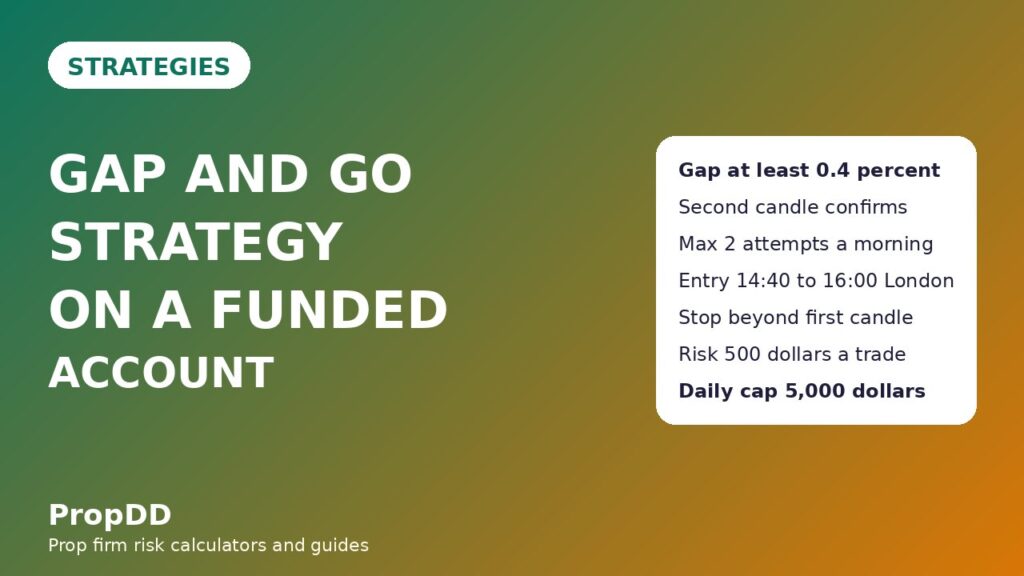
Setup: the market must gap at least 0.4 percent from the prior cash close, in either direction. Below 0.4 percent the gap is noise, not a setup, and I do not trade it. The gap must also be a genuine overnight gap, not a slow drift: the premarket high or low must sit clearly beyond the prior close, and the first cash print must open inside the top or bottom quarter of the premarket range, which shows the overnight move still has conviction behind it. Finally, there must be no red-folder news scheduled in the first 30 minutes after the open. A gap plus a news release is a coin flip with wide spreads, and I do not gamble a funded account on it.
Entry: wait for the first 5-minute candle to close. Do not trade inside it. Then enter on a break of that candle’s high (for a gap up) or low (for a gap down), with the break confirmed by a second 5-minute candle closing beyond the level. That second close is the “go” in gap and go: the gap has now survived ten minutes of real trading without filling, and momentum has a second witness. Entry on the first candle’s break alone, without the confirming close, is the most common way this strategy loses money, because the first break is often a stop hunt back into the gap.
Stop loss: beyond the opposite side of the first 5-minute candle, plus a small buffer of 5 points for spread and wick noise. For a long, the stop sits below the first candle’s low minus 5 points. For a short, above the first candle’s high plus 5 points. If that stop distance would risk more than the 500-dollar cap at the minimum size, the trade is skipped, not resized by wishful thinking. Take profit: half the position at 1R, the rest at 2R, and the stop on the second half moved to breakeven once the first target is hit. That is the same partial closes discipline used across this site, and it matters here more than anywhere, because gap trades that reach 1R and come all the way back are common.
The gap filter: which gaps qualify and which get skipped
Not every gap is a gap-and-go gap. The table below is the whole filter, and I run through it before the open every day I trade this strategy. A single fail means a skip, no matter how exciting the open looks.
| Filter | Qualifies | Skip if |
|---|---|---|
| Gap size | At least 0.4 percent from prior cash close | Below 0.4 percent, or above 2.0 percent (exhaustion risk) |
| Premarket conviction | Open inside the top or bottom quarter of the premarket range | Open in the middle of the premarket range |
| Premarket volume | Relative volume above 1.5 times the 20-day premarket average | Thin premarket volume, or no volume data available |
| News window | No red-folder news in the first 30 minutes | Any major release due before 15:00 London time |
| First 5-minute candle | Range at least 15 points, closes in the gap direction | Tiny range, or closes back toward the prior close |
| Prior day trend | Gap in the direction of the prior day trend, or a clean breakaway | Gap against a strong prior trend with no catalyst |
The 2.0 percent upper limit surprises traders, but it is there for a reason: a gap larger than 2 percent on the Nasdaq is usually exhaustion, not momentum, and it fills violently. The best gap-and-go mornings in my journal are the 0.5 to 1.2 percent gaps with a clear catalyst and strong premarket volume. Those are big enough to matter and small enough to still have buyers or sellers left to push them further.
Session and time filter: when the strategy is allowed to run
Gap and go is a US cash open strategy, and the clock is part of the rules, not decoration. The trade window opens at the 14:30 London time cash open and closes at 16:00 London time. No entries after 16:00, because by then the gap move has either happened or failed, and anything after that is a different strategy wearing this one’s name. I also do not trade gap and go on Mondays before the first full week of the month, when weekend gaps and thin Monday liquidity combine, and I do not trade it on Federal Reserve announcement days, when the afternoon session rewrites the morning’s story. The London breakout guide and the Asian range breakout guide on this site are session strategies too, and the lesson is the same in all three: a strategy that works at one open usually fails at another, and the session filter is what keeps it honest.
| Time (London) | What happens | Rule |
|---|---|---|
| Before 14:30 | Premarket scan and filter check | No entries, only preparation |
| 14:30 to 14:40 | First two 5-minute candles form | Wait, do not trade inside the first candle |
| 14:40 to 16:00 | Entry window | Enter only on a confirmed break of the first candle |
| After 16:00 | Gap move resolved or failed | No new entries, manage open trades only |
| Fed days and month-start Mondays | Unreliable gap behaviour | Strategy switched off for the day |
A worked trade, with every number shown
Here is a real-shaped trade from my journal, on the Nasdaq, after the Monday lesson. The prior cash close was 21,400. The market opened at 21,520, a gap up of 120 points, which is 120 divided by 21,400, or 0.56 percent. Premarket volume was 1.8 times average, the open sat in the top quarter of the premarket range, and no news was due before 15:00. The gap qualified. The first 5-minute candle ran from 21,520 to 21,545, a 25-point range closing near its high. The second candle closed above 21,545, confirming the break. I went long.
| Trade element | Value | How it was calculated |
|---|---|---|
| Prior close | 21,400 | Previous cash session close |
| Open and gap | 21,520, up 120 points | 120 / 21,400 = 0.56 percent |
| Entry | 21,546 | Break of the first 5-minute candle high (21,545) |
| Stop loss | 21,519 (27 points) | First candle low (21,520) minus a 5-point buffer, rounded |
| Position size | 1.80 lots | 500 / (27 x 10) = 1.85, rounded down to 1.80 |
| Risk | 486 dollars | 27 points x 10 dollars per point x 1.80 lots |
| First target (1R) | 21,573, half off | 27 points above entry, plus 243 dollars |
| Second target (2R) | 21,600, rest off | 54 points above entry, plus 486 dollars |
| Total result | Plus 729 dollars (1.5R) | 243 plus 486, with the stop never touched |
The point value matters here, so let me state it plainly: this worked example uses 10 dollars per point per lot, the standard Nasdaq CFD contract size on my account. If your contract pays a different amount per point, every size in this guide changes, and you must rebuild the grid below for your own contract before trading. The partial close is what turned a 2R move into a 1.5R banked result, and that is by design: half the position at 1R locks in 243 dollars and moves the rest to breakeven, so the worst outcome after the first target is a small profit, not a full loss. On a funded account, that is the difference between a good morning and a ruined one.
The sizing grid: what each stop distance allows
Gap mornings punish fixed lot sizes, because the first candle’s range changes every day. A 20-point stop and a 50-point stop are not the same trade, and trading the same size on both is how a trader risks 250 dollars one morning and 500 the next without noticing. The grid below, built at 10 dollars per point per lot under the 500-dollar cap, is the whole discipline in one table.
| Stop distance | Lots at 500-dollar risk | Actual risk after rounding down | Share of the 5,000-dollar daily limit |
|---|---|---|---|
| 20 points | 2.50 lots | 500 dollars | 10.0 percent |
| 25 points | 2.00 lots | 500 dollars | 10.0 percent |
| 30 points | 1.66 lots | 498 dollars | 10.0 percent |
| 40 points | 1.25 lots | 500 dollars | 10.0 percent |
| 50 points | 1.00 lot | 500 dollars | 10.0 percent |
Worked with the max daily drawdown calculator before the open, this grid is also your daily budget: one full-stop loss is 10 percent of the daily limit, so two consecutive losses are 20 percent, and my rule allows at most two gap-and-go attempts per morning. The third attempt is almost always a revenge trade after the first two failed, and revenge is not a filter. Two attempts, then the strategy is done for the day, win or lose.
Five trades, trade by trade
The worked trade above was the best morning in this log, not the typical one. Here are five consecutive qualifying mornings, each risking the full 500-dollar cap, so you can see the strategy the way it actually behaves: two good continuations, two fills that stopped me out, and one slow morning that paid half a target and then went nowhere.
| Morning | Gap | Direction | Outcome | Result |
|---|---|---|---|---|
| Monday | Up 0.56 percent | Long | Both targets hit | Plus 750 dollars (1.5R) |
| Tuesday | Down 0.71 percent | Short | Gap filled, stop hit | Minus 500 dollars (1R loss) |
| Wednesday | Up 0.48 percent | Long | Both targets hit | Plus 750 dollars (1.5R) |
| Thursday | Up 0.92 percent | Long | Reversal into the gap, stop hit | Minus 500 dollars (1R loss) |
| Friday | Down 0.63 percent | Short | First target only, then flat | Plus 500 dollars (1R) |
Net across the five mornings: 750 minus 500 plus 750 minus 500 plus 500, which is plus 1,000 dollars, or plus 2R. The two losing mornings are the strategy working correctly, not failing: the stop did its job, the loss was capped at 500 dollars, and neither loss touched more than 10 percent of the daily limit. The Friday trade is the one traders mishandle most: after the first target, the move stalled, and the correct action was to bank the 1R and walk away, not to add size hoping for the second target. Gap and go pays for patience twice: once at the entry, and once at the exit.
I tested it: twelve filtered trades against fifteen unfiltered
I tested the full filter over twelve qualifying gap mornings and fifteen unfiltered gap mornings, where unfiltered means trading every gap of any size, with or without the premarket, news, and confirmation rules. The filtered set is not spectacular, and that is the point: it does not need to be spectacular to survive a funded account, it needs to be consistent and small enough to fit inside the daily limit.
| Test set | Wins / losses | Maths | Net result |
|---|---|---|---|
| Filtered (full rules) | 8 wins, 4 losses | Winners 5 x 1.5R + 3 x 1R = 10.5R, losers 4R | Plus 6.5R = plus 3,250 dollars |
| Unfiltered (any gap) | 6 wins, 9 losses | Winners 3 x 1.5R + 3 x 1R = 7.5R, losers 9R | Minus 1.5R less 400 dollars slippage = minus 1,150 dollars |
The filtered best trade was 750 dollars, which is 23.1 percent of the 3,250-dollar net, inside the 30 percent consistency ceiling explained in the consistency rule guide, so no single morning dominates the result. The unfiltered set tells the real story: the same event, without the filters, gives back everything it makes and then some, because most gaps are not momentum gaps at all. They are overnight noise, exhaustion gaps, or news gaps that fill the moment real volume arrives. The filter is not what makes the money. The filter is what stops the gap from losing it.
When gap and go fails
The strategy fails in four predictable ways, and every one of them is a rule being skipped. First, the gap fills: the open reverses straight back through the prior close, and a trader who entered on the first print takes a full loss before the confirming candle can save them. That is why the second-candle confirmation exists. Second, the gap is too big: above 2 percent, the move is usually exhausted, and chasing it buys the top of a move that has already run out of buyers. Third, news lands inside the trade: a release in the first 30 minutes rewrites the gap’s story in seconds, and no stop placement survives a news spike cleanly. Fourth, the trader takes a third attempt: after two stopped-out mornings, the third trade is frustration, not analysis, and it is the trade that most often breaches the daily limit. The Tasuki Gap pattern on this site is a different animal entirely — a two-candle candlestick formation, not an opening-gap momentum plan — and confusing the two is a fifth failure mode worth naming: a pattern name that shares the word gap is not the same strategy.
The common thread is that gap and go does not fail because gaps stop working. It fails because the trader stops filtering. The mornings I lost the most money on gaps were never the mornings the rules failed me. They were the mornings I decided the rules did not apply to this particular gap, because this one looked special. It never was.
My daily routine with gap and go
My routine is short on purpose, because a gap strategy that needs an hour of analysis will be skipped on the morning it matters. Before the open I check the gap size, the premarket range and volume, and the news calendar. If any filter fails, the strategy is off for the day and I do not watch the open hoping it changes my mind. At the open I wait for the first 5-minute candle, then the confirming close, then I work out the stop from the first candle, read the size off the grid, and take at most two attempts. After 16:00 London time there are no new entries, whatever the chart is doing. At the close I log the gap size, the trade or the skip, and the reason in one line. After a month that log is the strategy’s real product: your own market’s qualifying gap sizes, your own filtered record, and your own proof that skipping most gaps is not missing out. It is the trade.
Frequently asked questions
Is gap and go the same as gap fill?
No, they are opposite trades. Gap fill bets the gap will close back toward the prior close. Gap and go bets the gap will keep moving away from it, after the first minutes confirm momentum. Never run both plans on the same open.
How big does a gap need to be?
At least 0.4 percent from the prior cash close on the Nasdaq, and no more than 2.0 percent. Below 0.4 percent the gap is noise. Above 2.0 percent it is usually exhaustion, and it fills violently.
Why wait for the second 5-minute candle?
Because the first break is often a stop hunt back into the gap. The second candle closing beyond the first candle’s high or low is the confirmation that real buyers or sellers are still in control after ten minutes of trading.
Can I trade gap and go on forex pairs?
Poorly. Forex trades almost around the clock, so true overnight gaps are rare and usually only appear at the weekend open, where spreads are widest. This is an index open strategy, built for a market that actually closes and reopens.
How many gap trades should I take per day?
At most two attempts per morning. One full-stop loss is 10 percent of a 5,000-dollar daily limit, so two losses are 20 percent. A third attempt is usually a revenge trade, and the rule exists to stop it before it starts.
What if the gap qualifies but the first candle is tiny?
Skip it. A first candle smaller than 15 points on the Nasdaq has no range to break from, and its break tells you nothing about momentum. A tiny first candle is a filter fail, not a smaller opportunity.
Trading involves substantial risk of loss and is not suitable for every investor. This guide is for education only and is not financial advice. Past performance does not guarantee future results, and you should never risk money on a funded account that you cannot afford to lose under the firm’s drawdown rules.


2 comments
[…] stop before you can react, which is why red-folder news within 24 hours is an automatic skip. The gap and go strategy guide is the mirror image of this problem — it trades gaps deliberately, with its own rules — […]
[…] Gap and go […]