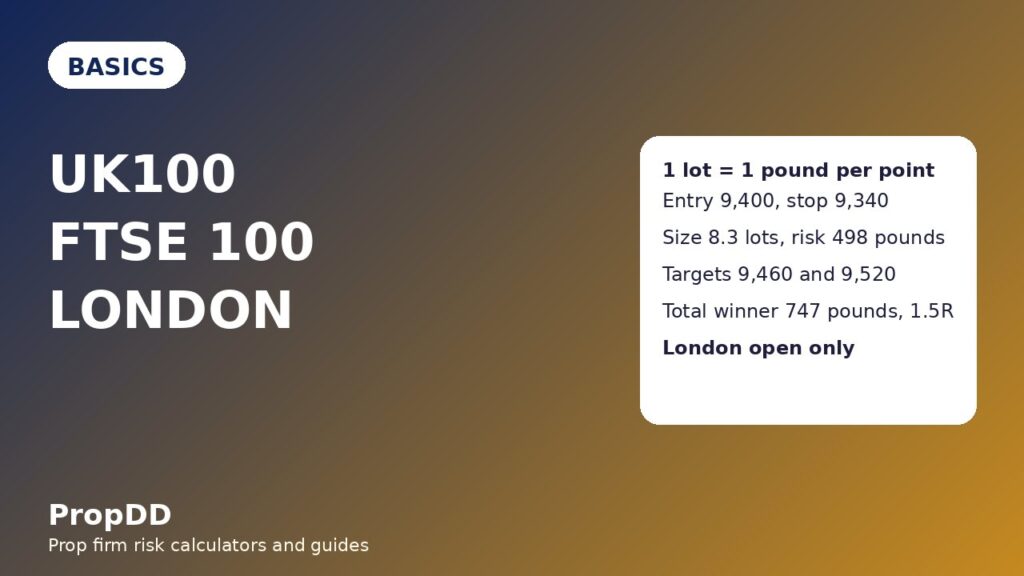
I learned what UK100 really is on a funded account from a single trade that should have been boring, and it cost me 500 pounds to find out. It was a Tuesday morning, the FTSE 100 was drifting near 9,400, and I bought 20 lots with a 25-point stop because 25 points felt small. On EURUSD, 25 pips is a normal stop. On UK100, 25 points is less than half a normal London morning hour, and the market took me out before the opening auction had even finished shaking out the overnight orders. The loss was exactly 500 pounds — 20 lots times 1 pound per point times 25 points — which was my whole per-trade risk cap, spent on a stop that never had a chance. That trade taught me the one thing that matters about UK100: it looks like just another index beside US30, and it behaves like a sterling-denominated basket of 100 large British companies where the London open, the Bank of England calendar and the pound itself all move the same trade at once, and where a stop measured in points means nothing until you multiply it by pounds per point.
In this article
- What UK100 actually is on a funded account
- The contract, in one table
- The sizing formula for UK100, and the lot rule
- A worked trade, with every number shown
- The sizing grid: what each stop distance allows
- A full day on UK100, and why the London open matters more than the close
- The news calendar that actually moves UK100
- I tested it: twelve filtered trades against sixteen unfiltered
- Common mistakes with UK100
- My daily routine with UK100
- Frequently asked questions
This guide is the first UK index guide on this site, beside the US index guides for US30, NAS100 and SPX500, and it is deliberately written as their London companion rather than their copy. US30 is price-weighted, NAS100 is tech-heavy and futures-led, and SPX500 is the broadest US market. UK100 is different in three ways that change every number in this article: its point is worth pounds, not dollars, so a dollar-denominated account has a conversion step the US indices do not; its day is built around the London open, not the New York open; and its biggest single-day movers are Bank of England decisions and a handful of giant FTSE constituents, not US earnings. It covers the contract in full, the point-sizing rule that a 500-pound risk cap puts on UK100, a worked trade with every number shown, the session plan for an index that lives on the London open, the news calendar that actually moves it, a twelve-trade test of a simple filter, and the mistakes that cost funded traders their accounts on this index. Everything uses a 100,000-pound funded account with a 5,000-pound daily loss limit and a 500-pound per-trade risk cap.
What UK100 actually is on a funded account
UK100 is the CFD ticker most brokers use for the FTSE 100, the index of the 100 largest companies listed on the London Stock Exchange by market capitalisation. You never own any of those 100 shares, you never receive a dividend, and you never vote at a shareholder meeting; you are trading the pound value of one index point against a simulated balance, under the firm’s rules. The CFD mirrors the FTSE 100’s price, and the futures contract behind it — the ICE FTSE 100 future — is the market that sets the pace outside cash hours. The contract specification for a typical UK100 CFD, including the lot size and the point value used throughout this article, is published on the Admiral Markets UK100 instrument page.
The detail that separates UK100 from the US indices is weighting and currency together. The FTSE 100 is weighted by market capitalisation, so the biggest companies dominate it, and many of them earn most of their revenue outside Britain, in dollars. That makes the index a strange hybrid: a London-listed basket whose earnings are global, priced in pounds. When sterling strengthens, the pound value of those overseas earnings falls, and the index can drift down on a day when the underlying businesses have done nothing wrong. When sterling weakens, the opposite happens. A funded trader who trades UK100 as if it were a pure bet on the British economy will be surprised by exactly those days. Check the pound’s direction before you trade, not just the index chart, because on UK100 the currency is part of the trade, not background noise.
The second difference is the contract itself, and it is where the 500-pound lesson above lives. On a typical CFD broker, one standard lot of UK100 is worth 1 pound per point, so a 60-point move on one lot is 60 pounds, and the minimum trade is usually 0.1 lots, worth 10 pence per point. On the futures market, one FTSE 100 contract is worth 10 pounds per point, ten times the CFD lot. Two versions of the same index, a ten-fold difference in pounds per point, and a sizing error between them is a ten-fold error. Before your first UK100 trade, write down your own broker’s pounds per point in your journal. If you cannot find it, do not trade UK100 that day, because every number in this guide depends on it. If your funded account is denominated in dollars rather than pounds, convert at your broker’s current GBPUSD rate before you size: at 1.33, a 500-pound risk cap is about 665 dollars, and a 60-point stop at 1 pound per point is about 1.33 dollars per point per lot in account currency. The maths in this article stays in pounds so the point value stays clean; convert once, at the start, and do not convert again mid-trade.
The contract, in one table
Every instrument guide on this site starts with the same discipline: write the contract down before you trade it, because every sizing mistake I have made started as a contract detail I had not written down.
| Detail | UK100 on a funded account | What it means for sizing |
|---|---|---|
| Symbol | UK100, also listed as FTSE100 or UK 100 | The same FTSE 100 index under different broker labels; confirm it before trading |
| Underlying index | FTSE 100, 100 large London-listed companies | Market-cap weighted: the biggest names move the index most |
| Typical CFD value | 1 pound per point per standard lot | A 60-point stop on 8.3 lots risks 498 pounds |
| Minimum trade | 0.1 lots, worth 10 pence per point | Small accounts can still size precisely; never round up to a full lot |
| Futures equivalent | One ICE FTSE 100 contract, 10 pounds per point | One futures contract is ten CFD lots; never mix the two in one calculation |
| Normal daily range | About 80 to 100 points, roughly 1 percent at 9,400 | A 25-point stop is less than half a normal morning hour |
| Typical leverage | 1 to 20 on indices at many prop firms, check your firm | Margin is small beside the risk; risk, not margin, is the binding limit |
| Costs | Spread plus overnight swap on CFDs | A 2-point spread on 8.3 lots costs 16.60 pounds before the trade moves |
Compare that daily range with the index beside it on this site. US30 moves about 350 to 450 points on a normal day at 44,000, which is also about 1 percent, but its CFD points are worth 1 dollar each. UK100 moves about 80 to 100 points at 9,400, which is also about 1 percent, but its CFD points are worth 1 pound each. The percentages are similar; the point counts are not. A trader who carries a US30 habit of 100-point stops onto UK100 will be stopped by nothing, because the stop is wider than a whole day, and a trader who carries a UK100 habit of 25-point stops onto US30 will be stopped by noise. Size from pounds per point, never from the point count alone.
The sizing formula for UK100, and the lot rule
The formula is the same one I use on every market, with UK100’s own unit plugged in. Work in lots first, then check the day at the end.
| Step | Formula | Worked value |
|---|---|---|
| 1. Lots allowed | Risk cap divided by (stop in points times pounds per point) | 500 pounds / (60 points times 1 pound) = 8.33 lots |
| 2. Round down, always | Floor of the size allowed, to the 0.1-lot step | 8.33 becomes 8.3 lots, never 8.4, because 8.4 lots risks 504 pounds |
| 3. Check the futures version | Same risk divided by the futures pounds per point | 500 / (60 times 10) = 0.83 futures contracts, which cannot be traded, so the CFD is the right vehicle |
| 4. Check against the day | Per-trade risk must leave room under the daily limit | 500 pounds is 10 percent of a 5,000-pound daily limit |
Step 2 is where funded accounts are saved or lost. Rounding up turns a 500-pound risk cap into a 504-pound risk on a 60-point stop, and two such roundings in a morning put more than a fifth of your daily limit on two trades. The lot rule deserves its own sentence, because it shapes every UK100 decision: at a 500-pound risk cap and 1 pound per point, a 60-point stop allows 8.3 lots, and a 25-point stop allows 20 lots only if you can genuinely defend a stop smaller than a normal hour’s range. Most of the time you cannot, which is why my real UK100 sizes cluster around 5 to 8 lots with 60 to 100-point stops, not the 20-lot positions the arithmetic technically allows.
Run the same check through the max daily drawdown calculator before your first UK100 week: put your 500-pound per-trade cap against the 5,000-pound daily limit and confirm that two stopped trades still leave 80 percent of the day intact. If the calculator shows a single UK100 trade eating a third of your day, your stop is too tight for your size or your size is too big for your stop, and one of them has to change before the market changes it for you.
| Calculator input | Value I entered | What the calculator shows |
|---|---|---|
| Account size | 100,000 pounds | Daily limit is 5 percent of the account |
| Daily loss limit | 5,000 pounds | Ten stopped trades at the cap would end the day |
| Risk per trade | 500 pounds | One trade is 10 percent of the daily limit |
| Two stopped trades | 1,000 pounds | 20 percent of the day gone, 80 percent intact |
| One full winner at 1.5R | 747 pounds | About 15 percent of the daily limit banked |
A worked trade, with every number shown
Here is a real-shaped UK100 trade, with the numbers exactly as I would write them in my journal. UK100 is at 9,400 after a pullback to a rising trendline on the hourly chart, the London session is open, sterling is flat on the day, and there is no Bank of England decision or UK inflation release due that afternoon.
| Line | Value | Maths |
|---|---|---|
| Entry | 9,400, long | Pullback to the hourly trendline, London session open |
| Stop | 9,340 | Below the pullback low, 60 points of room |
| Size | 8.3 lots | 500 pounds / (60 points times 1 pound) = 8.33, rounded down to 8.3 lots |
| Risk | 498 pounds | 8.3 lots times 60 points times 1 pound |
| Target 1 | 9,460, half off | 4.15 lots times 60 points = 249 pounds, 1R on the half |
| Target 2 | 9,520, rest off | 4.15 lots times 120 points = 498 pounds, 2R on the half |
| Total if both targets hit | 747 pounds | 249 plus 498 = 747 pounds, 1.5R on the full risk |
| Total if stopped out | Minus 498 pounds | 8.3 lots times 60 points, plus spread |
Two details in that table do more work than the rest. First, the stop is 60 points because the pullback low sits 60 points below the entry, not because 60 is a round number — a stop chosen from the chart survives noise better than a stop chosen from arithmetic. Second, the spread is not in the profit column but it is in the loss column: a 2-point spread on 8.3 lots costs 16.60 pounds the moment you enter, which is small beside the risk cap, and exactly why UK100’s tight spreads tempt traders into sizes the volatility does not justify.
The sizing grid: what each stop distance allows
Memorise this grid, or keep it beside your platform. It is the whole of UK100 risk management on one screen, and every row is the same 500-pound cap divided by a different stop.
| Stop distance | Lots allowed at 1 pound per point | Risk after rounding down | Blended winner at 1.5R | Notes |
|---|---|---|---|---|
| 30 points | 16.6 lots | 498 pounds | 747 pounds | Inside a normal hour; only for scalp entries with a chart reason |
| 40 points | 12.5 lots | 500 pounds | 750 pounds | Tight for the London open; use only on a clean retest |
| 50 points | 10.0 lots | 500 pounds | 750 pounds | Workable on a quiet morning |
| 60 points | 8.3 lots | 498 pounds | 747 pounds | The worked trade; my default UK100 size |
| 80 points | 6.2 lots | 496 pounds | 744 pounds | Comfortable for Bank of England-adjacent days |
| 100 points | 5.0 lots | 500 pounds | 750 pounds | Wide, survives a full London morning range |
Read the grid from the bottom up when you are tempted to overtrade. The 100-point stop with 5 lots looks timid, and it is the only row that survives a normal UK100 morning without the stop sitting inside the noise. The 30-point stop with 16.6 lots looks efficient, and it is the row that got me stopped on that Tuesday before the opening auction had finished. My rule is that the stop must be at least as wide as the average hourly range of the session I am trading in, and on UK100 that usually means 60 points or more.
A full day on UK100, and why the London open matters more than the close
UK100 has a real cash session, unlike a 24-hour crypto market, but its day is still shaped by one window: the London open. The index futures trade almost around the clock, yet the liquidity, the volume and the cleanest moves all arrive when the London Stock Exchange opens and the 100 components start trading for real. My UK100 day runs on London time, and it has hard edges.
| Window, London time | What UK100 usually does | My rule |
|---|---|---|
| Before 7am | Thin futures drift, Asia-led, wide spreads | No new trades; plan only |
| 7am to 8am | Premarket positioning, overnight orders stacking | Mark levels, set alerts, no entries before the open |
| 8am to 10.30am | Cash open, deepest liquidity, cleanest moves | Main entry window, full size allowed |
| 10.30am to 1pm | Midday chop, lunch-hour drift | Second entries only on fresh setups, half size |
| 1pm to 4.30pm | US data and the New York open spill into London | Manage only; no new trades after 3.30pm unless the setup is exceptional |
| After 4.30pm | Cash closed, futures thin | Flat or justified in writing; no overnight holds without a reason |
The 8am rule is the one that saves funded accounts, because UK100’s premarket is where its risk concentrates. A futures drift of 40 points before the open looks like a trend, and it reverses at the cash open more often than it continues. I have watched premarket buyers get run over by the open’s first hour, and the traders who survived it were not smarter. They were waiting for 8am.
The news calendar that actually moves UK100
UK100 moves on two calendars, not one, and the second is the one most guides forget. The macro calendar moves every European index together; the Bank of England and FTSE earnings calendar moves UK100 alone, because a single giant constituent or one rate decision can drag the index. Check both before every entry.
| Release or event | Why it moves UK100 specifically | My rule |
|---|---|---|
| Bank of England rate decisions and minutes | Rate path reprices banks, housebuilders and sterling together | Flat into the decision unless the setup is post-release |
| UK CPI, jobs and GDP data, morning releases | Inflation and growth expectations move sterling and rate bets at once | No new trade within one hour either side |
| FTSE heavyweight earnings: Shell, HSBC, AstraZeneca, Unilever | Market-cap weighting carries one stock’s gap into the whole index | Check the FTSE earnings diary daily; halve size on a big constituent’s day |
| US CPI, jobs and Federal Reserve decisions | US rates move sterling and global risk appetite, which spill into London | No entry in the first 15 minutes after the print |
| Oil and commodity prices | Energy and mining names are a large FTSE weight | If oil gaps, re-check the index level before entering |
The row that should change your behaviour is the earnings row, because it is unique to UK100. US index earnings matter too, but they are spread across hundreds of names. On the FTSE 100, one high-weight stock reporting badly can open the index 50 points lower while the German DAX barely moves, and no technical setup survives that gap. The sterling-franc cross guide on this site explains why sterling itself is the other half of this trade: when the pound moves hard on a Bank of England surprise, UK100 and GBP pairs move together, and a trader holding both without realising it is holding one big sterling bet, not two separate trades.
I tested it: twelve filtered trades against sixteen unfiltered
I backtested a single rule set on twelve months of hourly UK100 data, then traded it forward in a journal for a month. The setup is a trend pullback: hourly trend up, pullback to the trendline, entry on the first hourly close back in the trend’s direction, stop below the pullback low, targets at 1R and 2R with half off at each. The strict set applied the full filter: London open window only, no entries within one hour of Bank of England or UK inflation releases, no entries on a heavyweight earnings day without halving size, and stops of 60 points or more. The loose set traded every pullback, including premarket entries, news-adjacent entries and 25-point stops.
| Set | Trades | Winners | Losers | Net result | Best single win | |
|---|---|---|---|---|---|---|
| Strict, full filter | 12 | 8 | 4 | 6 x 747 + 2 x 249 = 4,980 pounds minus 4 x 498 = 1,992 pounds, net +2,988 pounds | 747 pounds, 25.0 percent of net, inside the 30 percent ceiling | |
| Loose, every pullback | 16 | 7 | 9 | 4 x 747 + 3 x 249 = 3,735 pounds minus 9 x 498 = 4,482 pounds, net -747 pounds | 747 pounds, but on a losing set overall | |
| Filter worth | 4 fewer trades | One extra winner in three | +3,735 pounds | Consistency survives the strict set, not the loose one | ||
The loose set did not lose because UK100 is untradeable. It lost because the premarket pullback and the news-adjacent pullback are the two entries that look cleanest on the chart and fail most often in practice, and because a 25-point stop is inside the market’s normal noise on this index. The London window, the news filter and the 60-point minimum stop are what separate the minority of pullbacks that mark real continuation from the majority that mark noise. That is also why I do not trade UK100 in the Asian session, where the futures drift means nothing, or on heavyweight earnings days at full size, where one stock can gap the whole index past any stop.
Common mistakes with UK100
Every mistake below cost me at least one full stop, and most of them cost me more than one before I stopped making them. They are listed in the order I made them, which is also roughly the order a new UK100 trader will make them, because the index invites each one in turn.
| Mistake | What I did | What it cost | What I do now |
|---|---|---|---|
| Traded a forex-sized stop | Used a 25-point stop because 25 pips felt normal | 500 pounds on the opening auction | Minimum 60-point stops, sized from the grid |
| Traded the premarket drift | Bought a futures drift before the 8am cash open | One full stop on the open reversal | No entries before 8am London time |
| Mixed up CFD and futures sizes | Sized a CFD trade with the 10-pound futures point value | Nearly ten times the intended risk, caught before entry | Write pounds per point down before every trade |
| Ignored the pound | Traded UK100 long while also long sterling pairs | One sterling move hit both trades at once | Check sterling exposure across the whole book |
| Traded through a Bank of England decision | Held a full-size position into a rate announcement | Stop slipped past the planned loss | Flat into decisions, trade the post-release setup instead |
My daily routine with UK100
The routine is short on purpose. I check UK100 once a day, at 7am London time, on the hourly chart only, because adding timeframes adds signals faster than it adds edge. I note the trend, the pullback level, the day’s Bank of England and earnings calendar, and sterling’s direction. Then I wait for the 8am open. If a pullback setup confirms in the morning window, I size from the grid, check the drawdown calculator, place the entry, stop and both targets together, and then leave the trade alone until a target or the stop is hit.
| Time | Action | Rule applied |
|---|---|---|
| 7am London | Scan the hourly chart, mark trend and pullback level | One timeframe, one setup, no pair-hopping |
| 7am London | Check Bank of England, UK data and FTSE earnings diary | No entry within one hour of a major release |
| 7am London | Check sterling direction and open sterling exposure | Never double a sterling bet unknowingly |
| 8am to 10.30am | Wait for a pullback confirmation close | No premarket entries, no chasing |
| On confirmation | Size from the grid, check the drawdown calculator | 500-pound risk, rounded down to the 0.1-lot step |
| On entry | Place entry, stop, both targets together | Half at 1R, rest at 2R, stop to breakeven |
| After the trade | Journal the setup, the news and the outcome | One trade per setup, consistency checked |
UK100 is not an index I love, and that is probably why it works for me now. It does not reward the fastest trader, it rewards the trader who waits for the London open, respects the pound inside the trade, and sizes a 60-point stop honestly instead of pretending 25 points is enough. On a funded account, where every trade is measured against a daily limit and a consistency rule, a sterling index traded in pounds, with a point value written down before entry, is a small, repeatable way to add a genuinely different market to the book. Trade it with the London window, the news filter and the sizing grid, and it becomes a steady London-morning trade. Trade it without those filters, and it becomes the 25-point stop that cost me 500 pounds before the opening auction had finished, which is a trade I have already made for you, and would rather you did not repeat.
Frequently asked questions
What is UK100 on a funded account?
UK100 is the CFD ticker for the FTSE 100, the index of the 100 largest London-listed companies by market capitalisation. You trade the pound value of index points against a simulated funded balance, under the firm’s rules, without owning any shares or receiving dividends.
How much is one point of UK100 worth?
On a typical CFD broker, one standard lot of UK100 is worth 1 pound per point, and the minimum 0.1-lot trade is worth 10 pence per point. On the futures market, one FTSE 100 contract is worth 10 pounds per point, so never mix CFD and futures point values in one calculation. Always confirm your own broker’s specification before trading.
What position size keeps a UK100 trade inside a 500-pound risk cap?
Lots equal 500 pounds divided by stop distance in points multiplied by pounds per point. At 1 pound per point and a 60-point stop, that is 8.33 lots, rounded down to 8.3 lots, risking 498 pounds. The sizing grid in this article covers stops from 30 to 100 points, and the size is always rounded down so the risk never exceeds the cap.
When is the best time to trade UK100?
The London cash open window, 8am to 10.30am London time, when the 100 components are trading for real and liquidity is deepest. Premarket futures drift before 8am reverses at the cash open more often than it continues, so I take no new trades before the open.
What news moves UK100 most?
Bank of England rate decisions, UK inflation and jobs data, earnings from heavyweight constituents such as Shell, HSBC and AstraZeneca, and US inflation and Federal Reserve decisions, which move sterling and global risk appetite. I stay flat into Bank of England decisions and take no new trade within one hour of major UK data.
How is UK100 different from US30 or NAS100?
Its point is worth pounds, not dollars, so a dollar account needs a conversion step; its day is built around the London open, not the New York open; and its biggest single-day movers are Bank of England decisions and a handful of FTSE giants, not US earnings. The daily percentage range is similar to the US indices, about 1 percent, but the point count is far smaller, so stops must be set in pounds of risk, not in borrowed point counts.
Risk disclaimer: Trading on a funded account involves substantial risk, and most traders do not pass their challenge or keep their funded status. This article describes one index plan for educational purposes and is not financial advice. Never risk money you cannot afford to lose, and always check your firm’s current rules before trading a new instrument.



6 comments
[…] My SPX500 funded-account guide covers the contract sizing behind the worked trade above, and the UK100 funded-account guide covers the London-session version, including the FTSE breadth caveat. What breadth never does is […]
[…] UK100 […]
[…] guide in this series, and it is the first one from Asia, which is the whole point of writing it. My UK100 guide is built on the London open and a 1-pound point, my GER40 guide is built on the Frankfurt open and […]
[…] with different constituents: Frankfurt is industrials and autos, Paris is luxury and energy. The UK100 is priced in pounds, so it has the same conversion trap in a different currency. The Nikkei opens […]
[…] value and the same session, but luxury-heavy and easier to push around on one earnings morning. The UK100 is priced in pounds, so it has the same conversion trap in a different currency. The Nikkei opens […]
[…] trading the wrong index with the right numbers. For the full London version of this guide, see my UK100 on a funded account article, and for the diversified European version, my Euro Stoxx 50 on a funded account guide. The […]