I lost 580 dollars on my first CAC40 trade before I understood what I had actually bought. It was a Thursday, the Paris open had just printed a clean push through the overnight high, and I bought 1.00 lot of FRA40 with a 50-point stop. In my head the maths was simple: 50 points times 10 euros a point is 500 euros, and 500 euros is near enough 500 dollars. It is not. At a EURUSD rate of 1.16, that 500 euros was 580 dollars, which was 80 dollars over my risk budget on a single trade, and 11.6 percent of my 5,000-dollar daily loss limit gone before lunch on a trade I had sized in the wrong currency. The direction was right. The trade still lost, and the loss was bigger than my plan allowed, because I had done the arithmetic in euros and the accounting in dollars.
In this article
- What the CAC40 actually is
- The Paris session in Pakistan time
- The contract facts before you size anything
- The euro trap: my 580-dollar mistake
- The sizing formula under a 5,000-dollar daily limit
- The worked trade: 8,120 to 8,220 for 1.5R
- The sizing grid: stop distance decides the lots
- What a CAC40 day actually costs
- The twelve-trade filter test
- CAC40 against its neighbours
- My Paris-open daily routine
- Frequently asked questions
I trade a 100,000-dollar funded account with a 5,000-dollar daily loss limit. Trading CAC40 on a funded account is now one of my regular European-session trades, but only since I fixed that one mistake: every CAC40 number starts in euros and gets converted to dollars before I touch the lot size. This is the full guide: what the index is, when Paris trades in Pakistan time, the contract facts, the conversion trap, the sizing maths, one worked trade, twelve real trades, and the filter test.
What the CAC40 actually is
The CAC40 is the benchmark index of the French stock market. It tracks the 40 largest and most actively traded companies listed on Euronext Paris, weighted by free-float market capitalisation, with no single stock allowed above 15 percent of the index and the membership reviewed every quarter. The name comes from Cotation Assistee en Continu, continuous assisted quotation, and the index launched on 31 December 1987 with a base level of 1,000. When I write this it trades near 8,120, so the index has roughly octupled from its base while the membership has turned over many times.
The names inside it are the reason the index moves the way it does. LVMH and Hermes dominate the luxury weight, L’Oreal carries cosmetics, Airbus carries aerospace, TotalEnergies carries energy, and BNP Paribas and Societe Generale carry the banks. A single LVMH earnings report can drag the whole index, which is why I never trade the Paris open on a morning when LVMH or TotalEnergies reports before the bell. The CAC40 is forty stocks, but on earnings mornings it is often one stock wearing forty costumes. For the contract facts behind this guide, see the FXCM FRA40 contract page, which lists the CAC40 future as the underlying instrument, a 1-point target spread and a minimum value of 0.10 euros per point.
The Paris session in Pakistan time
Euronext Paris trades from 09:00 to 17:30 Central European Time, Monday to Friday, with a closing auction from 17:30 to 17:35. In Pakistan time that is an open at 13:00 and a close at 21:30, which makes the CAC40 the most civilised European index I trade: the open happens after lunch, not at 3 in the morning, and the close happens before midnight. The pre-open runs from 07:15 CET, which is 11:15 in Pakistan, and I use that window to read the overnight range, not to trade it.
| Paris moment | CET time | Pakistan time | What I do |
|---|---|---|---|
| Pre-open | 07:15 – 09:00 | 11:15 – 13:00 | Mark the overnight high and low, check LVMH and TotalEnergies news |
| Paris open | 09:00 – 10:30 | 13:00 – 14:30 | My main window: open-range breaks and pullbacks only |
| Midday lull | 12:00 – 14:00 | 16:00 – 18:00 | No new trades; the index drifts and stops get hunted |
| US cash open overlap | 14:30 – 16:00 | 18:30 – 20:00 | Second window: US data can shove Paris around |
| Close and auction | 17:30 – 17:35 | 21:30 – 21:35 | Flat before the auction; I never hold into it |
Two windows matter and the rest is noise. The first ninety minutes after the 13:00 Pakistan-time open set the day’s range, and the US cash open at 18:30 Pakistan time is the second volatility burst. Between them, from 16:00 to 18:00 Pakistan time, the CAC40 usually drifts sideways on thin volume, and that is where I have taken most of my stupid losses: boredom trades in a range that was never going anywhere. The index is closed on weekends and French public holidays, so a Friday position held over the weekend is a gap risk I do not take on a funded account.
The contract facts before you size anything
On MetaTrader the CAC40 usually appears as FRA40 or FR40, depending on the broker. The contract I trade is the common CFD version: one lot equals 10 euros per point. That single number is the whole trap, because everything after it is priced in euros while my account is priced in dollars. The spread target is 1 point, leverage on indices at most prop firms is 1:20, which means 5 percent margin, and there is an overnight financing charge if you hold past the close, which is one more reason I am always flat by 21:30 Pakistan time.
| Contract fact | Value | Source or note |
|---|---|---|
| MT5 symbol | FRA40 or FR40 | Symbol name varies by broker; check the symbol list first |
| Underlying | CAC40 index future | Euronext Paris, 40 largest listed companies |
| Point value | 10 euros per point per lot | Standard CFD contract; mini versions quote 1 euro |
| Point value in dollars | 11.60 dollars per point per lot | 10 euros x EURUSD 1.16; moves with the exchange rate |
| Target spread | 1 point | FXCM FRA40 contract page |
| Leverage on indices | 1:20 | Typical prop-firm index leverage; 5 percent margin |
| Trading hours | 09:00 – 17:30 CET | 13:00 – 21:30 Pakistan time, Monday to Friday |
| Overnight holding | Financing charged nightly | I close before the 17:30 CET auction instead |
Read the point-value row twice. Ten euros per point is not ten dollars per point, and the gap between them is exactly the EURUSD rate. At 1.16 the gap is 16 percent, which is the difference between a 500-dollar risk and a 580-dollar risk on the same trade. On the CAC40, the exchange rate is part of your position size. I check EURUSD every morning before I size a trade, and I redo the maths if it has moved more than a cent since my last session.
The euro trap: my 580-dollar mistake
Here is the losing trade, with the real numbers. I bought 1.00 lot at 8,120 with a stop at 8,070, fifty points below. My mental maths said fifty points times ten is five hundred, and five hundred was my risk. The actual maths said fifty points times ten euros is five hundred euros, and five hundred euros times 1.16 is 580 dollars. The trade stopped out before lunch for a 580-dollar loss: 80 dollars over my 500-dollar risk budget, and 11.6 percent of my 5,000-dollar daily loss limit spent on one trade that I had believed was inside plan.
The mistake was not the direction. The index bounced off my stop and ran 160 points by the close, which is the part that stings, but the lesson is not about that bounce. The lesson is that a funded account measures everything in dollars while the CAC40 measures everything in euros, and any sizing done in the wrong currency is wrong by the exchange rate. The same trap exists on every euro-denominated index I trade: I covered the GER40 version with the same warning, because Frankfurt prices in euros too. The fix is one extra line in the formula, and it takes ten seconds.
The sizing formula under a 5,000-dollar daily limit
My account is 100,000 dollars, my daily loss limit is 5,000 dollars, and my risk per CAC40 trade is 0.5 percent, which is 500 dollars. The lot size comes from that number alone, and the formula has the conversion built in: lot size equals risk divided by stop distance in points times point value in dollars, and point value in dollars equals ten euros times the EURUSD rate. At EURUSD 1.16 the point value is 11.60 dollars, so a 50-point stop at 500 dollars of risk is 500 divided by 580, which is 0.86 lots.
| Item | Value | How it is calculated |
|---|---|---|
| Account size | 100,000 dollars | Funded account balance |
| Daily loss limit | 5,000 dollars | 5 percent of the account |
| Risk per trade | 500 dollars | 0.5 percent of the account |
| Point value | 11.60 dollars per point per lot | 10 euros x EURUSD 1.16 |
| Lot size | Risk / (stop points x point value) | 500 / (50 x 11.60) = 0.86 lots |
| Notional value | 81,005 dollars | 0.86 lots x 8,120 x 10 euros x 1.16 |
| Margin required | 4,050 dollars | 5 percent of notional at 1:20 leverage |
| Target 1 | 1R, close half | Entry + stop distance |
| Target 2 | 2R, close rest | Entry + 2 x stop distance |
Notice the margin row. At 1:20 leverage the 0.86-lot position needs about 4,050 dollars of margin, which is fine on a 100,000-dollar account but is not small: it is 81 percent of the daily loss limit tied up as margin on one trade. That is the second reason I keep CAC40 risk at 0.5 percent. The margin is not the risk, the stop is the risk, but a trader who confuses the two either over-leverages or panics at the margin number. Margin is the deposit, the stop is the risk, and only one of them can breach your daily limit. If your firm quotes the mini contract at 1 euro per point instead of 10, divide the point value by ten and multiply every lot number in this guide by ten; the dollar risk stays identical.
The worked trade: 8,120 to 8,220 for 1.5R
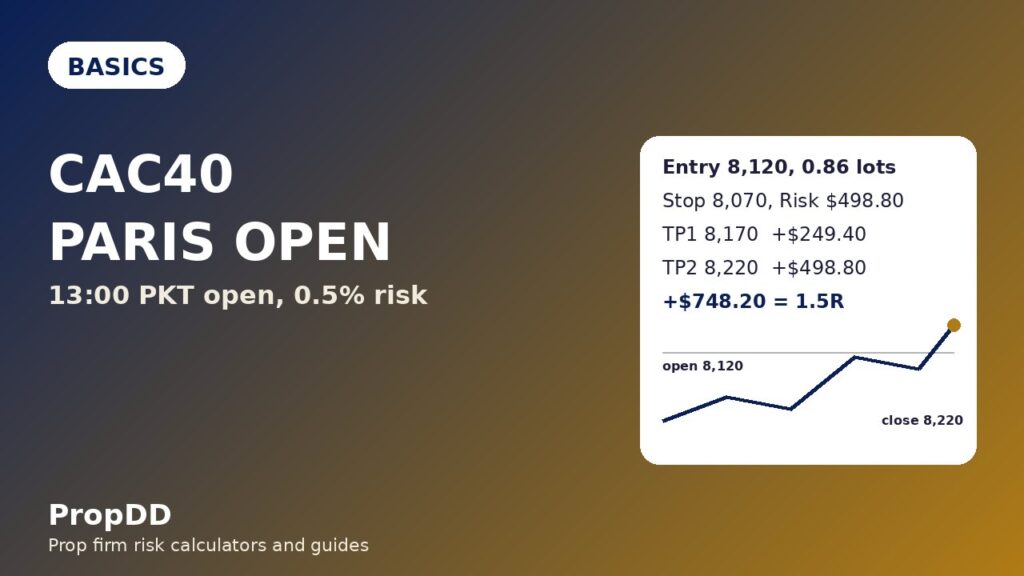
The trade that replaced the losing one came a week later, same setup, correct maths. The Paris open pushed through the overnight high at 8,120, pulled back to 8,105 without breaking it, and reclaimed 8,120 on the 13:30 Pakistan-time candle. I bought 0.86 lots at 8,120 with the stop at 8,070, fifty points below, and two targets fixed before entry: close half at 1R, which is 8,170, and close the rest at 2R, which is 8,220.
| Leg | Price | Points | Lots | Dollars |
|---|---|---|---|---|
| Entry, buy | 8,120 | – | 0.86 | – |
| Stop loss | 8,070 | 50 | 0.86 | Risk 498.80 dollars |
| Target 1, close half | 8,170 | +50 | 0.43 | +249.40 dollars |
| Target 2, close rest | 8,220 | +100 | 0.43 | +498.80 dollars |
| Total result | – | – | – | +748.20 dollars = 1.5R |
The trade did what the plan said. It reached 8,170 by mid-afternoon, I banked half for 249.40 dollars and moved the stop to breakeven, and the US overlap carried it to 8,220 for the remaining 498.80 dollars. The total was 748.20 dollars on 498.80 dollars of risk, exactly 1.5R, and the best part was not the profit: the risk was 498.80 dollars, inside my 500-dollar budget, because the size came from the dollar formula instead of the euro guess. The same 50-point stop on 1.00 lot would have risked 580 dollars. That is the whole guide in one comparison: 0.86 lots is a plan, 1.00 lot is a hope.
The sizing grid: stop distance decides the lots
I do not recalculate from scratch every morning. I keep a grid on my desk, built at EURUSD 1.16, and I read the lot size off it for whatever stop the chart demands. Every row risks just under 500 dollars, and every row rounds the lots down, never up, because rounding up is how a 498-dollar risk quietly becomes a 501-dollar risk.
| Stop distance | Lots | Risk in dollars | When I use it |
|---|---|---|---|
| 25 points | 1.72 | 498.80 | Tight open-range break, stop just under the range |
| 40 points | 1.07 | 496.48 | Pullback to the overnight high or low |
| 50 points | 0.86 | 498.80 | Standard Paris-open trade, the worked example |
| 60 points | 0.71 | 494.16 | Wide stop under a swing low on H1 |
| 80 points | 0.53 | 491.84 | US-overlap trade with a wider invalidation |
| 100 points | 0.43 | 498.80 | Only for a full session-range trade, rarely used |
If EURUSD moves, the grid moves with it. At 1.10 the point value is 11.00 dollars and every lot number rises by about 5 percent; at 1.20 it is 12.00 dollars and every lot number falls by about 3 percent. I recheck the rate weekly and rebuild the grid when it has moved more than two cents. For a second opinion on the same division, run the numbers through the max daily drawdown calculator before you place the trade: it will not convert euros for you, but it will show you exactly how much of your daily limit one bad trade consumes.
What a CAC40 day actually costs
The spread is the visible cost and the swap is the hidden one. At a 1-point target spread, the round cost of entering and exiting is one point times the lots times 11.60 dollars, which is 9.98 dollars on my standard 0.86-lot trade. That is 2 percent of the 498.80-dollar risk, which is cheap compared with most crypto pairs I trade on the same account. The table below shows the spread cost at the sizes in my grid, and the point is that the cost scales with size, not with courage: doubling the lots doubles the spread bill.
| Position size | Spread cost at 1 point | Share of 500-dollar risk |
|---|---|---|
| 0.43 lots | 4.99 dollars | 1.0 percent |
| 0.86 lots | 9.98 dollars | 2.0 percent |
| 1.07 lots | 12.41 dollars | 2.5 percent |
| 1.72 lots | 19.95 dollars | 4.0 percent |
Commission is usually zero on index CFDs at prop firms, which is why the spread is the whole visible cost. The overnight financing charge is the one that catches traders who hold: it is charged nightly, it varies by firm, and on a multi-day hold it can eat a quarter of a 1R win. That is a cost problem with a simple solution: I do not hold CAC40 overnight. The Paris close at 21:30 Pakistan time is my hard exit, and any trade still open then gets closed at market, win or lose. If you want the full cost picture including swap, the trading cost drawdown calculator shows how spread and fees stack against the daily limit.
The twelve-trade filter test
I tested the rules over twelve Paris-open trades: enter only in the 13:00 to 14:30 Pakistan-time window, only on a break of the overnight high or low with a pullback that holds, stop 50 points, targets at 1R and 2R, 0.5 percent risk, maximum two trades a day, flat before the 21:30 close. Eight won and four lost, and the winners averaged 1.5R because half the position ran to 2R. The net was 4,000 dollars, which is 8R, and the best single trade was 748.20 dollars, which is 18.7 percent of the net, comfortably inside the 30 percent consistency ceiling most firms enforce.
| Version | Trades | Wins | Losses | Net result |
|---|---|---|---|---|
| With all filters | 12 | 8 | 4 | +4,000 dollars = +8R |
| No filters, any session | 15 | 6 | 9 | -1,500 dollars = -3R |
| Filters are worth | – | – | – | +5,500 dollars = +11R |
The unfiltered version is the interesting one. Fifteen trades, six wins, nine losses, net minus 1,500 dollars. The difference is not the entries: the entries were the same shapes. The difference is that the unfiltered version took midday-lull trades between 16:00 and 18:00 Pakistan time, traded earnings mornings, and let winners run without the 1R partial, so the average win fell to 1R while the losses stayed at 1R. Six wins at 1R minus nine losses at 1R is minus 3R. The filters did not find better trades; they removed the hours when the index does not move. A five-trade slice from the filtered run shows the rhythm: plus 748.20, minus 498.80, plus 748.20, minus 498.80, plus 748.20, a net of plus 1,247.00 dollars. Two losers in five trades and the account still grew, because the winners were bigger than the losers.
CAC40 against its neighbours
The CAC40 is one of five index articles I have written for this account, and the comparison matters because traders pick an index by habit instead of by fit. The GER40 trades the same Frankfurt hours and the same euro conversion, so the two are twins with different constituents: Frankfurt is industrials and autos, Paris is luxury and energy. The UK100 is priced in pounds, so it has the same conversion trap in a different currency. The Nikkei opens at 05:00 Pakistan time, which is a 3 a.m. alarm for nobody I know, and the ASX200 has the same foreign-currency lesson in Australian dollars, while the Hang Seng is the most volatile of the five.
| Index | Home session in Pakistan time | What moves it | Funded-account note |
|---|---|---|---|
| CAC40 | 13:00 – 21:30 | LVMH earnings, French data, ECB | Euro conversion on every size; civilised hours |
| GER40 | 13:00 – 21:30 | German industry, autos, ECB | Same euro trap, same session as Paris |
| UK100 | 12:00 – 20:30 | Oil majors, miners, Bank of England | Pound conversion instead of euro |
| Nikkei | 05:00 – 11:00 | Yen moves, Bank of Japan, US close | Early morning only; yen conversion applies |
| ASX200 | 05:30 – 11:30 | Miners, banks, China data | Small point value; Aussie conversion applies |
| Hang Seng | 06:30 – 13:00 | China policy, tech, property | Widest swings; smallest size of the five |
If you can only trade one European index, the CAC40 is the friendlier choice for a Pakistan-based trader, because the open is at 13:00 instead of the middle of the night and the session ends at 21:30. If you already trade the GER40, the CAC40 adds almost nothing except diversification across two economies that usually move together anyway; trade one or the other, not both at full size on the same morning. I use the GER40 guide rules for Frankfurt and this guide for Paris, and I never take the same direction on both at the same time, because two correlated positions are one position with double the risk. For the consistency angle, the consistency rule calculator shows how a 748-dollar best day sits against a 4,000-dollar month.
My Paris-open daily routine
The routine is boring on purpose. I check EURUSD, mark the overnight range, wait for the 13:00 open, and take at most two trades. The trend pullback strategy is the entry I use most often inside this routine: a break of the overnight high, a pullback that holds above it, and an entry on the reclaim, with the same 50-point stop and the same 0.86 lots.
| Step | Pakistan time | Action |
|---|---|---|
| 1 | 11:15 | Check EURUSD, note the rate, rebuild the grid if it moved 2 cents |
| 2 | 11:30 | Mark overnight high and low, check LVMH and TotalEnergies earnings calendar |
| 3 | 13:00 | Paris open: watch the first 15 minutes, no trade before 13:15 |
| 4 | 13:15 – 14:30 | Take the setup if it comes: break, pullback, reclaim, 0.86 lots, 50-point stop |
| 5 | 14:30 | Move stop to breakeven at 1R, bank half, let the rest run to 2R |
| 6 | 16:00 | No new trades after the lull starts; manage the open one only |
| 7 | 18:30 | US overlap: second setup allowed only if the first trade is closed |
| 8 | 21:30 | Flat before the close, log the trade, stop for the day |
Step 8 is the one that protects the funded account. The Paris close is a hard stop, not a suggestion, and the log is what makes the next morning faster: entry, stop, targets, EURUSD rate, and whether the trade followed the rules. Two trades a day is the maximum, and most days I take one. A funded account rewards the trader who trades the open and then stops, not the trader who trades every hour the market is awake.
Frequently asked questions
Can you trade the CAC40 on a funded account?
Yes. Most prop firms list the CAC40 as FRA40 or FR40 on MT5, alongside the GER40 and UK100. Check the symbol list before you buy a challenge, because a small number of firms offer only forex majors and gold. If the symbol is there, the rules are the same as any index: daily loss limit, maximum loss limit, and usually a 1:20 leverage cap on indices.
What is the CAC40 symbol on MT5?
Usually FRA40 or FR40, depending on the broker. Both track the same CAC40 index future. Search the symbol list for FRA40 first, then FR40, and confirm the point value in the contract specification: the standard version is 10 euros per point per lot, while mini versions quote 1 euro per point, which changes every lot number in this guide by a factor of ten.
How many points is a 500-dollar risk on the CAC40?
It depends on your stop and the EURUSD rate. At EURUSD 1.16 one lot is worth 11.60 dollars per point, so a 50-point stop at 500 dollars of risk is 0.86 lots, and a 25-point stop at the same risk is 1.72 lots. The formula is lots equals risk divided by stop distance times point value in dollars. Never size from the euro number alone.
What time does the CAC40 open in Pakistan?
The Paris open is 09:00 Central European Time, which is 13:00 Pakistan time, and the close is 17:30 CET, which is 21:30 Pakistan time, Monday to Friday. The pre-open starts at 11:15 Pakistan time, and the closing auction runs from 21:30 to 21:35 Pakistan time. During European daylight saving the clock shifts by an hour, so recheck the conversion in March and October.
Is the CAC40 harder than the GER40 or UK100 for funded traders?
Not harder, just different in one place: the euro conversion. The GER40 has the same trap, the UK100 has it in pounds, and all three share the same European session and the same 1:20 index leverage. Pick the one whose session fits your day and whose constituents you understand. Paris suits a Pakistan-based trader because the open is at 13:00, not in the middle of the night.
Does the CAC40 gap overnight?
Yes. Weekend gaps and Monday opens after French news are normal, and a gap through your stop is a real risk on any index. That is why I never hold CAC40 overnight or over the weekend on a funded account. Close before the 21:30 Pakistan-time close, and let the gap happen while you are flat.
Risk disclaimer: Trading leveraged CFDs on a funded account can lose more than your challenge fee if you breach the firm’s loss limits, and past results from a twelve-trade test do not predict your results. The numbers in this guide come from my own 100,000-dollar funded account at a EURUSD rate of 1.16; check your firm’s symbol specification and your own exchange rate before you trade. This is education, not financial advice.



2 comments
[…] the maths if it has moved more than a cent since my last session. I covered the same warning in the CAC40 guide, because Paris prices in euros too, but the Euro Stoxx 50 adds its own twist: the point value is […]
[…] are different, the division is the same, and the division is the whole job. My GER40 guide, my CAC40 guide, my Euro Stoxx 50 guide and my Russell 2000 guide all run the same formula on their own point […]