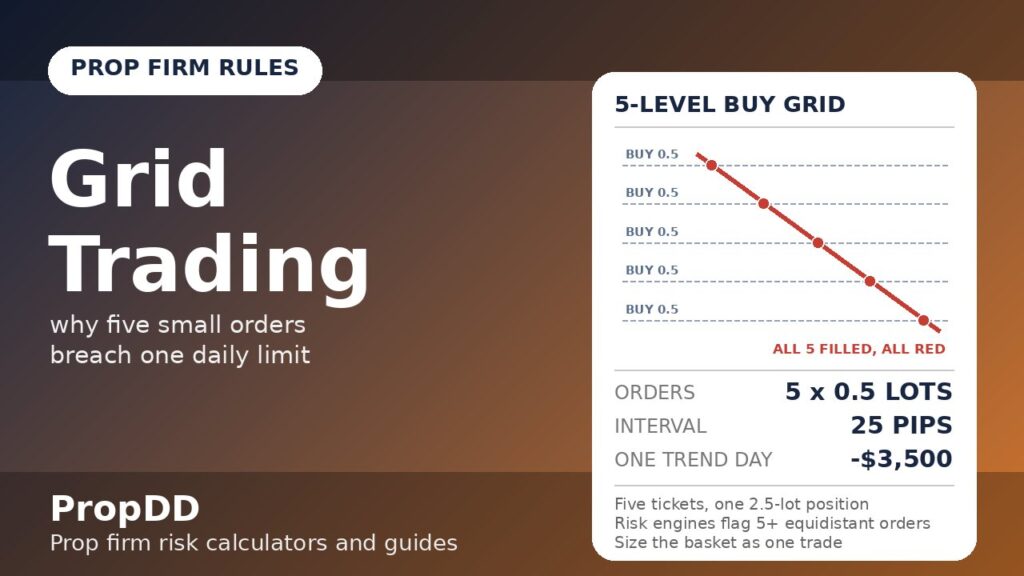
I did not lose my first $100,000 evaluation to a bad strategy. I lost it to five small ones wearing the same shirt. It was a quiet Monday when I stacked five buy-limit orders on EURUSD, 25 pips apart, 0.5 lots each — a “grid”, a trader in a forum called it, the civilised way to buy dips. Monday and Tuesday the range held and the grid collected +$620 while I felt like a genius. Then Thursday’s CPI print ripped the pair 190 pips straight down through every single level. All five orders filled. All five went red together. By the time I closed the basket I was down $3,500 on the session — 70% of the firm’s daily loss limit, gone in one trend day. And the real damage came later: at the payout review, the firm’s risk team flagged the pattern as a prohibited strategy and closed the account anyway. Five small orders, each “safe” on its own, had behaved as one giant 2.5-lot position with no plan — and the firm had been watching the pattern the whole time.
In this article
- What a grid actually looks like on a funded account
- Grid is not martingale — and the difference matters
- How a risk engine spots a grid in seconds
- The maths: why five small orders breach a 5% daily limit
- What the rulebooks actually say about grids
- "But my grid is different": four arguments that fail at payout review
- What I do instead: entries that stay inside the rules
- I tested it: 20 demo sessions, grid vs fixed risk
- Frequently asked questions
This guide is the article I wish someone had handed me that Monday: what a grid actually is, how it differs from martingale (they are not the same thing, and firms detect them differently), the exact maths that turns five small orders into one daily-limit breach, how risk engines spot a grid in seconds, what the rulebooks really say, and the compliant way I layer entries now. On a prop firm account, a grid is not five trades — it is one trade with five entry tickets and no real stop.
What a grid actually looks like on a funded account
A grid is a set of pending orders placed at fixed price intervals above or below the current price, filled one by one as price moves through them. There is no signal per order and no individual stop per order — the “strategy” is the spacing itself. Grids come in four flavours, and I have watched each one end an account:
| Grid type | How it is built | What the trader hopes | What happens on a trend day |
|---|---|---|---|
| Buy grid | Buy-limit orders stacked below price at fixed intervals | “Buy every dip” | Every level fills, then price keeps falling — all tickets red at once |
| Sell grid | Sell-limit orders stacked above price | “Sell every rally” | Mirror image into a strong rally |
| Hedged grid | Buy grid and sell grid running simultaneously | “Market neutral” | Margin trapped both ways, swap bleeds daily, one side eventually dominates |
| Martingale-grid hybrid | Fixed intervals plus doubling size per level | “Recover faster” | The worst of both: the biggest size sits at the worst price |
The seductive part is that grids win most of the time. In a ranging market — which is most weeks — price bounces between your levels and each fill closes green. My Monday and Tuesday proved it: +$620 of easy money. The grid’s entire business model is collecting small wins while building one enormous correlated position, and the bill arrives on the first real trend day. Which is exactly when a prop firm account can least afford it.
Grid is not martingale — and the difference matters
Traders use the two words interchangeably. Firms do not, and the distinction decides which detection tripwire catches you. Martingale doubles size after each loss; a grid spaces orders evenly regardless of outcome. Different maths, different signature, different breach path:
| Grid | Martingale | |
|---|---|---|
| Core mechanic | Orders at fixed price intervals | Doubles size after each losing trade |
| Size progression | Flat — same lots per level | Geometric — 2x, 2x, 2x |
| What triggers the next order | Price reaching the next level | The previous trade losing |
| Detection signal | Five or more equidistant pending orders | Lot-multiplier sequence across consecutive losers |
| Breach path | Correlated basket moves as one giant position | One doubled loser exceeds the daily limit alone |
| Full treatment | This guide | Why martingale fails on prop firm accounts |
Why does the difference matter to you? Because the defences are different. Against martingale, the defence is “never double”. Against a grid, the defence is subtler: a flat 0.5 lots five times is still 2.5 lots of the same directional bet — and most traders never do the basket maths until the trend day does it for them.
How a risk engine spots a grid in seconds
Firms do not watch your charts. They watch patterns in the order log, and the detection technology prop-tech vendors sell to firms is specifically built for this. Here is what a risk engine looks for:
| Detection signal | What the engine sees | Why it trips |
|---|---|---|
| Equidistant pendings | Five or more pending orders at equal price intervals | The hallmark grid signature — no discretionary trader places orders this evenly |
| Fuzzy interval matching | 24, 26, 25, 27-pip spacing instead of exact 25s | Catches “clever” uneven grids; the pattern survives jitter |
| Same-direction adds on losers | Three or more adds to a red position | Averaging-down and compounding-risk behaviour |
| Cross-session rebuild | The same grid replaced day after day for a week | The pattern persists across sessions — not a one-off idea |
| Correlated instruments | Identical grids on EURUSD and GBPUSD simultaneously | One macro bet duplicated across symbols |
The uncomfortable truth in that table: detection reads the order log, not your mouse. Manual grids flag identically to EA grids, because the engine never asks who clicked — it asks whether five orders sit at equal intervals. And the review is usually retrospective: nothing happens on the day, and the flag lands at the payout review when the account history gets its full audit.
The maths: why five small orders breach a 5% daily limit
Back to my Thursday. Account $100,000, firm daily loss limit 5% ($5,000), and my own personal daily stop at $2,500 — half the firm limit, the rule that normally keeps me safe. Five buy limits on EURUSD, 0.5 lots each, 25 pips apart. Pip value: 0.5 lots on EURUSD is $5 per pip per order, so five open orders move at $25 per pip combined. Price fell 190 pips through the whole grid, and I closed the basket 40 pips below the lowest fill. Here is the damage, order by order:
| Order | Adverse move at close | Loss (0.5 lots = $5/pip) |
|---|---|---|
| Level 1 (top fill) | 190 pips | $950 |
| Level 2 | 165 pips | $825 |
| Level 3 | 140 pips | $700 |
| Level 4 | 115 pips | $575 |
| Level 5 (bottom fill) | 90 pips | $450 |
| Basket total | 700 pips combined | $3,500 |
$3,500 — that is 140% of my personal daily stop and 70% of the firm’s hard limit, from orders I had sized at “only 0.5 lots”. Five small orders behaved as a single 2.5-lot position with a 190-pip stop, and nobody had done that maths before clicking buy. The formula is simple enough to tattoo on your monitor:
| Formula | What it means |
|---|---|
| Grid exposure ($) = total open lots × adverse pips × pip value per lot | My Thursday: 2.5 lots × 140 avg pips × $10 = $3,500 |
| Basket check: total lots ≤ personal stop ÷ (stop distance × pip value) | $2,500 ÷ (190 × $10) = 1.31 lots total — my five orders should have been 0.26 lots each, not 0.5 |
That second line is the whole lesson. Size the basket as one trade: total risk divided by stop distance times pip value, or the grid is just leverage with extra steps. Run the same check through my position sizing routine before you ever stack a second order — if the basket breaks your personal stop, it is one oversized trade wearing five small costumes.
What the rulebooks actually say about grids
Almost every serious firm bans grids under its prohibited-strategies or conduct clauses. The wording varies — some name grids explicitly, others catch them under risk-concentration language — so always re-read your firm’s current terms before you trade. Typical published stances:
| Firm | Published stance on grids | Where it sits |
|---|---|---|
| Funding Pips | “Martingale or grid behavior” listed as prohibited | Rulebook summary |
| Velotrade | Grid trading prohibited “however executed” | Algo and bot trading policy — see their published policy |
| FTMO | No standalone “grid” clause in most versions; flagged under risk-management and gambling conduct rules | Terms and conditions |
| The5ers | Grid and martingale-style risk concentration flagged as prohibited practice | Program terms |
| Topstep | “Prohibited conduct” covers martingale-style risk concentration | Futures rulebook |
Two things in that table deserve emphasis. First, “however executed” — the ban follows the pattern, not the tool, so manual grids, EA grids and copy-traded grids all count. Second, enforcement is retrospective: the breach is usually found at payout review, not on the day. Passing the challenge with a grid does not mean the grid was allowed; it means nobody has audited the order log yet.
“But my grid is different”: four arguments that fail at payout review
Every grid trader has a version of these. Risk teams have heard them all, and the order log answers each one in seconds.
1. “My grid uses stops.” Each level’s stop still correlates — every stop in the basket triggers on the same trend day. A weekend gap or a news spike skips all of them at once (see my news trading guide for how fast that happens), and the equidistant order pattern trips detection before the stops ever matter.
2. “It’s hedged — market neutral.” Hedged grids trap margin on both sides, bleed swap every night, and both legs still count as open risk. Firms read offsetting positions as the same concentration wearing a costume, not as no risk.
3. “I place the orders manually.” Covered above: detection reads the order log, not your mouse. A hand-placed grid flags identically to an EA grid.
4. “It’s only two or three levels.” This one has a grain of truth, which is what makes it dangerous. Two planned layers at real support levels, each with its own stop and its own risk budget, is legitimate scaling — each level is its own trade. Five equidistant pendings is a grid whatever you call it. The line is the pattern, not the label.
What I do instead: entries that stay inside the rules
I still layer into positions — I just do it in a way where every layer could survive an audit on its own. The principle: each entry is an independent trade with an independent stop and an independent slice of risk, and the basket total never exceeds my personal daily stop.
| Instead of | Do this |
|---|---|
| Five-level buy grid at fixed intervals | One position, scaled out at partial targets — single entry, single stop, same patience |
| Adding into a losing grid level | Re-enter only after the first trade is closed or its stop is moved to breakeven |
| Fixed-interval pending orders | Limit orders at real support and resistance levels, each with its own stop and its own risk budget |
| Averaging down through a range | Wait for the range edge plus a confirmation candle, then take one full-size entry |
The mental shift is small but the maths is completely different. A grid risks the basket on one outcome with no exit plan; layered independent entries risk a fixed slice per idea, and any single layer getting stopped out costs its own 0.5% — never the whole basket. Same market, same patience, one-tenth of the correlated risk.
I tested it: 20 demo sessions, grid vs fixed risk
After the account closure I needed to see the difference in numbers, not just in scars. I ran 20 demo sessions on the same $100,000 demo, same pair, same London hours: 10 sessions trading a 3-level buy grid (0.3 lots per level, 30-pip intervals), and 10 sessions trading single positions at fixed risk per my normal routine. No cherry-picking — every session counted:
| Block (10 sessions) | Trades | Win rate | Avg win | Avg loss | Net | Worst session |
|---|---|---|---|---|---|---|
| Grid block | 34 | 56% (19/34) | +$210 | -$390 | -$1,860 | -$1,240 |
| Fixed-risk block | 22 | 50% (11/22) | +$485 | -$410 | +$825 | -$820 |
Read that table twice, because it contains the entire grid illusion: the grid won more often (56% vs 50%) and still lost money. Small frequent wins, rare catastrophic losses — that asymmetry is the grid’s signature, and it is exactly what a daily loss limit punishes. The grid’s worst session ate half my personal daily stop in one afternoon; the fixed-risk block never came close. I later ran both win/loss profiles through the risk of ruin calculator: the grid’s profile showed a ruin path the fixed-risk profile never touched, because ruin maths cares about the size of your worst loss, not the frequency of your small wins.
Frequently asked questions
Do prop firms allow grid trading?
Almost universally, no. Grids sit on the prohibited-strategies list at most serious firms — either named explicitly (Funding Pips, Velotrade) or caught under risk-concentration and conduct clauses (FTMO, The5ers, Topstep). Assume it is banned at your firm unless the current terms say otherwise in writing.
Is grid trading the same as martingale?
No. Martingale doubles position size after each loss; a grid places same-size orders at fixed price intervals. They are detected differently (lot-multiplier sequences vs equidistant pending orders) and they breach differently (one doubled loser vs one correlated basket). Firms ban both, for different reasons.
Can I run a grid on the evaluation and stop once funded?
The pattern is in the account history either way. Evaluations are audited at payout review, and a grid flagged on the challenge phase can void the pass. “I stopped before funded” is argument number five on the list that fails.
What happens if my firm catches a grid?
The standard sequence: account closed, evaluation fee forfeited, and any pending payout withheld. Enforcement is retrospective — the flag usually lands at the payout review when the full order log is audited, weeks after the trading happened.
Does a two-order “grid” count as grid trading?
Two planned layers at real levels, each with its own stop and its own risk budget, is legitimate scaling — each layer is its own trade. The line is the pattern: five or more equidistant pending orders with no independent exits is a grid whatever you call it.
Is grid trading allowed on a personal account?
Yes — on your own money, a grid is simply a high-risk technique, and plenty of traders run them with eyes open. The ban is a firm-risk thing: the firm cannot have one correlated basket threatening its daily loss limits across hundreds of accounts, so it writes the pattern out of the rulebook.
Risk disclaimer: this article describes how prop firm rulebooks treat grid trading and the maths behind correlated order baskets. It is educational content, not financial advice. Always read your firm’s current terms before trading, and never risk money you cannot afford to lose.


