My first challenge died on the minimum trading days rule. Not on the drawdown, not on the profit target — on the days. I had hit the 8% profit target on day 4 of a 5-day minimum and spent day 5 staring at the screen, terrified that one stupid trade would cost me the whole challenge. I passed, but I swore I would never again navigate a challenge without knowing exactly where I stood on all three gates at once: days, profit, and daily pace. That is what this tracker does, and it pairs directly with my minimum trading days rule guide.
In this article
In this article
Why Three Gates, Not One
A prop firm challenge has three gates and traders obsess over only two of them: the profit target and the drawdown. The third — the minimum trading days — quietly ends more challenges than most people admit, because it punishes exactly the wrong behaviour. Finish the profit target early and you sit in purgatory, one careless day from giving it all back. Trade too cautiously and you never reach the target at all. The tracker shows all three gates on one screen: days completed against the minimum, profit against the target, and the daily pace that connects them.
The critical insight: once the minimum days are satisfied, the only remaining question is pace. If you need $800 per day for 5 remaining days at a $5,000 daily loss limit, the plan is sound. If you need $4,000 per day, you are one normal losing day from disaster, and the correct move is to extend the timeline, not to increase size.
Using the Minimum Trading Days Tracker Step by Step
Enter your firm’s minimum trading days, your profit target, your daily loss limit and your risk per trade. Then log each day’s net P&L — one row per day, blank or zero for skipped days. Hit Calculate and you get six numbers: days completed, days remaining, total P&L, profit remaining, the daily pace you need across the remaining days, and your profitable-day count. The status line does the interpretation for you: whether the minimum is satisfied, whether the target is hit, and two warnings that matter — pace above half the daily loss limit, and pace demanding unrealistic R-multiples.
Log daily, not at the end of the week. The tracker only works if the log is honest, including the red days — a losing day still counts as a trading day at most firms, and hiding it from the tracker is the same as hiding it from your plan.
The Daily Pace Formula
Daily pace needed = (profit target – profit so far) / (minimum days – days traded)
Sanity rule = daily pace should be under half your daily loss limit
The sanity rule is the whole point. A daily pace of $1,200 on a $5,000 daily limit is a plan; a pace of $3,500 on the same limit is a hope. When the tracker flags the pace, do not argue with it — add days. Most firms give you unlimited or generous time; the minimum is a floor, not a deadline.
Losing streaks complicate all three gates at once — when one hits, my losing streak on a funded account guide covers the streak maths and the reset routine.
One Challenge, Worked Through
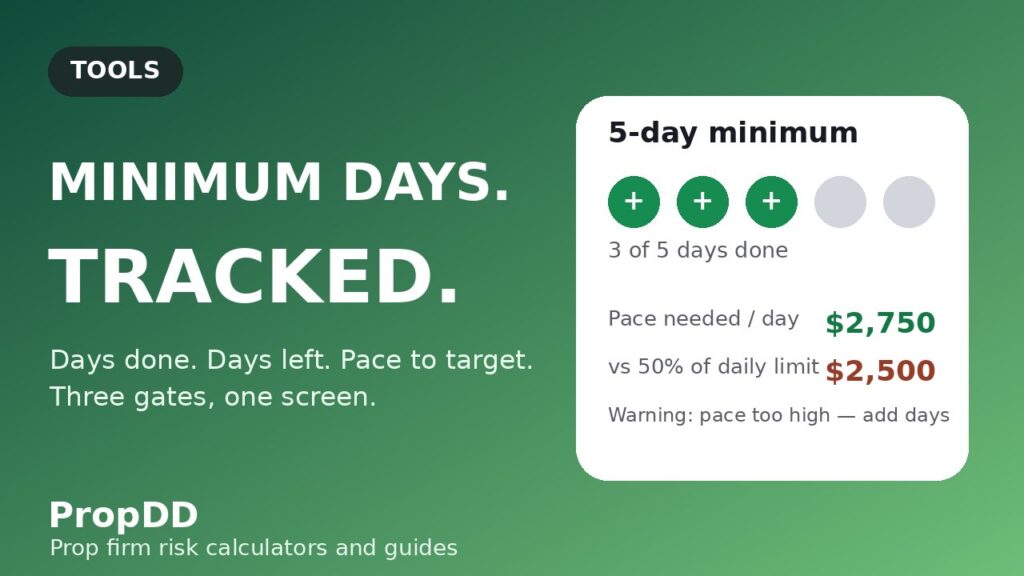
Take a $100,000 account: 5 minimum trading days, $8,000 profit target, $5,000 daily loss limit, $750 risk per trade. After three days the log reads: Day 1 +$1,900, Day 2 -$600, Day 3 +$1,200. The tracker shows: 3 of 5 days done, +$2,500 total, $5,500 remaining, 2 days left — a daily pace of $2,750. That pace is 55% of the daily loss limit, so the warning fires: one average losing day wipes out a good day’s work. The correct response is not bigger size; it is smaller, steadier days — the minimum is a floor, so trade day 4 and day 5 at normal size and let a sixth day exist if the target needs it. Read the minimum trading days guide for how firms count qualifying days.
The Pace Warning Most Traders Ignore
The tracker’s second warning — pace demanding more than 1.5R winners every remaining day — is the one traders dismiss. “I can do 2R days,” they say. Some days, sure. Every remaining day, with a challenge on the line? That is not a plan, it is a lottery ticket. When the warning fires, the fix is always the same: extend the timeline. Trade more days at your normal size instead of fewer days at a heroic one. The firms that set minimum-day and generous-maximum rules were built for exactly this reason.
And when the target is hit early, protect it. A funded account pays you for the profit you keep, not the profit you almost kept — run the numbers through the Profit Split Calculator so you know what the early finish is actually worth in your pocket.
Questions Traders Ask About Minimum Trading Days
What counts as a trading day at most prop firms?
Usually any calendar day on which you open or close at least one trade. Some firms require a minimum position size or a minimum time in the market, and a few exclude days where you only close a carried position. Always check your firm’s current trader agreement — the tracker’s day count assumes the standard “any traded day” definition.
Can I finish the profit target before the minimum days are done?
Yes, and it happens often. You still have to trade the remaining days. The danger period is exactly this: profitable traders get sloppy on the filler days. Trade them small, trade your normal setups, and treat capital preservation as the job for those days.
Do losing days count toward the minimum?
At almost every firm, yes — a day with closed trades counts regardless of the outcome. That is why the tracker counts any row with a non-zero P&L as a trading day. Never skip logging red days to make the numbers look better; the firm counts them anyway.
What if I need more days than the firm’s time limit?
Then the challenge maths does not work at your current size, and the honest answer is a smaller account or a slower firm, not bigger trades. Many firms offer unlimited-time evaluations now; the time limit is a product feature you can shop for.
Should the daily pace include weekends?
No — pace is per trading day. Weekends and market holidays do not consume minimum-day progress or profit pace. They do consume patience, which is arguably the real constraint.
Risk disclaimer: trading funded and personal accounts involves substantial risk of loss. Minimum-day and payout rules change between firms and plans — always verify against your firm’s official trader agreement. Nothing here is financial advice.