The first time I traded gold with a prop account, I sized it like EURUSD. One lot, a stop that “looked right”, done. The trade stopped out for a loss that was almost three times what I had planned. Nothing was wrong with my analysis. My lot size was wrong, because gold does not move in pips the way a currency pair does.
In this article
- How gold changes the way you size a trade
- The percentage-risk formula for XAUUSD lot size
- A 0,000 account, a stop, and the lot size that follows
- Using the XAUUSD Lot Size Calculator step by step
- Contract size, lot steps and other details that break the maths
- Staying inside a prop firm daily limit while trading gold
- Questions traders ask about XAUUSD lot size and risk percentage
That is why I built the XAUUSD Lot Size Calculator above. You give it your account, your risk percentage and your stop distance in dollars. It gives back a lot size you can actually place. No guessing. Let me explain the maths, then walk through a real example.
How gold changes the way you size a trade
On most platforms, one standard lot of XAUUSD is 100 ounces. So every $1 move in price is worth about $100 per lot. A currency pair pays roughly $10 a pip per lot. Gold can move several dollars in a minute. Do the multiplication and you see the problem.
| Lot size | Ounces | Profit or loss per $1 move | A $5 move |
|---|---|---|---|
| 0.01 | 1 oz | $1 | $5 |
| 0.10 | 10 oz | $10 | $50 |
| 0.50 | 50 oz | $50 | $250 |
| 1.00 | 100 oz | $100 | $500 |
| 2.00 | 200 oz | $200 | $1,000 |
One lot and a $5 stop is a $500 loss. Two lots is $1,000. On a prop firm account with a 5% daily limit, that can be a fifth of your whole day in one trade. Check your own broker’s contract specification, because a few brokers use a different contract size.
The percentage-risk formula for XAUUSD lot size
Pick the money you are willing to lose first. Let the stop decide the size. Never the other way round.
| Variable | What it is | Typical value |
|---|---|---|
| Account Size | Your current balance or equity | $100,000 |
| Risk % | The share of the account you accept losing | 0.25% to 1% |
| Stop Loss in $ | Distance from entry to stop, in dollars of price | $3 to $12 |
| Contract Size | Ounces in one lot | 100 |
Then round the result down to your broker’s lot step. Rounding up quietly adds risk, and across fifty trades it adds up. The general method for every instrument lives in position sizing for prop firm challenges.
A $100,000 account, a $6 stop, and the lot size that follows
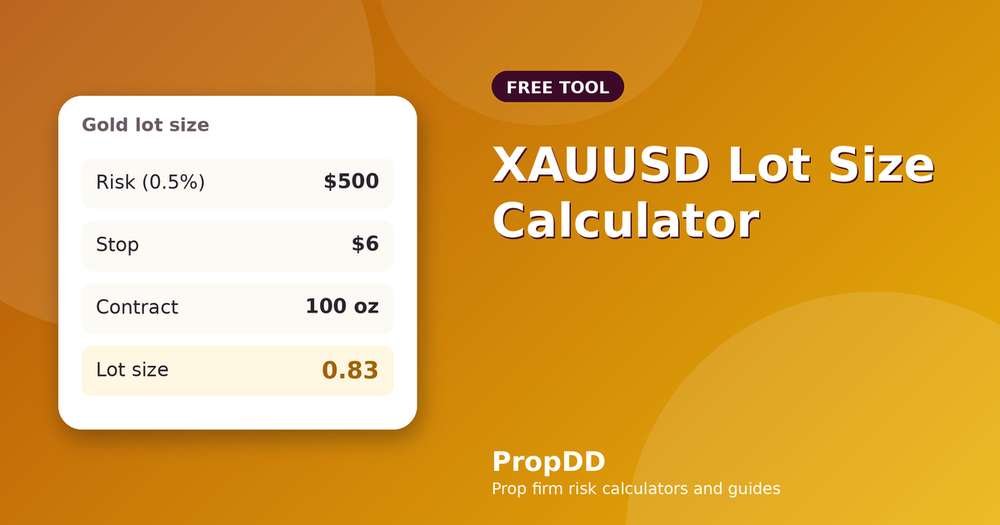
Here is the case I run most often. Account $100,000. Risk 0.5%. Stop $6. Contract size 100. Lot step 0.01.
| Step | Calculation | Result |
|---|---|---|
| Risk amount | $100,000 × 0.5% | $500 |
| Exact lot size | $500 ÷ ($6 × 100) | 0.833 |
| Rounded down | 0.833 → 0.83 | 0.83 lots |
| Real risk at that size | 0.83 × $6 × 100 | $498 (0.498%) |
| Value of a $1 move | 0.83 × 100 | $83 |
See how the wider stop shrinks the size. The same $500 of risk at different stop distances:
| Stop distance | Exact lots | Lots to trade | Real risk |
|---|---|---|---|
| $3 | 1.667 | 1.66 | $498 |
| $5 | 1.000 | 1.00 | $500 |
| $8 | 0.625 | 0.62 | $496 |
| $12 | 0.417 | 0.41 | $492 |
A $3 stop looks tempting because it allows 1.66 lots. But gold’s normal noise will probably hit it. A trader who keeps the same lot size after widening the stop has quietly doubled the risk. I did exactly that once, and my account paid for the lesson.
Using the XAUUSD Lot Size Calculator step by step
Fill the fields at the top of this page, then press Calculate lot size.
| Input field | What to enter | Sample figure |
|---|---|---|
| Account size ($) | Your current balance or equity | 100000 |
| Risk per trade (%) | Your fixed plan percentage | 0.5 |
| Stop loss distance ($) | Entry to stop, in dollars of price | 6 |
| Contract size | Ounces per 1.00 lot | 100 |
| Lot step | Your broker’s smallest increment | 0.01 |
| Reward : risk | Your planned target in R | 2 |
| Daily loss limit (%) | Optional, from your firm’s rules | 5 |
| Result | Meaning | Sample answer |
|---|---|---|
| Risk amount | Money at risk on this trade | $500.00 |
| Lot size (rounded down) | The size to enter on your platform | 0.83 |
| Real risk at that size | What you actually lose at the stop | $498.00 (0.50%) |
| Take profit at your R | The target move and its value | $12 move = $996.00 |
| Share of daily limit | How much of the day this trade uses | 10.0% |
Everything is calculated in your browser, and nothing is stored.
Contract size, lot steps and other details that break the maths
Three details trip people up.
Contract size. If your broker uses 100 ounces per lot, enter 100. If not, enter what your specification says. A wrong number here makes every lot size wrong by the same factor.
Lot step. Some accounts allow 0.01. Others only 0.1. At 0.1, an exact 0.83 becomes 0.8, so your real risk is smaller than planned. If the minimum lot risks more than your plan allows, skip the trade.
Spread and slippage. Gold’s spread widens around releases, and a stop can fill beyond your level. I size from a stop slightly wider than planned on news days, or I stay out. Check the Forex Factory Economic Calendar before you trade, and read news trading and daily drawdown.
Staying inside a prop firm daily limit while trading gold
Gold is where I see accounts break fastest, so I build in extra margin. My habits:
I use about half the risk percentage I use on forex. If I risk 0.5% on a currency pair, I risk 0.25% on gold until I trust my fills. I keep at most two gold trades open, and I treat them as one position, because they usually lose together.
Before I press buy, I look at how much of the daily limit this one trade will use. The calculator shows it. Anything above 25% makes me cut the size. Then I run my numbers through the Max Daily Drawdown Calculator to see the floor.
If the day goes badly, a Drawdown Recovery Gain Calculator shows how much you would need to win back, and a Prop Firm Consistency Rule Calculator helps if a payout rule limits one big day. For the deeper gold-specific notes, read trading gold within a daily drawdown limit. A neutral background on sizing is in the Investopedia position sizing guide.
Here is the quick routine I run before every gold entry. It takes thirty seconds and it has stopped me from more bad trades than any indicator.
| Check | Question I ask | If the answer is no |
|---|---|---|
| Stop first | Is my stop where the idea is wrong, in dollars of price? | Move the stop, then resize |
| Size second | Did I round the lots down to my step? | Recalculate |
| Daily share | Does this trade use 25% of the day or less? | Cut the risk percentage |
| News | Is a major release inside the next thirty minutes? | Skip or flatten first |
I remember skipping this routine on a quiet Friday because “gold looked calm”. It was calm for six minutes. Then it was not. That trade is why the checklist exists.
Questions traders ask about XAUUSD lot size and risk percentage
How do I calculate XAUUSD lot size from a risk percentage?
I take the account size times the risk percentage to get the money at risk, then divide that by the stop distance in dollars times the contract size. On $100,000 at 0.5% with a $6 stop and 100 ounces per lot, that is $500 divided by $600, which gives 0.83 lots.
How much is one lot of gold worth per dollar move?
On most platforms, one standard lot is 100 ounces, so a $1 move in price changes your profit or loss by about $100. At 0.10 lots it is about $10. I always confirm the contract size on my broker’s specification page before trusting any calculation, because a few brokers differ.
What risk percentage is safe for gold on a prop account?
There is no universal number. I use 0.25% to 0.5%, lower than on forex, because gold moves fast and stops can slip. The better test is whether five or six losses in a row still leave me well inside my personal stop. Work backwards from your daily limit.
Should I round the lot size up or down?
Always down. Rounding up adds risk beyond your plan, and over many trades that adds up. If the exact answer is 0.83 and my step is 0.01, I trade 0.83. If my broker only allows 0.1 steps, I trade 0.8 and accept slightly less risk.
Why does my stop distance matter more than my lot size?
Because the stop decides the lot size. I place the stop where my trade idea is wrong, then size from it. If I fix the lots first and place the stop afterwards, my risk changes every trade. Widen the stop and the size must shrink.
How much of my daily drawdown limit should one gold trade use?
I try to keep one trade near 10% of the daily limit, and I rarely go above 25%. On a 5% limit and 0.5% risk, one full loss uses 10%. That leaves room for several losses and for the slippage gold likes to deliver at the worst moment.